Midair Collision Claims One Life at Colorado Airport

NTSB is investigating a collision between Cessna 172 and Extra EA-300 on approach to Fort Morgan Municipal.

Extra EA-300
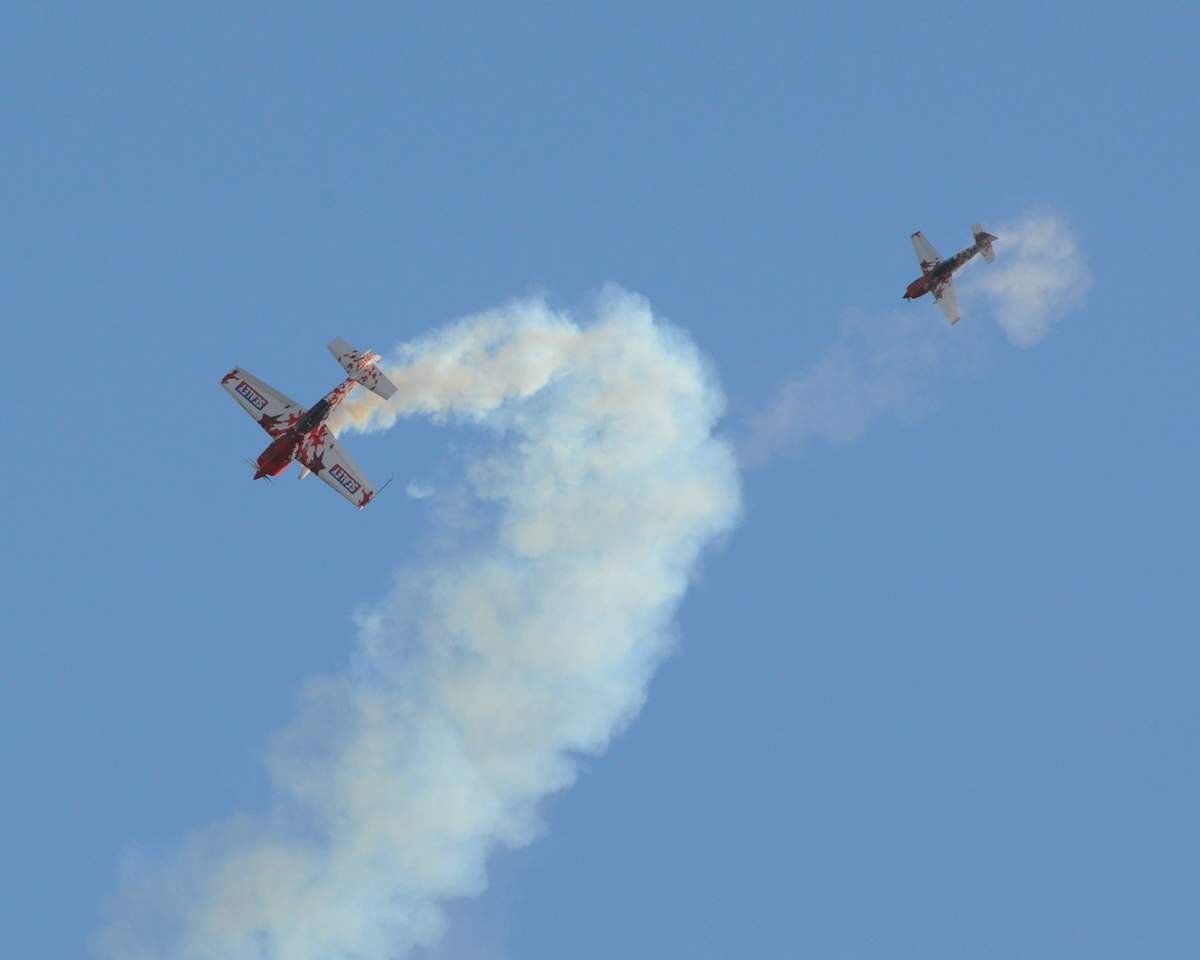
A pair of Extra EA-300s in flight [Shutterstock/David JC]
Gemini Sparkle

Key Takeaways:

  • A deadly midair collision occurred at Fort Morgan Municipal Airport between a Cessna 172 and an Extra EA-300, resulting in one fatality and three injuries.
  • The NTSB is investigating the accident, which involved both aircraft on approach to Runway 14 at the nontowered airport.
  • Initial reports suggest the Extra EA-300, a low-wing aircraft, turned from base to final into the high-wing Cessna 172, which was on a straight-in approach.
  • The NTSB's multifaceted investigation will examine the pilot, aircraft, and operating environment to determine the cause, while noting potential visibility issues between the different aircraft types.
See a mistake? Contact us.

The National Transportation Safety Board (NTSB) is on scene in Colorado at the site of a deadly midair collision at Fort Morgan Municipal Airport (KFMM). One person was killed and three people survived in the accident that took place Sunday morning at the nontowered airport. 

The weather at the time of the accident was clear. 

The collision involved a Cessna 172 (N61657), a high-wing aircraft and the most popular design used for flight training, and an Extra EA-300 (N333AN), a tandem-seat, low-wing design used primarily for aerobatics.

According to the NTSB and local law enforcement, both aircraft were on approach to Runway 14.

On Tuesday, the NTSB is documenting the scene and examining the aircraft. According to the agency, the investigation is multifaceted.

“The investigation involves three primary areas: the pilot, the aircraft, and the operating environment,” the agency said.

This NTSB process includes gathering information, including flight track data, recordings of any air traffic control (ATC) communication, aircraft maintenance records, weather forecasts and actual weather and lighting conditions at the time of the accident, the pilot’s experience and the previous 72 hours leading up to the accident to determine if there were any issues that could have affected their ability to safely operate the flight, collecting witness statements (if any) and information from electronic devices, and any available surveillance video.

During the on-scene phase of the investigative process, the NTSB does not determine or speculate about the cause of the accident. 

However, according to a press release from the Morgan County Sheriff’s Office and ADS-B data, the Cessna 172 was on a straight-in approach to Runway 14, and the Extra EA-300 made a left turn from base to final and into the Cessna. In a low-wing aircraft, when the aircraft is wings up in a left turn, the view to the right side of the airplane is obstructed. 

The wreckage came down on the right side of the approach end of the runway and burned. 

There were two people in each plane. One of the occupants of the Extra was pronounced dead at the scene by the Morgan County coroner. The other was taken to a local hospital. 

The two occupants of the Cessna were treated at the scene for minor injuries.

Within an hour of the accident, photos and videos of the wreckage were posted to social media. They show a large burn spot on the grass infield with the charred wreckage of both aircraft. Parts of the Cessna, including a wing that appears to have separated from the fuselage at the root, are lying on the runway.

Audio of the law enforcement dispatch to the event indicated that the initial report was of two airplanes that had crashed and were on fire, and there was a possibility of someone trapped inside one of the aircraft.

Multiple agencies responded to the scene, including deputies from the Morgan County Sheriff’s Office, officers from the Fort Morgan Police Department, the Colorado State Patrol, the Fort Morgan Fire Department, and Morgan County Ambulance.

About the Airport

The airport that became Fort Morgan Municipal was built in 1933 as Young Municipal Field and used primarily for agricultural aviation operations. As World War II approached, it was leased by the U.S. Army Air Corps and used to train glider pilots. 

Today the airport has three runways: 14/32, measuring 5,219 feet by 60 feet with a concrete surface and two turf runways, 17/35, 3,800 by 30, and 8/26, 2,467 by 100. Field elevation is 4,595, and there is a common traffic advisory frequency of 123.05.

There is an RNAV approach to Runway 14, which would result in a straight-in to that runway but it has not been determined if the Cessna was flying this approach at the time of the accident or if the pilots were communicating on the airport common traffic advisory frequency (CTAF).

If the Cessna was flying the RNAV approach, that would have necessitated talking to Denver Center before switching over to the CTAF. In addition, if the Cessna was flying the published RNAV approach, it is possible it could have been at a lower altitude than the Extra, which could have exacerbated the blind spot that exists between low-wing and high-wing aircraft. 

Advisories to Pilots

FAA Advisory Circular C No: 90-66c addresses straight-in approaches, noting that “while the FAA encourages pilots to use the standard traffic pattern when arriving or departing a nontowered airport, there are occasions where a pilot can choose to execute a straight-in approach for landing when not intending to enter the traffic pattern, such as a visual approach executed as part of the termination of an instrument approach.”

The AC continues: “Pilots should clearly communicate on the CTAF and coordinate maneuvering for and execution of the landing with other traffic so as not to disrupt the flow of other aircraft. Therefore, pilots operating in the traffic pattern should be alert at all times to aircraft executing straight-in landings, particularly when flying a base leg prior to turning final.”

About the Aircraft

A search of the FAA database shows the C172 was owned by Bell Ornithopters Flying Club Inc., located at Rocky Mountain Metropolitan Airport (KBJC) in Denver, approximately 66 nm to the southwest of Fort Morgan Municipal.

The Extra EA-300 is registered to 333AN LLC based in Castle Rock, Colorado.

The names of the persons involved have not been released.

Meg Godlewski

Meg Godlewski has been an aviation journalist for more than 24 years and a CFI for more than 20 years. If she is not flying or teaching aviation, she is writing about it. Meg is a founding member of the Pilot Proficiency Center at EAA AirVenture and excels at the application of simulation technology to flatten the learning curve. Follow Meg on Twitter @2Lewski.


Ready to Sell Your Aircraft?

List your airplane on AircraftForSale.com and reach qualified buyers.

List Your Aircraft
AircraftForSale Logo | FLYING Logo
Pilot in aircraft
Sign-up for newsletters & special offers!

Get the latest stories & special offers delivered directly to your inbox.

SUBSCRIBE