













Instrument ACS Update

Shortly after we published our update on making ACS regulatory (March 2024 issue), the FAA finalized the change. Here’s what you need to know.

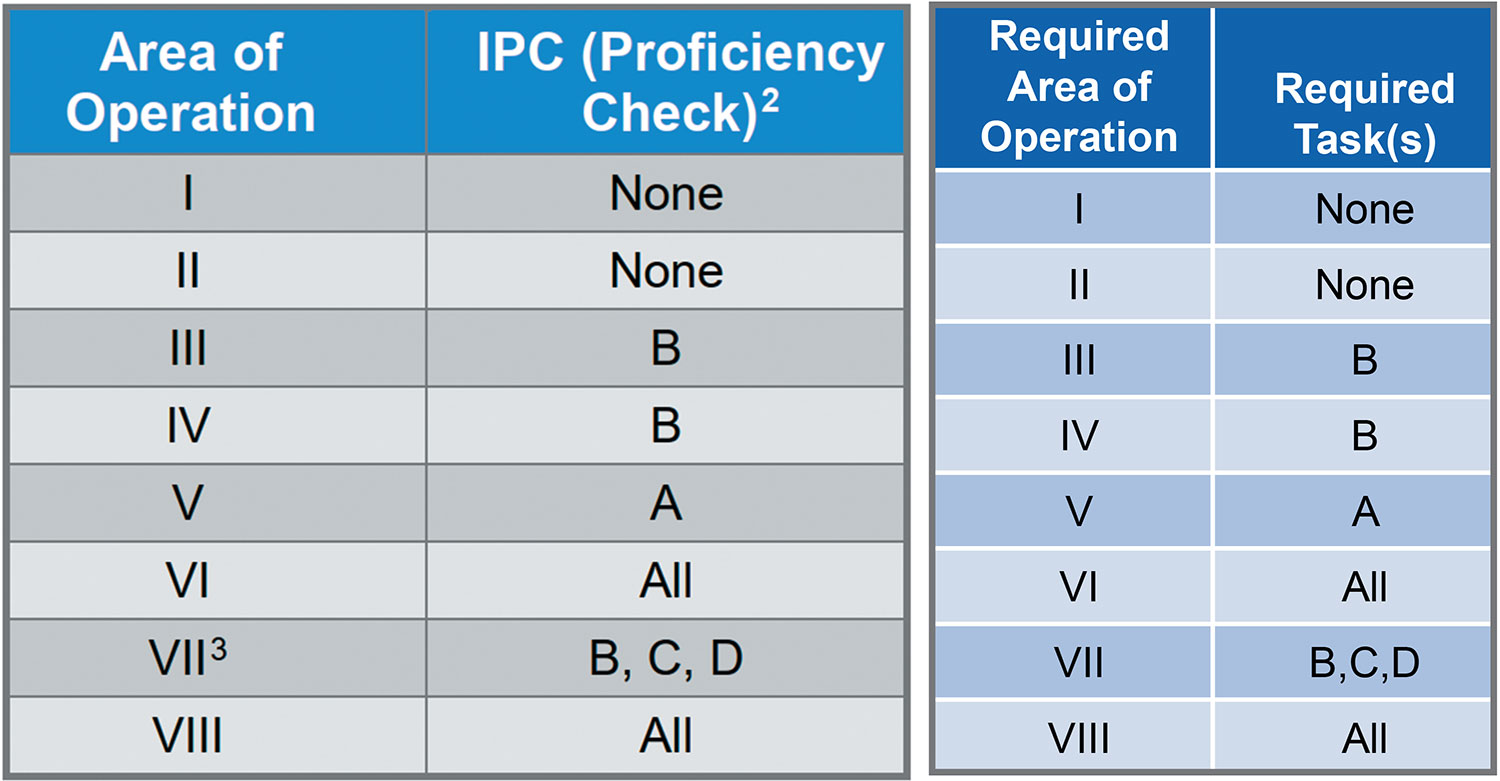
The task table itself remains unchanged in the proposed amendment, but the column headers are renamed to Required Area of Operation and Required Task(s).
Gemini Sparkle

Key Takeaways:

  • The Airmen Certification Standards (ACS) and Practical Test Standards (PTS) are now legally incorporated into Part 61 regulations, making them mandatory for practical tests and proficiency checks, effective May 31, 2024.
  • A "precision approach" is now defined as any standard instrument approach procedure to a published decision altitude using *approved* vertical guidance (e.g., ILS, LPV, LNAV/VNAV DA), explicitly excluding advisory "+V" guidance.
  • The requirement for nonprecision approaches to use "two different types of navigational aids" has been removed, allowing all three required approaches (one precision, two nonprecision) to be GPS-based.
  • The Instrument Proficiency Check (IPC) task table is now explicitly regulatory, ensuring adherence to its specified areas of operation.
See a mistake? Contact us.

Incorporating the Airmen Certification Standards (ACS) into Part 61 of the regs has been underway for some time. We reported on that effort in “ACS Will Be Regulatory” back in March after awaiting the final rule for months. As you might expect, the final rule was released shortly after our article, on April 1 (no, not an April Fool’s joke.) In that article we discussed how the proposed revisions to the Instrument Airplane ACS would affect checkrides and IPCs—in a good way.

Neither the Final Rule nor the testing standards differ significantly from the proposals. The Part 61 (63 and 65) amendments go into effect May 31, 2024. Technically, so do the new testing standards but the FAA created a transition period permitting them to be used immediately if the Examiner/CFII and applicant/learner agree.


Making the ACS Mandatory

Both the FAA and the aviation community have always treated the test standards as at least quasi-regulatory. But for various reasons, the FAA decided it needed more. Perhaps the recurrent argument whether the IPC Table in the Instrument PTS and ACS was mandatory was a factor. As we reported earlier, there was at least one case in which the FAA brought a civil penalty action against a training center for endorsing IPCs without including a circling approach. The Department of Transportation (which hears appeals from FAA civil penalties), rejected the FAA’s position because, as the DOT held, the PTS was not regulatory.

The Part 61 amendments effective at the end of May 2024 change that. The new §61.14 lists the various ACS and PTS and incorporates them into the FAA Regulations. For checkrides, revisions to §61.43 say that success on a practical test for a certificate or rating means “Performing the tasks specified in the areas of operation contained in the applicable Airmen Certification Standards or Practical Test Standards…” There are also amendments requiring adherence to the testing standards for other privileges and currency requirements. These include sport pilot and sport instructor additional category/class endorsements and §61.58 PIC proficiency checks for turbojets and aircraft which require more than one pilot. For instrument-rated pilots, the big one is the IPC.

IPC Task Table is Regulation

There are no significant changes to the IPC table itself. The headings now include the word “Required,” but the list is identical and the underlying tasks are substantially the same. However, the amendments to the regulations make it clear that the table is regulatory and its use as a baseline for IPCs is mandatory. “The instrument proficiency check,” says amended §61.57(d), must include the areas of operation contained in the applicable Airman Certification Standards … as appropriate to the rating held” (emphasis added). 

One Precision Approach

The requirement for one precision approach and two nonprecision approaches for both checkride and IPC has not changed. But which approaches qualify for each has been redefined.

Appendix 3 of the 2024 ACS (Appendix 7 in the 2018 ACS) discusses the equipment requirements for the instrument approach tasks. Our focus is the 2024 Instrument-Airplane ACS, but the new language also applies to other instrument certificates and ratings—helicopter, powered lift, and ATP/type ratings.

Ever since the 2010 Instrument PTS, the FAA has accepted either an ILS or an RNAV approach with LPV minimums below 300 feet AGL to satisfy the precision approach requirement. The 2024 ACS does away with the above/below 300 feet distinction in favor of a much simpler definition, perhaps borrowing from the “2D” (lateral guidance only) vs. “3D” (both lateral and vertical guidance) distinction adopted by ICAO back in 2014. A “precision approach” for 2024 ACS purposes is simply a “standard instrument approach procedure to a published decision altitude using provided approved vertical guidance.” Approved vertical guidance refers to official vertical guidance created using TERPS standards—vertical guidance to a published ILS, GLS, LPV or LNAV/VNAV decision altitude. Approved vertical guidance does not include the advisory “+V” guidance available with many modern boxes.

Nonprecision Approaches

On the flip side, a “nonprecision approach” in the 2024 ACS is a standard instrument approach “to a published minimum descent altitude without approved vertical guidance.” As mentioned, advisory “+V” vertical guidance is not “approved vertical guidance.” Its use does not change an RNAV approach with nonprecision LNAV or LP minimums into a precision approach.

The big news though, is the removal of the requirement to use a ground-based navaid approach at all. The 2018 ACS limited the options: “The choices must use at least two different types of navigational aids.” That meant if you used any RNAV approach as one of the two nonprecision approaches, the other was required to be a VOR, LOC, NDB, or other ground-based navaid approach.

This has recently become a problem. FAA initiatives to decommission VORs to a “Minimal Operational Network” and decommission approaches considered to be redundant (mostly VOR and NDB) have made it increasingly difficult to find realistic ground-based nonprecision approaches. If we are lucky, we have something nearby, but there have been some interesting work-arounds. For example, we might fly a VOR or LOC approach with required DME stepdowns using GPS in lieu of DME. This is permitted, but many—perhaps most—of us, would never fly a LOC or VOR approach in real life unless there was a GPS outage. In that case, many of us would not be able to fly VOR/DME or LOC/DME because we don’t have “real” DME in our modern aircraft. Add to this the growing popularity of replacing NAV radios with lower-cost GPS panel units such as the Garmin GNX 375, GNC 355, and GPS 175, which have no VLOC capability at all, and the problem increases. 

The 2024 ACS retains the requirement for two nonprecision approaches but removes the limitation that the approaches “use two different types of navigational aids.” In its place, we are simply required to do “two different non-precision approaches.” All three required approaches, both precision and nonprecision, may be GPS based. 

Different Approaches

Since the publication of the 2024 ACS, there have been several discussions about what makes two RNAV nonprecision approaches “different.” There has been no specific guidance from the FAA. 

The narrower view is that the two RNAV approaches must have different types of minimums. This view is based on the way the FAA has interpreted the “three different kinds of approaches” language in the §61.65 IFR cross-country requirement. Different kinds of approaches “can be defined by the various lines of minima found on an approach plate.” (FAA Order 8900.1, ¶5-434, discussed in “These Three Approaches,” February 2023 IFR). Applying that standard would mean flying an approach to LNAV minimums and then flying it again to circling minimums satisfies the “different” requirement, but flying a completely different LNAV approach would not.

The broader view is, the removal of the “different types of navigation aids” limitation without replacing it with any other limiting language (including the “kinds of” wording in §61.65) means that “different approach” just means “not the same approach,” Yes, an RNAV approach to LP minimums is different from an RNAV approach to LNAV minimums, but the approach to Runway 15 with LNAV minimums is also a “different approach” from the one to Runway 33 with LNAV minimums, even at the same airport. 

Aside from the English meaning of the words, I see a trend toward creating more options, not different limitations. This supports the broader view. It also bears mention that the tasks required for each nonprecision approach are significantly different. One must use a course reversal or a TAA, not vectors. One must be flown without an autopilot. And one must be flown partial panel (old school) or using backup instrumentation (new school). The application of those requirements differentiate those approaches more significantly than the same approach flown twice, once to LP minimums and again with SBAS disabled to LNAV minimums.

Ultimately however, the choices rest with the DPE or CFII who performs the checkride or IPC. Whether one subscribes to a broad or narrow meaning of “different approaches,” there are plenty of nonprecision RNAV options. RNAV to LNAV, LP and circling mins are “different” under the narrower “various lines of minima” view. And, of course, available ground-based approaches remain on the table, if available. The important thing is we now have options to make the selection more realistic than pretending we have DME to fly an approach we would not even be able to fly in case of a GPS failure. It’s a welcome change. 


Whether people or approaches, CFII and (mostly) retired aviation lawyer Mark Kolber believes Steven Covey was correct: “Strength lies in differences, not in similarities.” 

Ready to Sell Your Aircraft?

List your airplane on AircraftForSale.com and reach qualified buyers.

List Your Aircraft
AircraftForSale Logo | FLYING Logo
Pilot in aircraft
Sign-up for newsletters & special offers!

Get the latest stories & special offers delivered directly to your inbox.

SUBSCRIBE