











On The Air: May 2018
For years, V141 from Boston would take you to CELTS and then to DRUNK, which mysteriously became DUNKK around St Patricks Day a few years back. I dont recall any announcement. I wonder if that was a lucid moment of sobriety.

For years, V141 from Boston would take you to CELTS and then to DRUNK, which mysteriously became DUNKK around St Patricks Day a few years back. I dont recall any announcement. I wonder if that was a lucid moment of sobriety.

Your favorite phrase as a pilot probably isnt, Go around. You might have been set up on final, aircraft perfectly configured, ready to call it a day, and suddenly youve got to throw all that out and try again. For a controller, the go-around is a last-minute tactic to resolve insufficient clearance or some other unexpected danger. Sure, it fixes an immediate problem, but it instantly creates other risks. Whether ATC initiates it, or you do, its adding complexity for everyone involved.
The optimistic among us, besides having sunnier dispositions when asked to copy a reroute or enter a hold, like to assume positive outcomes during flight planning. This means looking for bright spots (literally) in weather forecasts and finding the upsides to adjusting departure times. While its nice to have a good attitude in flight, completely ignoring the pessimist in you can result in not-so-positive results.

Remember when complex transport-category aircraft had a flight engineer (FE) to manage systems? I imagine there was quite an uproar when automation progressed to the point where the FE became unnecessary and airliners were certified for two-person crews.
Changes Follow Fatal Helicopter AccidentBoth the FAA and NTSB called for change after five people died in a helicopter accident in New York in March. They were flying in a Eurocopter AS350 with the doors off, a popular option for sightseeing flights, and were wearing special harnesses that were difficult to release. The helicopter lost power, and the pilot made an emergency landing on the East River. The aircraft then rolled over and sank. Only the pilot, who was wearing a different kind of harness, was able to escape. The FAA prohibited doors-off flights unless passengers have quick-release harnesses. The NTSB called on the FAA to prohibit commercial flights of all kinds that secure passengers without quick-release mechanisms.
I was able to pull the ODP data but not the SID data, but I can give a fairly good guess as to whats going on. On the ODP, the controlling obstacle is a 2729-foot tower a few miles to the east of the runway. The initial climb is extended a bit more than usual in order to allow for a standard climb gradient when turning right (note that for turns other than to the right, a normal 400-foot turn is allowed). The WENDY and TRUPR are examples of Open SIDs, which have a route off the runway followed by radar vectors to a route. In these cases, the route off the runway is evaluated, but then the radar vector area gets no additional evaluation (other than MVA, etc.). SID evaluation begins again at the defined route. Because theres no SID evaluation required after the initial climb, the controlling obstacle for the ODP isnt considered. The minimum turning altitude for an RNAV SID is 500 feet above the runway, which would give you a turn at 1800 vs. the turn at 1900 on the ODP to keep a standard climb gradient and clear the tower. -LS
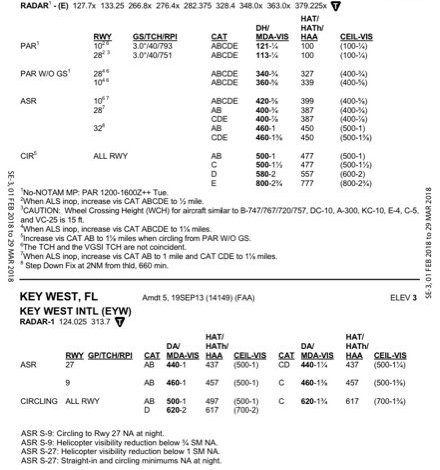
Before the advent of GPS approaches, most civilian approach control facilities provided Airport Surveillance Radar (ASR) approaches, usually as a back-up to pilot-nav approaches. Many are now gone but some airports still have them. In Florida, only two civilian airports have ASR approaches: Key West and Tallahassee, at opposite ends of the state. However, there are seven military airports with ASR approaches.
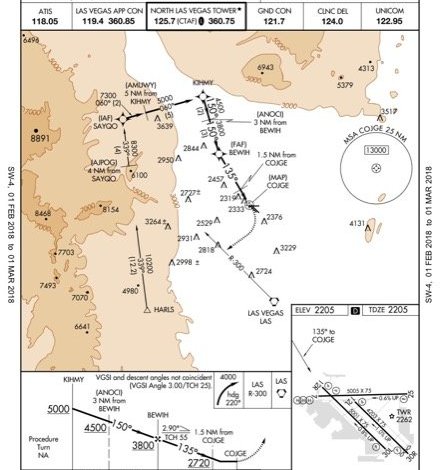
Its the end of a long day filled of uncooperative weather, ground stops, and a diversion tossed in to make it interesting. Youre shooting the non-precision (of course) GPS approach, and upon reaching minimums, you look up and see … nothing. Wait a minute! Isnt that a PAPI glowing out of the left side of your window? Is that your runway? If so, whats it doing all the way over there?
In June 2017, President Trump led off Infrastructure Week with his plan to move ATC to a nonprofit, private corporation. With two bills already in Congress, D. J. Gribben, special assistant to the president for infrastructure, called it low-hanging fruit from a policy perspective. Little did he know how incendiary the word privatization is to the aviation community. Mr. Gribben often uses this word, but savvy proponents avoid it and even refute those who use it.
For some, the shoulder seasons mean ideal flying weather – crisp spring and fall mornings with great visibility, often under a stable ceiling. These conditions offer fantastic climb performance, and the lack of bugs splattered all over the windshield is a plus. Morning fog, too, is pretty to look at, although it sure puts a damper on early-bird departures.

Get the latest stories & special offers delivered directly to your inbox.
SUBSCRIBE