













How We Die, Part 1

Gemini Sparkle

Key Takeaways:

  • Pilots frequently make critical errors by disregarding ATC instructions, failing to adhere to regulations (e.g., minimums, clearance requirements), or through inadequate pre-flight planning.
  • A "mission mindset" or "get-there-itis" can lead pilots to push limits, such as attempting flights without proper clearances, flying into known hazards like icing, or misinterpreting weather data.
  • Loss of situational awareness, sometimes compounded by a false sense of invulnerability from advanced avionics, can cause pilots to misidentify runways, descend below safe altitudes, or become disoriented.
See a mistake? Contact us.

(This is the first of a four-part series of articles in which contributing editor Fred Simonds will fully explore common, oft-fatal mistakes that we pilots make. This first article merely relates a number of ultimately harmless incidents that will serve as illustrations on which we’ll build in subsequent articles. As I read Fred’s manuscript, I was struck at how truly common some of these incidents really are. As a pilot flying en route high above, I’ve heard some incidents like these unfold. As a pilot down low, I’m forced to admit that at least parts of some of these incidents sound a bit too familiar. In each of these incidents reviewed here, fate (the hunter, remember?) allowed the pilots to complete their flights with no more than injury to their pride or perhaps a serious discussion with the appropriate ATC facility. It’s easy, however, to imagine a darker outcome. You know the old expression, “Live and learn.” Well, another suitable title for this series could be “Learn and Live,” but I wanted to stick with the attention-grabbing, sensational title author Simonds used because, well, it’s simply true. —Editor)

A Visual in IMC

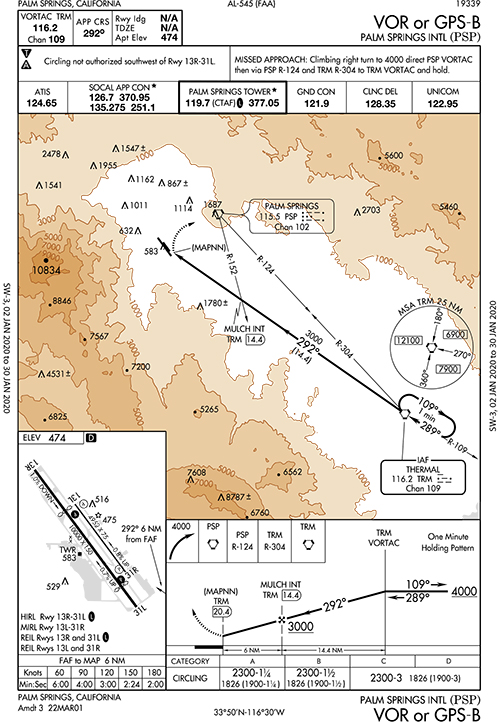
Unusually, Palm Springs International (KPSP) in southern California was socked in with rain and low clouds. And it was night. An aircraft on the VOR-B reported they barely saw the field at circling mins, 2300 feet MSL.


Shortly afterward, the tower controller was handed another aircraft, thinking he also was on the VOR-B. It later developed that the airplane’s radar tag mistakenly said VOR-B, but SOCAL TRACON (SCT) verified that he was cleared for the visual approach. The aircraft called “field in sight” but was low, triggering a Low Altitude Alert.

Scanning for the plane with binoculars, Tower relayed the Low Altitude alert and verified that the pilot still had the field in sight. The aircraft was at 600 feet, four miles out, abeam a 1780-foot obstacle. At three-plus miles, the aircraft began climbing and said he needed to go around. He realized that what he thought was a runway, wasn’t.

The controller was sure that the pilot became disoriented and mistook a road for the runway—a not uncommon mistake. Tower issued missed approach instructions and handed him back to SCT. Bolstering the controller’s belief, the pilot instead returned to the tower frequency, said he had the field “now,” and landed safely. The controller asked him to call after parking.

The pilot claimed to have broken out at 4000 feet and had the field in sight all the way down. Given the field conditions, the recent PIREP, and the Tower’s inability to spot him visually with binoculars, this was a tough sell but would have legitimized his request for a visual approach. If the weather was that good, why did the pilot try to land on something he thought was the runway three miles short of the real thing?

The controller saved his life, but the pilot could have done more to safeguard his flight. He didn’t realize he’d lost situational awareness until the controller spoke up. This was the time for an instrument approach, not a visual. He failed to notice that his “runway” lacked visual features like the PAPI, runway lights, and beacon. He could have asked that the lights be turned up, or stayed higher to help find the airport. The pilot took a shortcut with an illegal visual approach. Had he flown the procedure, he might have avoided his loss of situational awareness and the illusory runway that nearly cost him his life.

Do as You’re Told!

A GA aircraft was under IFR and level at 9000 feet when the controller received a Minimum Instrument Altitude (MIA) alert. He instructed the aircraft to climb to 10,000 feet to clear the MIA and immediately called the airplane again to inform him that he needed to vector the aircraft to avoid military airspace. The pilot started to question him, but the controller pressed on, telling the pilot he needed a vector or would have to cancel IFR and enter a military training complex at his own risk. Plus, the aircraft was not climbing. The controller repeated his climb and heading instructions.

The pilot started to climb but too late. He’d already entered the MIA box because he failed to follow instructions. He was also confused, and his delayed responses precipitated a loss of separation. The controller summed it up concisely: “Pilots need to take action when given a clearance.” In a similar incident, an already busy
controller responded to an aircraft request for a GPS 12 approach, so he cleared them to an IAF for the approach. Unexpectedly the aircraft turned south into a higher 5600-foot MVA. The controller issued a Low Altitude Alert and instructions to climb to 5600 feet, but the aircraft did not comply. He then issued a heading to the north and a climb, but again the aircraft did not respond or comply.

Some IFR pilots fail to internalize the fact that IFR is seriously scripted. This clueless pilot flew an unapproved heading and altitude and stumbled into an MVA. The AIM says, “When ATC issues a clearance or instruction, pilots are expected to execute its provisions upon receipt.” He could have hit an obstruction or another aircraft.

Mooney Mission Mindset

The Mooney pilot departed S50 in Auburn, WA, to practice approaches in IMC. He filed a Round-Robin IFR flight plan. The S50 weather was marginal VFR due to stratocumulus clouds, with better than six miles’ visibility, ceilings 1500-2000 AGL and tops reported at 3000-5000 feet MSL.

In the run-up area, the pilot reached Seattle Clearance Delivery, but they were too busy to issue his clearance. Alternate frequencies did not work. He departed VFR and remained in the pattern to try again. ATC advised that if he flew south into another sector, his clearance might be deliverable.

This didn’t work either. The ceiling had risen enough to let him climb to MVA but he lost sight of his escape route and nearby airports. He realized that if conditions worsened, he could be trapped without a clearance. That’s precisely what happened. He became disoriented and entered IMC but eventually landed safely.

On later reflection, he realized that deciding to take off into the pattern, traveling south, and climbing through a “hole” were all hazardous. Once he decided to return to S50, he considered declaring an emergency to get a clearance rather than trying to navigate down through the clouds and to the airport. In retrospect, this would have been wise.

Said the pilot, “I should have dealt with the clearance on the ground, not in the air. When talking to SEA Clearance, I should have been more direct to see if they could help get my clearance, and if not, then don’t depart.” Mission mindset in full control, he assertively took off expecting an airborne clearance that might never come, leaving himself few if any ways out.

Keep your perspective and remember every flight is optional.

Ice is for Drinks, not Airplanes
Flying his Mooney Ovation, this pilot encountered icing conditions even though his aircraft was not legal to operate in ice and he knew beforehand of an icing AIRMET. He planned to stay below the cloud layer until clear of clouds, then climb in VMC to an altitude too cold for icing.

The plan was upended when the clouds proved lower and more widespread than expected from his weather briefing, picking up trace ice at around 10,000 feet. He informed ATC and, with their help, decided to climb to 16,000 to get out of icing conditions. He immediately began to climb and was soon in temperatures well below freezing and out of icing conditions.

He later realized he’d misinterpreted the satellite weather depiction as showing the only places where there were clouds or clouds with moisture significant enough to produce icing. He learned that this is not the case.

Knowing that he didn’t know, he faulted himself for not making a no-go decision based on the icing AIRMET. As he said, “That would have been the prudent thing to do.”

TAA Trouble

The 3500-hour ATP was en route to Tracy, MN, in a Cirrus SR-22. The weather report was clear at KTKC. Expecting a visual approach, the pilot discovered
that the weather had deteriorated to 400 feet broken. The LNAV MDA for RNAV 29 was 445 feet AGL. The pilot elected to try, hoping to emerge below the broken layer.

Reinforcing his decision was the Garmin Perspective avionics suite aboard with LNAV+V vertical guidance for many LNAV approaches and synthetic vision. He followed the vertical navigation down to MDA and continued past the VDP 1.3 miles from the threshold. Too high to land on the short 3000-foot runway, he went missed.

Flying to the IAF for another attempt, he noticed a large hole in the clouds that would legally allow him to descend into Class G airspace, then proceed to his destination. However, he was uneasy because towers or terrain might lurk below. But he had flown many straight-in approaches to Runway 29 at Tracy and knew there were no obstacles on the approach path. He chose to try again.

As before, he followed the VNAV down the final approach. Reaching MDA, he still did not see the runway. He elected to descend a little further. At about 150 feet below MDA or 290 feet AGL, he saw the runway at 12 o’clock, on glide path, exactly like any other precision approach. He landed.

When the view out the windshield at minimums still resembles the inside of a milk carton, but the PFD shows this, would you consider pushing on?

Not many pilots deliberately consider flying below minimums and that includes this pilot. However, get-thereitis, along with a formidable avionics package that provided vertical advisory guidance and synthetic vision that displays the runway ahead (“there is no more IMC”), tempted the pilot to turn a nonprecision approach into a homemade precision approach.

In his words, “…this is an excellent lesson for anyone flying TAA aircraft. They certainly can give the feeling of invulnerability in several areas, including instrument approaches, fuel planning, and thunderstorm avoidance with XM weather. Invulnerability is a classic human factors pitfall, and a powerful one at that.”

TAAs were expected to decrease the accident rate, but they did not. One speculation is that TAAs allow pilots to nibble at the edge of safety. This narrative
shows how easy that is to do.

A Flight to Die for

The Cessna 172 departed under VFR from Custer County Airport in Custer, SD, and called Denver Center for his IFR clearance to Billings, MT. The Center issued a squawk code, then noticed the pilot had filed for 8000 feet where the area MIA is 9300 feet. He asked the pilot if he could climb to 10,000 feet as a final altitude due to the MIA. The pilot responded negatively and that he was IMC climbing through 7500 feet. ATC instructed him to maintain VFR and reminded him that he did not have an IFR clearance.

The Cessna descended to 7300 feet and said he was trying to stay VFR. When asked if he could see the ground, he said yes, and there was a cloud layer above at 7600 feet.

Again, ATC asked the pilot if he could maintain terrain and obstruction clearance and climb to 9300 feet. Once again, he replied no. He said he would try to stay VFR until ATC could give him a clearance. Instead, ATC suggested he return to his departure airport. The pilot added that he thought he could stay VFR.

As the pilot descended to 7100 feet, ATC suggested a westerly heading out
of the Black Hills into lower terrain if he could maintain VFR. He said he would and crossed the boundary into the controller’s 9000-foot MIA airspace at 7300 feet, above terrain and obstacles in that immediate area. ATC then issued him an IFR clearance with a climb to the MIA at 9000 feet, and he complied with
the clearance.

This pilot’s problem was inadequate flight planning. KCUT’s field elevation is 5620 feet. He filed for 8000, although the local OROCA is 9500 feet. An airway northwest of CUT has a telling MOCA at 9200 feet and MEA of 13,000. No wonder he got into trouble so fast. He could have easily avoided busting VFR minimums because KCUT has 24-hour clearance delivery service. Had he used the tools at hand and picked up his clearance while still on the ground, he would have avoided risking his life.

Illusions, disobeying ATC, completion bias, unexpected icing, false invulnerability, and shoddy flight planning are a few ways pilots tempt fate. You may think, “I’m too smart. Couldn’t happen to me.” These pilots likely thought the same thing.

Ready to Sell Your Aircraft?

List your airplane on AircraftForSale.com and reach qualified buyers.

List Your Aircraft
AircraftForSale Logo | FLYING Logo
Pilot in aircraft
Sign-up for newsletters & special offers!

Get the latest stories & special offers delivered directly to your inbox.

SUBSCRIBE