













Register

Hidden Weather Tool

Models like the NAM, RAP, and HRRR are often considered the cutting edge of weather forecasting on supercomputers. Indeed, these are some of the best forecasting innovations of the past 15 years. They are a class of tools called dynamical models, designed to solve conditions in the entire atmosphere across a large forecast zone. Typically a three-dimensional grid is built with a granularity of several miles, and the equations of motion are solved at each gridpoint to provide us with temperature, pressure, moisture, and wind.

Gemini Sparkle

Key Takeaways:

  • MOS (Model Output Statistics) is a sophisticated statistical weather forecasting system developed by the National Weather Service, leveraging dynamical model data and extensive predictors to generate accurate, station-specific forecasts.
  • Key advantages of MOS include providing detailed weather parameters, extending forecasts beyond the 24-30 hour range of TAFs (up to 8 days), and being available for a wide range of airfields, including those without TAFs.
  • The system offers different types—MET, MAV, and MEX—each optimized for various forecast durations and scales, from short-term mesoscale details to long-range global outlooks, with LAMP providing an even timelier, higher-detail enhancement for the next 24 hours.
  • While highly reliable and time-tested, MOS data should be used in conjunction with human-issued TAFs and briefings for a comprehensive understanding of the forecast and to account for potential model biases.
See a mistake? Contact us.

Models like the NAM, RAP, and HRRR are often considered the cutting edge of weather forecasting on supercomputers. Indeed, these are some of the best forecasting innovations of the past 15 years. They are a class of tools called dynamical models, designed to solve conditions in the entire atmosphere across a large forecast zone. Typically a three-dimensional grid is built with a granularity of several miles, and the equations of motion are solved at each gridpoint to provide us with temperature, pressure, moisture, and wind.

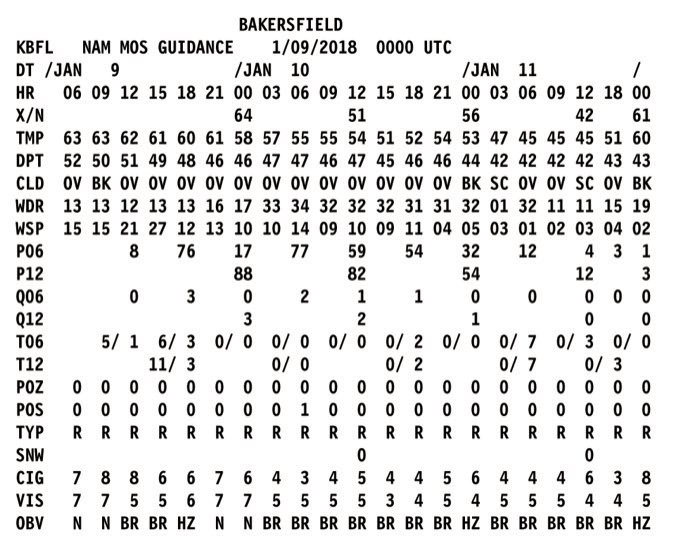
Extracting this raw data directly does not provide good information for planning purposes. Forecasters rely onstatisticalmodels, which offer better integration of all the available information. A statistical model often usesdynamicalmodels or other data as a source of information, and then uses a system of predictors to determine the weather.


Ready to Sell Your Aircraft?

List your airplane on AircraftForSale.com and reach qualified buyers.

List Your Aircraft
AircraftForSale Logo | FLYING Logo
Pilot in aircraft
Sign-up for newsletters & special offers!

Get the latest stories & special offers delivered directly to your inbox.

SUBSCRIBE