GA-ASI’s Uncrewed Fighter Crashes in California, Halting Testing

Company’s experimental YFQ-42A Dark Merlin ‘experienced a mishap’ that will pause trials.

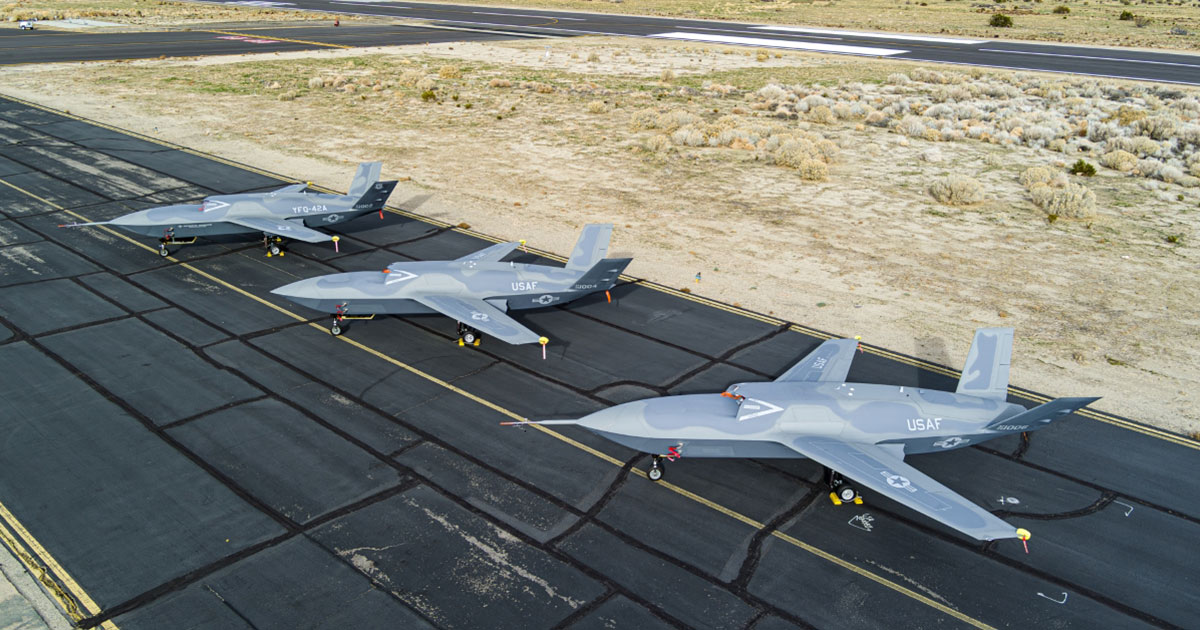
GA-ASI YFQ-42A CCA aircraft
GA-ASI’s YFQ-42A Dark Merlin is one of several candidates to be the first U.S. Air Force Collaborative Combat Aircraft (CCA). [Credit: GA-ASI]
Gemini Sparkle

Key Takeaways:

  • An experimental YFQ-42A Dark Merlin drone, developed by General Atomics for the U.S. Air Force's "loyal wingman" program, crashed in the California desert.
  • The crash, which caused no injuries, has temporarily paused flight testing for the Dark Merlin while an investigation into its cause is underway.
  • The incident occurs as General Atomics competes for production contracts under the Air Force's Collaborative Combat Aircraft (CCA) program, a major initiative to integrate uncrewed drones with crewed fighter jets.
See a mistake? Contact us.

An experimental aircraft developed to serve as an autonomous “loyal wingman” for next-generation U.S. Air Force fighter jets crashed in the California desert on Monday.

General Atomics Aeronautical Systems Inc. (GA-ASI)—the manufacturer of the YFQ-42A Dark Merlin in question—said Monday that the aircraft “experienced a mishap” after taking off from a company-owned airport.

GA-ASI owns Gray Butte Field Airport (04CA) in Palmdale, California, where it tests various uncrewed aircraft systems (UAS).

The company began semiautonomous testing with Dark Merlin in February after its maiden flight last year.  It is competing for the first round of production deals under the Air Force’s Collaborative Combat Aircraft (CCA) program, which seeks to pair crewed fighters with uncrewed drones that could carry munitions and improve the range of sensors, among other capabilities.

GA-ASI said there were no injuries due to the crash. But YFQ-42A flight testing will be “paused temporarily in an abundance of caution” and “resume when deemed appropriate,” it said.

The company added that it would be “premature” to speculate on what caused the mishap as it assesses the aircraft’s condition and investigates what went wrong.

“Safety is our top priority, for our people and the public,” said C. Mark Brinkley, a GA-ASI spokesperson. “In this case, established procedures and safeguards worked as intended, and there were no injuries. We’re going to take a close look at what happened, gather all the data, and allow the investigation to guide us moving forward.”

Air Force Secretary Troy Meink in a statement Tuesday added that “this is exactly why we test.”

Uncrewed Loyal Wingmen

The crash could be a setback for GA-ASI, which is competing to deliver the first of 1,000 Air Force CCA aircraft.

These “loyal wingmen” would complement next-generation fighter jets like Lockheed Martin’s F-35A and Boeing’s F-47 on missions that are risky, austere, or require additional air assets on a moment’s notice.

GA-ASI and Anduril in 2024 won contracts to demonstrate their CCA concepts for the Air Force. In the next six months, the department is expected to decide which will advance to scaled production. It could select either or both, or it could opt for a third CCA concept such as Northrop Grumman’s YFQ-48A Talon Blue, which has emerged as a late contender. A second phase of development and testing is already underway.

GA-ASI said the Dark Merlin that crashed is one of several production-representative CCA aircraft in the “technical maturation and risk reduction phase,” which it added are flying “regularly.” Three YFQ-42As have been announced to the public.

The experimental aircraft first flew in late 2025. GA-ASI began semiautonomous flights alongside crewed fighters in February, using Collins Aerospace’s Sidekick autonomy system. The company earlier this year said it has flown multiple prototypes and conducted “push-button autonomous takeoffs and landings.”

Anduril’s YFQ-44A Fury also first flew in 2025, advancing to sorties with inert air-to-air munitions in February. It has since begun semiautonomous flights with Shield AI’s Hivemind software. Northrop has similarly tested Hivemind on its Talon Blue.

The Pentagon has spent close to $2 billion developing CCA aircraft since fiscal year 2024. Its budget request for fiscal year 2027 contains nearly $1 billion for CCA procurement next year, $150 million for advance procurement for 2028, and $1.37 billion for further research. The CCA funding is the largest addition to the Pentagon’s 2027 aircraft procurement budget.

Jack Daleo

Jack is a staff writer covering advanced air mobility, including everything from drones to unmanned aircraft systems to space travel—and a whole lot more. He spent close to two years reporting on drone delivery for FreightWaves, covering the biggest news and developments in the space and connecting with industry executives and experts. Jack is also a basketball aficionado, a frequent traveler and a lover of all things logistics.


Ready to Sell Your Aircraft?

List your airplane on AircraftForSale.com and reach qualified buyers.

List Your Aircraft
AircraftForSale Logo | FLYING Logo
Pilot in aircraft
Sign-up for newsletters & special offers!

Get the latest stories & special offers delivered directly to your inbox.

SUBSCRIBE