











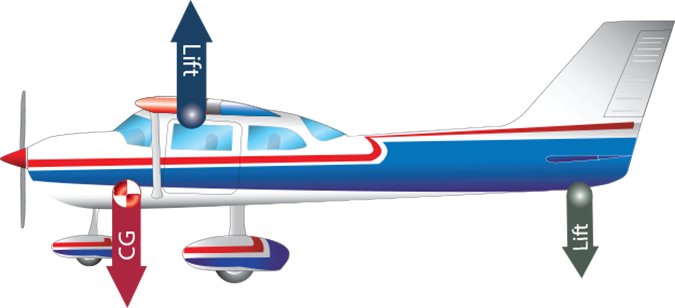
Figures 1 and 2 depict the same airplane with a forward center of gravity and one in which the CG is further aft, closer to the center of lift. The CG acts on the airplane via the red arrow while lift—shown here opposing CG, actually works at a right angle to the relative wind. In both instances, some tail down force must be generated, as represented by the green arrow at each tail. That tail down force imposes an increase in the aerodynamic weight the wings must support, requiring the wings to generate greater lift than demanded by the airplane’s weight. When greater lift must be generated, the wing’s induced drag increases. Tail down force and the wing’s induced drag are greater when the distance between CG and CL is greater.
Forward Center of Gravity

Key Takeaways:
- Airplanes require tail down force to balance the center of gravity (CG), which increases the effective aerodynamic weight the wings must support.
- This increased wing load necessitates greater lift production, leading to a corresponding increase in the wing's induced drag.
- Both the tail down force and the induced drag are greater when the distance between the center of gravity (CG) and the center of lift (CL) is larger.
Key takeaways sponsored by Aviator Pro | Start Your Training ->
See a mistake? Contact us.

