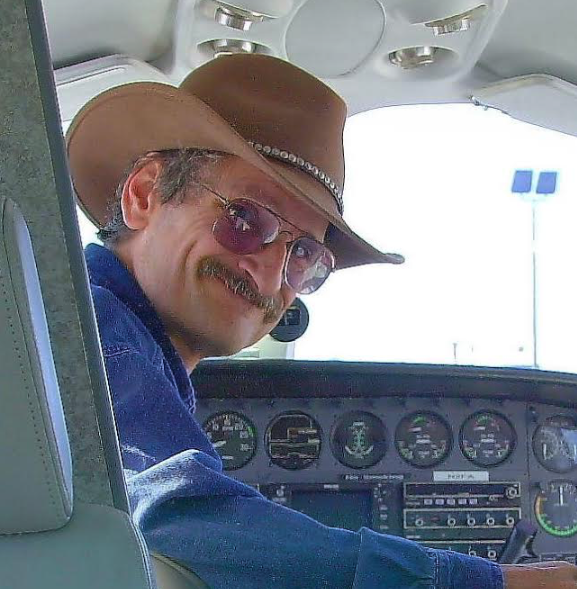
As a kid, Greg Heifner’s life was narrowly circumscribed.
Diagnosed with the blood clotting disorder hemophilia B, also known as Christmas disease, he suffered frequent bleeding into his joints, which reduced his mobility and left him reliant on a wheelchair. Something as minor as losing his baby teeth could have killed him.
Sitting on the porch of his parents’ house, he shot cheap windup gliders out into the yard and dreamed of an escape. He found a temporary respite looking up and watching airplanes thousands of feet above, soaring, free and unencumbered.
“That was the beginning of starting a process of trying not to let a birth defect like that rule my life and ruin it,” Heifner said in a recent video interview from his home in Missouri. “So my entire being’s all about, what can I do? What more can I do?”
Thanks to gradual improvements in treatment options and his own persistence, Heifner was eventually able to realize his dream of flying aircraft. He also explored hobbies like diving, built successful companies, and started a family. And even though his health did ultimately end his time as a pilot, the burden of hemophilia has largely been lifted following a new treatment that Heifner jokingly described as part science fiction.
“I’ve felt better than I have probably at any other period of my life back to when I was in my 20s,” he said.
Long Road to a License
Partially inspired by the 1950s and early ’60s television series Sky King and its famous Songbird—initially a Cessna T-50, later a Cessna 310—Heifner learned everything he could about aviation and started flying remote-controlled airplanes. When advances in medicine allowed him to walk again in his late teens, he set his sights on becoming a pilot, though his condition sometimes put his training on hold.

“Back in those days there were no real treatments for hemophilia,” Heifner said. “You simply lived with it. And you had one joint hemorrhage after another…I had to survive and go through all of that, learn how to walk again after getting out of the wheelchair, before I had any chance to even think about being a pilot.”
Still, Heifner made good progress. He was already well acquainted with aircraft design and aerodynamics from flying and competing with remote-control airplanes, and he impressed his instructors on training flights.
Things seemed to be looking up, until he went to obtain his medical certificate and was told the FAA did not allow people with hemophilia to pilot engine-powered aircraft.
“I was quite disappointed,” he said. “I’d gone through all of this, learned how to walk again, to get to the point that I could fly an airplane quite easily—my instructors indicated I could fly quite easily—and then be told, ‘No, I’m sorry, but that’s a rule that had been made decades ago.’”
Not one to quit, Heifner instead learned how to operate sailplanes and gliders, and flew them all across the U.S. The experience was thrilling, but he still wanted to fly the kind of aircraft he fell in love with as a boy.
“I had already solicited the FAA, the aeromedical branch down in Oklahoma, and I said, ‘Would you please review my case and see if there’s not something I can do in order to obtain a medical and a pilot’s license?’ I heard nothing for four years—absolutely nothing.”

Then out of the blue, Heifner received a letter in his mailbox from the FAA. He was told to come to St. Louis, where an examiner would evaluate him.
“No promises, but they would see,” he said.
The examiner put Heifner “through the ringer,” he recalled, even having him climb on top of and underneath the aircraft.
“At the end of it, he said something to me I remember to this day,” Heifner said. “He said, ‘You’re an excellent pilot. I’d fly with you any day.’ And he handed me what’s called a Waiver of Demonstrated Ability, which I did not know existed. And it basically said that I was qualified to get up to a Class 2 medical regardless of my hemophilia. I demonstrated it had not affected my ability to be a pilot.”
Finally free to fly recreationally, Heifner acquired a series of small aircraft and flew as often as he could. Among them was a Steen Skybolt, which he used to fly in airshows, and a twin-engine Cessna he lovingly called “my Songbird.”
“I really felt like I was alive,” he said.
Even as Heifner built his own satellite communications company and raised a family, flying remained a major part of his life.

“For me it was a feeling of freedom,” he said. “The ability to put a key in a machine and go some place at high speed, and see the world from a whole other perspective…I can’t think of anything that I ever did in my life that was as altering to my perception of the world as being a pilot.”
‘Where There’s a Will, There’s a Way’
Around 2003, Heifner suffered a heart attack and had to undergo quintuple bypass surgery.
“That messed up my flying career,” he said. “It doesn’t prevent you from flying, but it certainly does put a whole other level of complications on top of it. So unfortunately I just stopped flying.”
While Heifner’s time as a pilot in command (PIC) was over, he didn’t drift far from the aviation world. His son John became a pilot, and the two fly together frequently. And Heifner’s brother-in-law has a Cessna Mustang that he sometimes flies on.
“It’s not like I had to walk away from flying,” he said. “It’s all over me.”
Through all this, Heifner continued to live with hemophilia, receiving treatments to keep him stable. He remained on the lookout for new therapies, but for years progress was slow, and the accumulated damage from the disease took a mental and physical toll.

“I was always a big science fiction fan,” he said. “I didn’t like what the doctors had to tell me every time I went to see them. I always hoped that one day I’d wake up on the [Star Trek’s USS] Enterprise and Bones would say to me, ‘You have a Factor IX deficiency, and we’re going to fix it.’ And, of course, that never happened. But I kept wishing for something like that to happen.”
Last year, Heifer received a one-time gene therapy known as Hemgenix, developed by biopharmaceutical company CSL Behring, which increases clotting factor in patients. He took the treatment as an infusion at a hospital in St. Louis, had no adverse reactions, and over time began to feel better than he had in years.
Since the infusion, he has not had to take any medication for his hemophilia, and he has not had another bleeding episode.
“This is science on a level that’s hard for me to get my head around,” he said. “It’s what I prayed for when I was sitting in a wheelchair watching the planes go over.”
Heifner said he now spends more time enjoying family and friends than worrying about hemophilia, a welcome break after decades of extreme diligence.

Asked what advice he would give to others pursuing a pilot career or any other goal in spite of significant health-related obstacles, Heifner said resilience is key.
“I’d say you need to roll up your sleeves and don’t feel sorry for yourself about it, but see if there’s a way for you to pursue the thing you want,” he said. “You might get a ‘no.’ In fact there’s good odds you’re going to get a ‘no.’ But you also might get a ‘yes,’ and in my case that’s what I got.
“Recognize that where there’s a will there’s almost always a way.”