











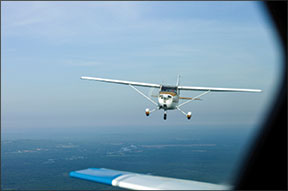


All pilots fear mid-air collisions (MACs), even though they’re relatively rare. The AOPA Air Safety Institute’s 2011 Nall Report, an annual look-see at general aviation’s safety record in the U.S., found only four of them. That means the other 1373 accidents occurring in the U.S. during 2010, the year examined, involved other causes, including the always-interesting stupid pilot tricks. Of the four mid-airs in 2010, one of them involved no fatalities; in only one MAC did everyone aboard both aircraft suffer fatal injuries.
The relative lack of mid-airs doesn’t mean we should ignore the risks they pose. History has demonstrated a mid-air can occur anywhere, anytime, although the risk is greatest near an airport—who’d have thought it?—where the concentration of aircraft is greatest. The sidebar on the opposite page highlights some recent statistics, also from AOPA’s ASI, and the traffic pattern diagram serves as a reminder of where the highest risks can be found. Once we have this information, there are some very easy things we can do to detect other airplanes and avoid collisions. Some of them we are taught before we ever solo an aircraft—although many of us seem to forget them along the way. Other mitigations aren’t commonly taught in most flight instruction, but they’re simple and effective. Avionics, portable or installed, also can help, of course, but their utility is limited in most environments, and even more so once we’re in the traffic pattern. Ultimately, how we view the chances of a mid-air translates into how we should fly a traffic pattern.

