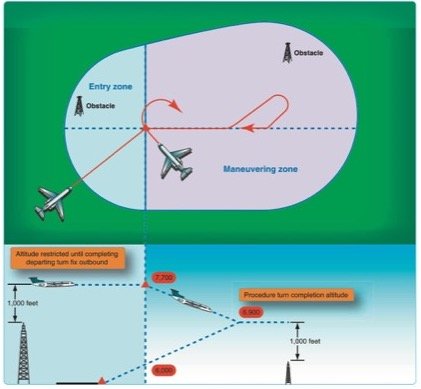
Establish yourself on the reciprocal of the ILS localizer course, 351 degrees, and fly outbound on the localizer. Since youre outbound on the front course, remember to correct away from the needle on the localizer. (See, Reverse Sensing and Reverse Sensing-HSI in the June and July 2016 issues.) Two minutes is usual. Then turn to the outbound procedure turn heading of 036 degrees. The Instrument Flying Handbook specifies flying that heading for 40 seconds, although many of us were taught to fly it for a full minute. Either is fine so long as you remain inside the limit. Then, make a standard-rate left turn to 216 degrees and join the 171-degree localizer.
Many new instrument pilots and instructors lack fundamental knowledge of procedure turns, reflecting a modern shift away from traditional ground-based approaches towards RNAV, though procedure turns remain essential.
Procedure turns serve to reverse direction, facilitate descent, or intercept an inbound course for an approach, and are required unless explicitly cleared straight-in, vectored, or if the chart indicates "NoPT."
While specific altitude and distance limits apply to procedure turns, pilots generally have flexibility in their execution, such as flying a 45/180, 80/260, or teardrop turn, unless a unique charted teardrop is specifically mandated.
Pilots should always clarify with Air Traffic Control if unsure about flying a procedure turn, as controller instructions can vary, and flying the full published approach is the default if clarification is not possible.
Recently, at an IMC Club meeting, a newly instrument-rated pilot took out a VOR approach chart and asked what the hook-like line meant.
His question rocked my boat: A newly-rated pilot didn’t know what a procedure turn was. Compounding the issue, he said his instructor didn’t know either.
CREATE A FREE ACCOUNT
Sign up to keep reading
Create a free account to continue. Already a member? Sign in below.