














Florida Airport Builds Flood Defense With Innovative Barrier System

Naples’ new Tiger Dam setup offers rapid deployment and cost-effective protection against storm surge.

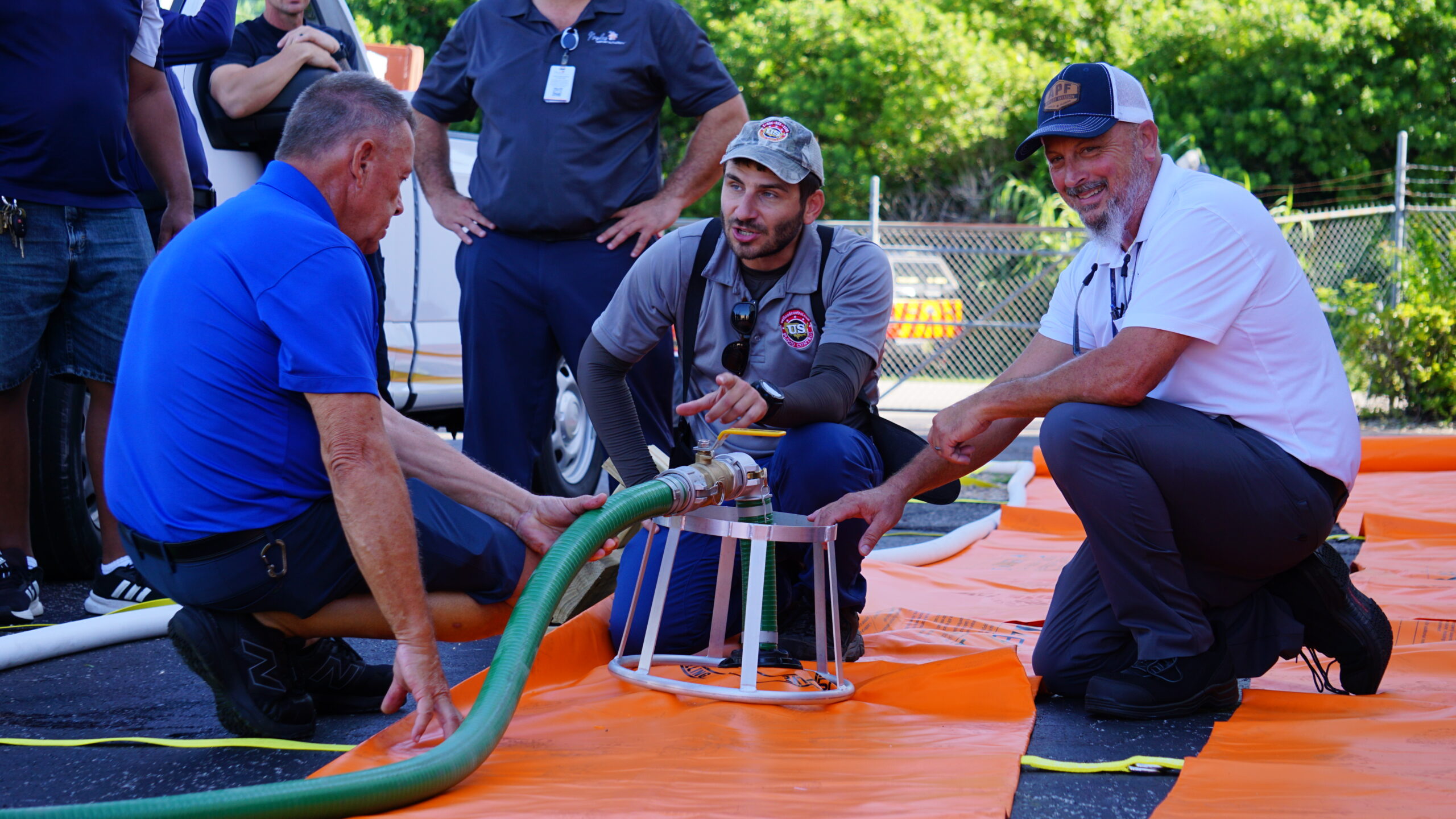
U.S. Flood Control director of operations Kyle Roussel (center) explains how to properly fill Tiger Dam flood barriers to Dennis Denault (left) and Trent Marlow (right). The operations team at Naples Airport in Florida will connect and fill a series of industrial-grade tubes that act as a water-tight dam to control flooding during tropical storms and hurricanes. [Courtesy: Naples Airport Authority]
Gemini Sparkle

Key Takeaways:

  • Naples Airport (KAPF) in Florida installed a Tiger Dam flood barrier system to protect against future flooding after experiencing significant storm surge during Hurricane Ian.
  • The Tiger Dam system, comprised of water-filled industrial tubing, is rapidly deployable and offers a cost-effective solution compared to other flood protection methods.
  • Airport staff received training on the system's setup and deployment, which involves filling, anchoring, and stacking the water-filled tubes to create a barrier.
  • The $259,370 system, funded by the airport itself, will protect key buildings including terminals, offices, and the fuel farm.
See a mistake? Contact us.

You have probably heard the expression “fighting fire with fire.” In Naples, Florida, the airport authority has plans to protect the facility from flooding using a Tiger Dam flood barrier system, which consists of industrial-grade tubing filled with water, linked together, and anchored in place. In short, fighting water with water.

Naples Airport (KAPF) is located on the west coast of Florida adjacent to Naples Bay. Built during World War II, it served as a training base for Army fighter pilots and then became a civilian facility in 1947. The airport has a field elevation of 8 feet above sea level.


This week airport staff received training on the use of the Tiger Dam system and had a chance to practice setting it up. The training exercise involved filling, stabilizing, anchoring, stacking, draining, and packing the flood barriers. The Tiger Dams are stored on-site in a custom trailer and rapidly deployed within hours based on weather forecasters’ predictions for storm surge.

Tiger Dam is an emergency rapid deployment,” said Cheryl Witmer, sales director for Louisiana-based U.S. Flood Control, which manufactures the flood barriers. “You can put it up very quickly with very few people.”

During Hurricane Ian in 2022, portions of Naples Airport were, according to officials, inundated with storm surge from the Gordon River and Naples Bay, with some facilities coming within inches of catastrophic flooding.

“Having seen the water 3 to 5 feet [high] throughout the airport really changed our thinking about how we prepare and mitigate our facilities for future events,” said Justin Lobb, deputy director of aviation at Naples Airport.

Barry Brown, director of operations and maintenance at KAPF, added that the facility realized the need to take a more proactive approach to protect it.

“We looked at a number of different resources that could meet those needs, and Tiger Dam really stood out as pretty easy to deploy and a lot less expensive than some of the other systems,” Brown said. “And it’s pretty intuitive.”

The Naples Airport Authority purchased 3,000 feet of sturdy, industrial-grade flexible tubing that—once filled with water—is linked together and anchored into place, creating an airtight barrier more effective than sandbags at holding back floodwaters.

When needed, the Tiger Dam system will be positioned around key buildings at the airport, including the North Road Terminal, General Aviation Terminal, airport office buildings and facilities, and fuel farm.

About Tiger Dam

Each 50-foot tube stands 2 feet tall when filled and holds 1,300 gallons of water, weighing 10,842 pounds. The airport will use a two-by-one configuration with two tubes on the bottom and one stacked on top, creating a 3.5-foot-tall dam.

According to the Naples Airport Authority, the Tiger Dam system cost $259,370 and was paid for using airport funds. Naples Airport is a self-sustaining entity that generates revenue through fuel sales, hangar rentals, and other related services. It receives no tax dollars.

Meg Godlewski

Meg Godlewski has been an aviation journalist for more than 24 years and a CFI for more than 20 years. If she is not flying or teaching aviation, she is writing about it. Meg is a founding member of the Pilot Proficiency Center at EAA AirVenture and excels at the application of simulation technology to flatten the learning curve. Follow Meg on Twitter @2Lewski.

Ready to Sell Your Aircraft?

List your airplane on AircraftForSale.com and reach qualified buyers.

List Your Aircraft
AircraftForSale Logo | FLYING Logo
Pilot in aircraft
Sign-up for newsletters & special offers!

Get the latest stories & special offers delivered directly to your inbox.

SUBSCRIBE
