













Today, it is common practice for active pilots to use an electronic flight bag (EFB), typically a tablet with an aviation app like ForeFlight or Garmin Pilot, among others. One of the advantages of an EFB is the ability to store information about specific aircraft. Information about onboard equipment can easily be stored and used when filing flight plans without entering the same information every time. As an instrument flight instructor, I’ve found that equipment flight plan codes stored in EFBs are commonly incorrect. Let’s dig deeper into the codes.
Our focus is on the two blocks dealing with equipment in the Flight Plan (FAA Form 7233-4): Block 10: Equipment and Block 18: Other Information. Note that since the old domestic flight plan was dropped in August 2019, it is now just the Flight Plan; let’s drop the “ICAO” and “International” monikers.

Block 10: Equipment
Let’s start with a typical well-equipped light IFR GA airplane with VHF COMM, VHF NAV, WAAS IFR GPS, and ADS-B capability.
As an example, the codes for Block 10 for the above airplane could be SBGR/EB2. Before the slash mark we list the nav and com avionics, but surveillance equipment, i.e., transponder and ADS-B, follow the slash. (Note: if handwritten on a flight plan form, codes should be entered alphabetically except for S.)
S: VHF COM & VHF NAV (VOR & ILS)
B: Capability to conduct GPS approaches to LPV minimums, implying WAAS (internationally known as Satellite Based Augmentation System or SBAS). Note that B cannot stand alone; it must be associated with G.
G: IFR GPS (WAAS and non-WAAS)
R: is a “pointer code” that the navigation equipment has Performance Based Navigation (PBN) capabilities, and details are captured in Block 18.
Other options for Block 10:
SGR: for non-WAAS IFR GPS (remove B)
Note that S is a bit of a catch-all. If you don’t have all of the equipment for S, you use L for ILS, O for VOR, and/or V for VHF COMM. For example, GORV says you’ve got non-WAAS GPS, PBN capabilities, VOR, VHF COMM, but no ILS.
If the aircraft has a working DME, add a D and/or for ADF add an F. Panel-mounted boat anchors need not apply.
The latter part of Box 10, after the slash, specifies surveillance equipment. Mode S transponders are common (S for select). Next up is a transponder with “extended squitter” (ES) with ADS-B OUT and IN. In the code EB2, E is for Mode S-ES extended squitter and B2 adds ADS-B OUT and IN. Extended Squitter provides additional information, such as LAT/LON position.
Other options for surveillance equipment (assuming ADS-B capability) are:
EB1: Mode S-ES extended squitter, ADS-B OUT only.
CU1: Mode C with UAT OUT (Universal Access Transceiver)
CU2: Mode C with UAT OUT and IN
Other less common possibilities are:
SU1 and SU2. Mode S with UAT.
EU1 and EU2. Mode S-ES extended squitter and UAT. Since both can transmit ADS-B OUT, one OUT, usually the UAT, has to be disabled. UAT IN would provide traffic and weather information.
Just by looking at an aircraft’s instrument panel, it might not be obvious what type of surveillance equipment is installed; we need to look at the AFM supplement for verification.
ADS-B IN (traffic and weather) needs a panel-mounted or portable display. Although both add a layer of safety and should be indicated, ATC doesn’t really care about IN capabilities.
These codes indicate communications, navigation, and surveillance capabilities only. There are no codes to say you’ve got two of something, like dual navcom or GPS, nor are there codes for autopilots.
Block 18: Other Info
Block 18 allows us to add additional information, but we’ll only cover avionics. The general format is a code to identify what capability we’re clarifying, a slash, then the further clarifying information.
For example, in Block 10, we used the pointer code R to look at Block 18 for Performance-Based Navigation capabilities. In our case, we’ll only consider PBN using GPS.
PBN/B2C2D2S1
B2: RNAV-5 Fly from any LAT/LON waypoint to another LAT/LON waypoint using a great circle route that does not include C2 and D2.
C2: RNAV-2 Fly T Routes (below FL180) and Q Routes (above FL180)
D2: RNAV-1 Fly Standard Instrument Departures (SIDs) and Standard Terminal Arrival Routes (STARs)
S1: RNP APCH Conduct GPS approaches with and without WAAS
SUR/260B or SUR/282B
We must add that ADS-B surveillance equipment meets the RTCA (Radio Technical Commission for Aeronautics) specifications. A 260B is for Mode S-ES transponder specifications, and 282B is for UAT. Most current ADS-B OUT equipment meets those standards, so it’s not clear how this is useful to ATC.
For example: CODE/AC6DD5 indicates tail number N90LH.
Additionally, we need to add the hexadecimal code, formally Mode S Code (Base 16 / Hex), which is the encoded base 16 aircraft registration or tail number. It consists of six alphanumeric characters, and for U.S.-registered aircraft, all the codes start with an “A,” which can be found on the FAA Aircraft Registry website under the relevant tail number.
On the radio, we often hear ATC ask a pilot, “Say type.” For example, a typical response could be: “Skylane slash golf.” That “slash golf” is an old code; that and other codes from the obsolete domestic flight plan are no longer relevant. The correct response is simply “Skylane” or “C182.”
Deeper Dive into PBN
To better understand the PBN codes we need to take a slight detour.
By using GPS, we are in the world of Performance Based Navigation, PBN, that includes surveillance. PBN might be transparent for Part 61 operations (except for subpart K), but it has long been a mainstay in Part 121 (airlines) Flight Management Systems (FMS). Typically, an airline FMS has multiple simultaneous navigation inputs and other inputs, such as temperature and atmospheric pressure, collectively providing navigation and additional information.
This has shifted the focus to capability—what the equipment can do rather than what the equipment is. In light GA, one implies the other. For example, if I have a VOR receiver (equipment), I can fly Victor Airways using VOR and shoot VOR approaches (capabilities).
PBN code D2 (Block 18) means the ability to fly SIDs and STARs using GPS. However, there are other options (usually not available to light GA) to fly SIDs and STARS. For example, D4 says you can fly SIDs and STARs using DME/DME/IRU (inertial reference unit).
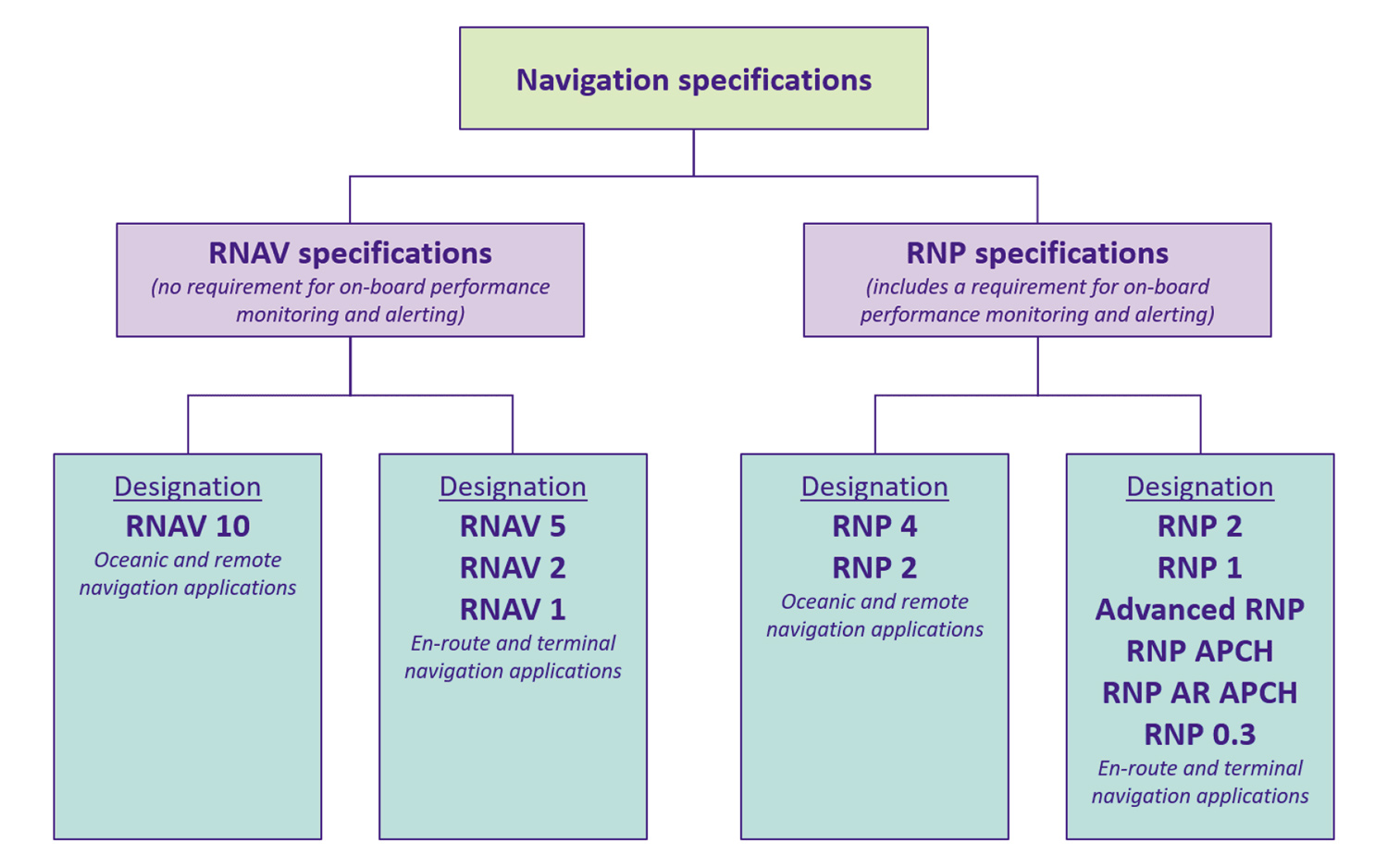
PBN has two components: RNAV and RNP. (Ref. AIM Fig 1-2-1, above). The difference is that RNP requires “onboard performance monitoring and alerting,” while RNAV does not. For non-WAAS GPS, the alerting system is RAIM (receiver autonomous integrity monitoring), which is called fault detection. An error message indicates the need for an alternate navigation system like VOR if sufficient satellites are unavailable.
With WAAS-GPS, fault detection and exclusion continuously monitors the health of the GPS constellation and excludes any “misbehaving” satellites from the position calculation. WAAS-GPS is considered primary navigation, while non-WAAS GPS is supplemental navigation because it only takes one miscreant satellite to make the system unreliable. There is no need to do RAIM checks with WAAS, but some pilots do anyway. There is nothing wrong with that “belt and suspenders” approach, but it is unnecessary.
Adding a number, for example, RNAV-1, is a measure of probabilistic accuracy: 95 percent of the time, the displayed position is within 1 nautical mile of the actual position. There is a nesting issue. For example, if a car can go 100 MPH, it can also go 50 MPH, but not necessarily the other way around. If the equipment meets RNAV-1 accuracy, it also meets RNAV-5. However, using code B2, we communicate that we are willing and able to fly RNAV-5 courses. Additionally, despite the possible nesting, each specification stands on its own.
The relevant PBN RNAV specifications for light GA using GPS are: B2 (RNAV-5), C2 (RNAV-2) and D2 (RNAV-1). The applicable RNP specification is S1 (RNP APCH).
PBN approvals are usually found in the device AFM supplement.
Luca F. Bencini-Tibo, a CFII in South Florida, thinks PBN extends to an espresso machine (equipment) and its ability to make a cappuccino. For most coffee drinkers, the product, not the equipment, is usually important.
