














FAA Restricts Helicopters, Powered Lift Aircraft Around Washington National

Interim rule implementing NTSB recommendations for the airspace will go into effect on Friday.

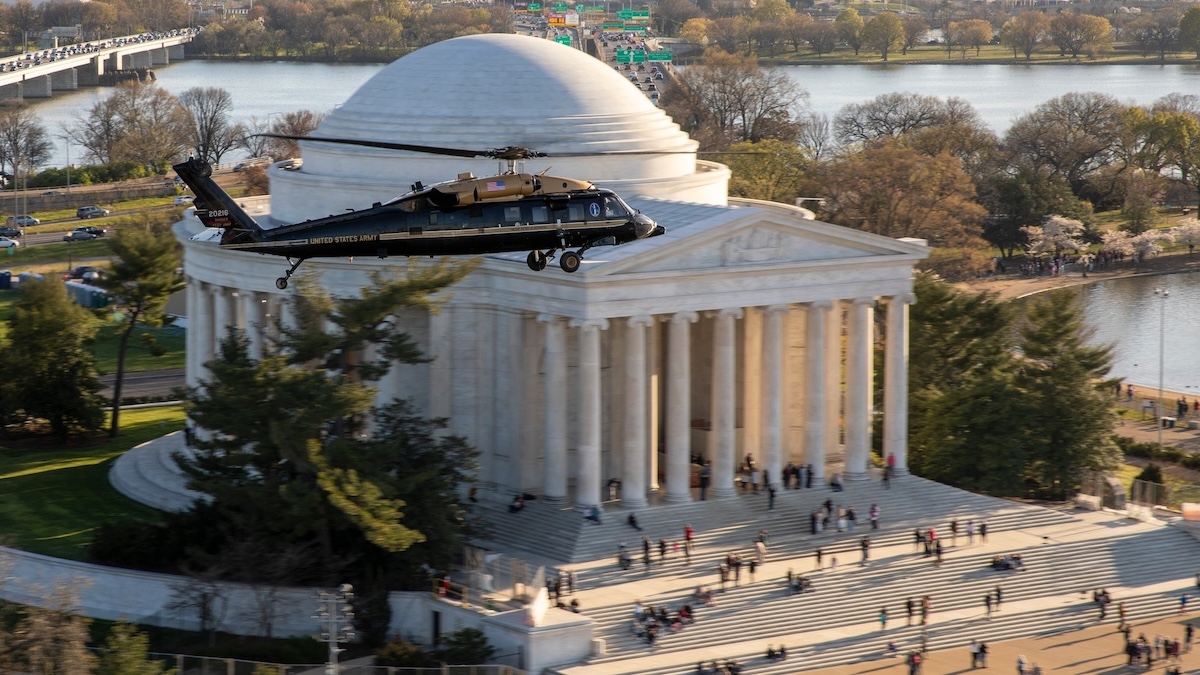
Black Hawk helicopter over Washington
A Black Hawk helicopter over Washington [U.S. Air Force photo by Mr. Nicholas A. Priest]
Gemini Sparkle

Key Takeaways:

  • Following a fatal midair collision a year ago, the FAA is implementing permanent restrictions on certain aircraft types, specifically helicopters and powered lift, around Ronald Reagan Washington National Airport (KDCA).
  • An interim final rule will prohibit helicopter operations near KDCA when runways 15 and 33 are in use, a measure based on National Transportation Safety Board (NTSB) recommendations.
  • These new restrictions are part of ongoing efforts by the FAA and U.S. DOT to enhance air safety in the area, which also include previous measures like closing hazardous helicopter routes and requiring ADS-B Out for military aircraft.
See a mistake? Contact us.

Close to one year after a fatal midair collision between an American Airlines jet and a U.S. Army Black Hawk helicopter in Washington, D.C., the federal government is moving to permanently restrict certain aircraft types from operating around Ronald Reagan Washington National Airport (KDCA).

U.S. Transportation Secretary Sean Duffy announced Thursday that the FAA is formalizing restrictions for helicopters and powered lift aircraft in certain areas near Washington National unless they are conducting essential operations.


The agency is set to publish an interim final rule on Friday that will prohibit helicopter operations when runways 15 and 33 are in use. The rule is based on recommendations from the National Transportation Safety Board (NTSB), which is still reviewing the accident.

“After that horrific night in January, this administration made a promise to do whatever it takes to secure the skies over our nation’s capital and ensure such a tragedy would never happen again. Today’s announcement reaffirms that commitment,” Duffy said in a statement. “The safety of the American people will always be our top priority. I look forward to continuing to collaborate with the NTSB on any additional actions.”

The public is invited to submit comments on the new regulations before the FAA decides on issuing a final rule.

The FAA and U.S. Department of Transportation have already implemented a number of measures meant to reduce mixed military and civilian air traffic around Washington National. These include closing a potentially hazardous helicopter route, requiring military aircraft to use ADS-B Out in the area, and eliminating the use of visual separation within 5 nm of the airport.

In October, the FAA updated helicopter routes and zones at Washington National, Washington Dulles International Airport (KIAD), and Baltimore/Washington International Thurgood Marshall Airport (KBWI) in Maryland.

A total of 67 people on both aircraft were killed in the collision on January 29, 2025. The American Airlines flight, operated by PSA Airlines under the American Eagle brand, was traveling from Wichita, Kansas, and was set to land at Washington National. The Black Hawk was on a nighttime training flight.

The U.S. government has acknowledged its partial responsibility for the crash in court documents in response to lawsuits from family members of the victims. The government contends that American Airlines and PSA Airlines are also at fault.

Zach Vasile

Zach Vasile is a writer and editor covering news in all aspects of aviation. He has reported for and contributed to the Manchester Journal Inquirer, the Hartford Business Journal, the Charlotte Observer, and the Washington Examiner, with his area of focus being the intersection of business and government policy.

Ready to Sell Your Aircraft?

List your airplane on AircraftForSale.com and reach qualified buyers.

List Your Aircraft
AircraftForSale Logo | FLYING Logo
Pilot in aircraft
Sign-up for newsletters & special offers!

Get the latest stories & special offers delivered directly to your inbox.

SUBSCRIBE
