














Embraer’s Eve Begins Electric Air Taxi Flight Tests

Company anticipates certification, first deliveries, and entry into service as soon as 2027.

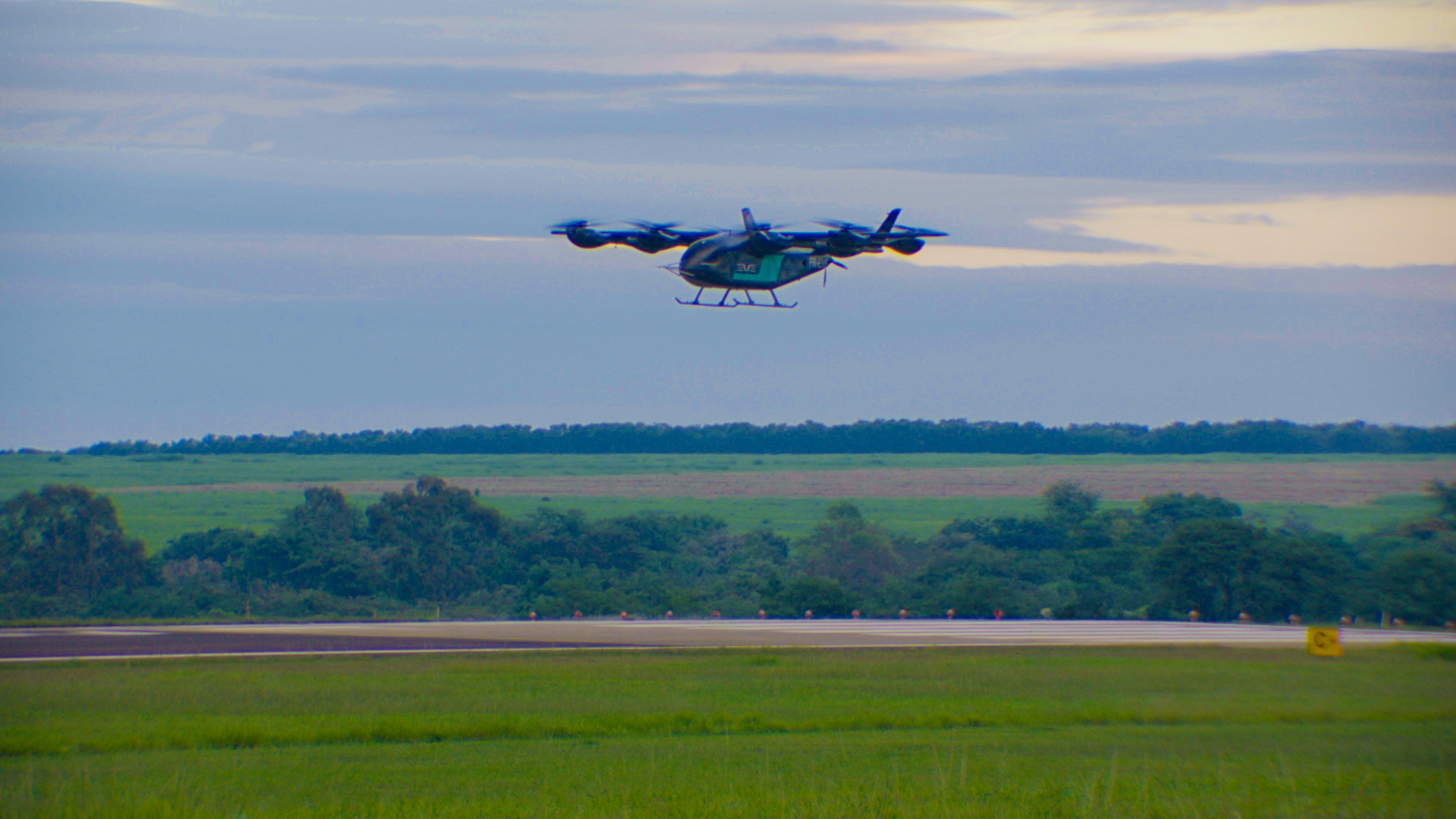
Eve Air Mobility eVTOL air taxi prototype hover flight
Eve Air Mobility’s electric vertical takeoff and landing (eVTOL) air taxi prototype lifts off for the first time. [Credit: Eve Air Mobility]
Gemini Sparkle

Key Takeaways:

  • Eve Air Mobility, Embraer's eVTOL arm, successfully conducted the first uncrewed hover flight of its engineering prototype air taxi.
  • Eve anticipates ANAC type certification, initial customer deliveries, and entry into service by 2027, a timeline aligned with Brazilian regulators.
  • The company employs a "certify to fly, not fly to certify" approach, focusing on extensive ground testing before flight and planning to build six conforming prototypes.
  • Eve's air taxi features eight vertical-lift propellers and a rigid wing, will initially be piloted for four passengers with a 60-mile range, and has accumulated around 2,800 preorders.
See a mistake? Contact us.

Electric vertical takeoff and landing (eVTOL) air taxis are getting closer to reality.

Days after Boeing’s Wisk Aero shared the maiden sortie of its Generation 6 prototype, Eve Air Mobility, the eVTOL aircraft arm of Embraer, announced the first flight of its own air taxi. The uncrewed hover flight of Eve’s “engineering prototype”—a full-scale, nonconforming variant of the model it aims to certify with the FAA, Brazil’s National Civil Aviation Agency (ANAC), and other regulators—lasted about one minute, the company told FLYING.


Luiz Valentini, Eve’s chief technology officer, said at the Paris Air Show that the prototype is remotely piloted and has simpler systems than its production model, “but it’s very representative with respect to the dynamics of flight [and] noise characteristics.” Per an announcement Eve made during the event, first flight was originally scheduled for the summer.

With flight testing now underway, Eve on Friday said it anticipates ANAC type certification, initial customer deliveries, and entry into service by 2027.

Tiago Faierstein, the president of ANAC, told Reuters in September that certifying the air taxi is the regulator’s top priority. He said the agency is operating on the same timeline as Eve—and that certification could come even sooner.

“Let’s work with 2027,” Faierstein said, “but our goal, our desire is to be in 2026.”

Different Approach to Air Taxi Testing

Many of Eve’s eVTOL competitors have been flying nonconforming prototypes for years. But the Embraer subsidiary has opted for a slower, steadier approach.

“Our approach is to ‘certify to fly, not fly to certify,’” Valentini said during the Paris Air Show.

ANAC published final airworthiness criteria for Eve’s design in late 2024, and the company is working toward a means of compliance. Simultaneously, it has been laying the groundwork for a successful flight test campaign.

Before flying, Eve conducted component- and system-level testing on the ground. Testing rigs in Brazil are used to evaluate different parts of the design. The company also completed initial wind tunnel testing, including with some rotors turned off.

Now, it believes it is ready for the real deal.

The maiden hover flight at Eve’s facility in São Paulo captured what CEO Johann Bordais described as “high-fidelity data” on the airframe design, control laws, integrated propulsion system, and vertical lift rotors. It also validated the integration of Embraer’s fifth-generation fly-by-wire system, which Valentini said is already proven on the company’s E2, KC-390, and other models.

“The fact that we have much more maturity on fly-by-wire for cruise flights, we believe that it’s more important for us to focus on vertical flight,” Valentini told FLYING in Paris.

The initial test also assessed the air taxi’s energy management, noise footprint, and “dynamic response,” Eve said. It will conduct further hover flights before expanding the envelope.

“The prototype behaved as predicted by our models,” Valentini said. “With these data points, we will expand the envelope and progress toward transition to wingborne flight in a disciplined manner, ramping up to hundreds of flights throughout 2026 and building the knowledge required for type certification.”

Eve said it will build six conforming prototypes for the flight test campaign.

The company’s all-electric air taxi will be piloted at launch with room for up to four passengers, plus standard carry-on baggage, and a range of about 60 miles. Future variants will be autonomous and carry up to six passengers. Per Eve, the aircraft will have a cost-per-seat six times lower than helicopters.

Unlike Joby Aviation’s S4, Archer Aviation’s Midnight, or Wisk’s Generation 6, Eve’s design lacks tilting propellers and other moving parts. It instead relies on eight four-bladed, vertical-lift propellers and a rigid overhead wing with distributed rotors, no flaps, and a single actuator and aileron on each side.

The air taxi will also utilize an electric pusher propeller powered by dual electric motors from Beta Technologies. Other third-party components include Garmin’s G3000 Integrated Flight Deck; Honeywell’s navigation technology; BAE Systems’ energy storage system; rotors and propellers from DUC Hélices Propellers; and electric propulsion from a joint venture between Embraer and Japan’s Nidec Motor Corp.

Pilots will fly the air taxi using fly-by-wire controls and a four-axis sidestick. They will be trained through a joint venture between Embraer and CAE, which is part of Eve’s TechCare suite of complementary services.

Valentini in Paris said Eve has about 2,800 air taxi preorders, most of which are nonbinding letters of intent (LOI).

The company is working with FBO operator Signature Aviation—which has an extensive U.S. network—to trial its Vector traffic management system and study required ground operations for the integration of its air taxi.

Jack Daleo

Jack is a staff writer covering advanced air mobility, including everything from drones to unmanned aircraft systems to space travel—and a whole lot more. He spent close to two years reporting on drone delivery for FreightWaves, covering the biggest news and developments in the space and connecting with industry executives and experts. Jack is also a basketball aficionado, a frequent traveler and a lover of all things logistics.

Ready to Sell Your Aircraft?

List your airplane on AircraftForSale.com and reach qualified buyers.

List Your Aircraft
AircraftForSale Logo | FLYING Logo
Pilot in aircraft
Sign-up for newsletters & special offers!

Get the latest stories & special offers delivered directly to your inbox.

SUBSCRIBE
