











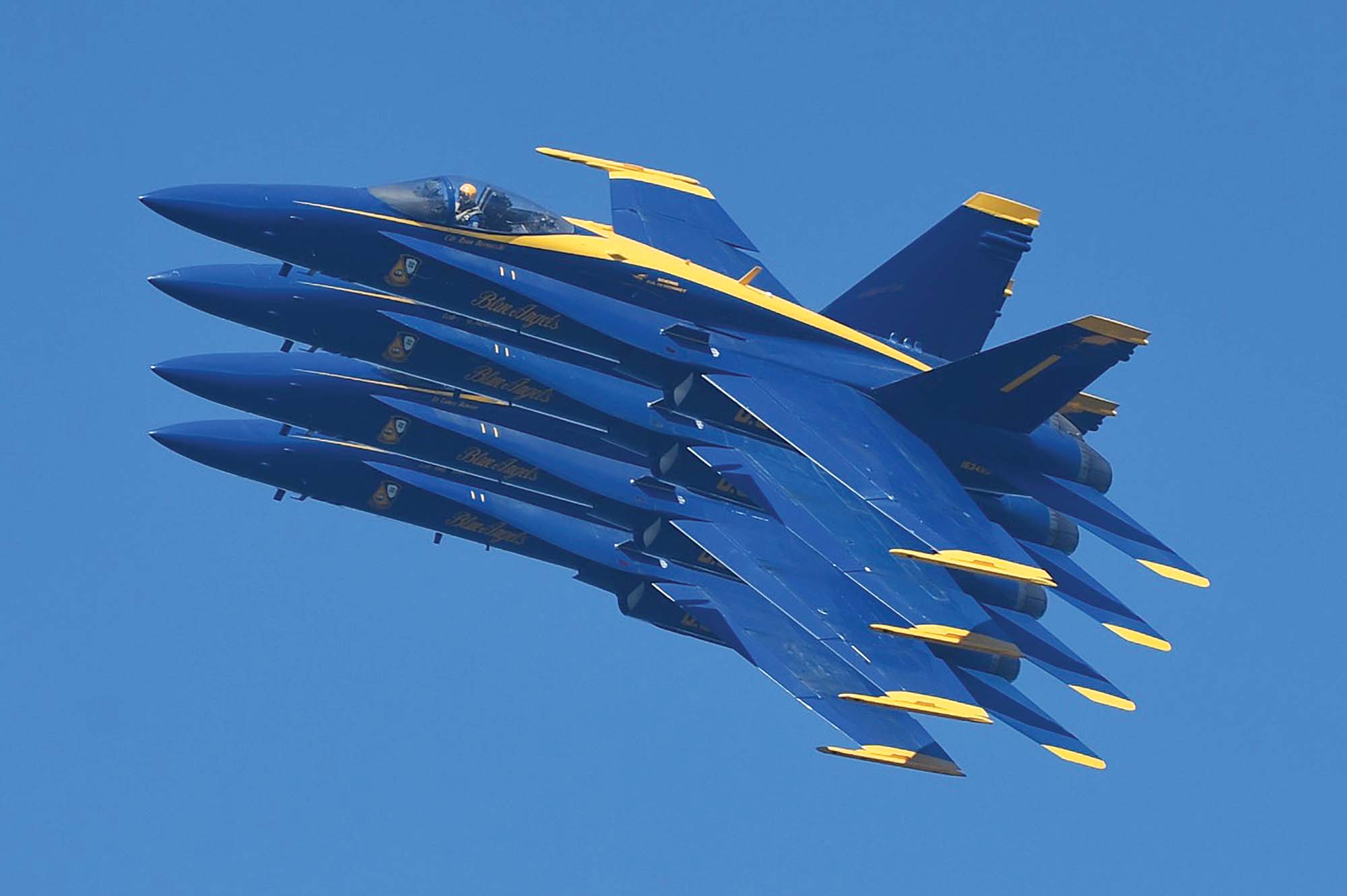


As I watched the U.S. Navy’s Blue Angels flight demonstration team fly a fingertip-formation loop during their recent appearance at the 2024 edition of the Fargo (N.D.) Airsho, it suddenly occurred to me: I used to fly fingertip formation in a T-38 almost daily, and it’s not all that hard with a lot of practice.
I bet parts of the Blue Angels show are easy for them—play, really. Like flying fingertip formation, doing turning rejoins. Maybe when the last guy of the six comes diving down at like 450 knots, nose buried, to rejoin the other five, and then tucking into place in the tight formation. Horseplay for those guys.

It also suddenly occurred to me that the Blue Angels have to constantly practice the “hard” parts of their airshow to be that good. It reminded me of a short video of tennis player Roger Federer I saw one time, where he said he got out on the court every day for five hours and “did the hard yards.”
The “hard yards”—the tight fingertip barrel rolls with smoke, the bombursts or whatever the Blue Angels call their skyrockety-looking vertical split up, the high-speed head-to-head runs over the runway, the down-in-the-dirt high-speed passes in afterburner, the flying in formation inverted. (I know, right?) Arriving over the runway at exactly the same time from four directions at ideally four different altitudes. That stuff, the hard stuff.
I bet that stuff takes practice, practice, practice.
This Is Supposed To Be Easy
Most of us don’t have to practice our flying that much. We’re mostly in cruise flight, which isn’t that hard. Unless you have rapid decompression where you get to finally put on the quick-don mask on “for realsies” and the “rubber jungle” comes out for the pax, or you lose an engine or two or three—or all four, in the case of KLM Flight 867. (Quick joke: A frequent airline passenger was asked why he only flew on four-engine airliners. He responded, “Because there are no five-engine airliners.”)
Thanks in part to my military training, flying my Lancair IV-P normally doesn’t require too much mental effort. I can do overhead patterns, VFR patterns or even a “90-270” pattern, if the winds and tower are calm. But when I have to think—walk and chew gum—those are the “hard parts.” The parts of flying I have to practice.
Like the other day. I flew on an IFR flight plan from Fargo (KFAR) to Crookston, Minn. (KCKN). Mission: practice filing an IFR flight plan from a non-towered airport, shoot instrument approaches. Did I mention weather avoidance and radio calls and changing my flight plan in midair? I will….
En route, I asked for the RNAV (GPS) Rwy 31 approach at Crookston. The controller was pretty busy, what with all the University of North Dakota flight school traffic. (UND’s flight school mascot I think is a locust.)
The ATC guy says, “Lancair 12345, cleared direct AKKIF, cleared the RNAV Runway 31 at Crookston. Traffic in your one, two, three o’clock, four o’clock rock….” I was confused—I wasn’t mentally ready to be cleared to that fix, AKKIF. It’s there, all right, on the approach plate as an IAF, but I was looking at the bold-print fixes FAPVU and EHOBI.
So I queried the controller to spell AKKIF, and he did. Then I asked for an initial vector to AKKIF, because I was trying to type AKKIF into the flight plan with both hands and my nose as the screen playfully bounced along with the aircraft. I didn’t want to keep flying on my current heading if AKKIF didn’t just happen to be in line with where I was flying. The controller chirped, “Sorry, I don’t have radar.” I finally programmed the avionics correctly, and was able to fly the soothing magenta line toward what turned out to be, go figure, an IAF for the approach. One small step for man, one giant smack upside my head with my throttle hand.
Self-Awareness 101
Then I caught myself before I self-immolated and realized this is why I’m practicing. Even though I don’t get cleared to a fix that’s not in my flight plan very often, I should familiarize myself with what’s written on the approach plate. Who knew?
After the approach, instead of going IFR directly back to Fargo, I sallied forth across the “Land Of Ten Thousand Lakes.” There, nestled in lake country, is Brainerd, Minn. (KBRD), home, as everyone knows, of Paul Bunyan. So I land in Brainerd, a non-towered airport, and for practice, file IFR outta there to Park Rapids, Minn. (KPKD).
In this modern day, with all the technology—satellites, cell phones, iPads, 5G, ForeFlight and magenta lines—filing IFR out of a non-towered airport is simple, if by “simple” a person means “not simple.”
Idling on the ramp, I file an IFR flight plan on my iPad via ForeFlight, and then call Minneapolis Center using the telephone number listed in ForeFlight. Someone tells me to use the radio to call for clearance. So then I do that, using 132.15, which I look up on a plate, since they didn’t give me a freq on the phone, and why would they, the big-city folks talking to little old me in the forest with Paul Bunyan? I copy a clearance, which involves a little more craftiness than “C.R.A.F.T.,” I noticed, because they also want to know which runway I’m using when I’m taking off.
Then ATC spews out something like: “Lancair 12345, cleared to Park Rapids as filed, climb and maintain four thousand feet, expect seven thousand feet in ten minutes. Contact Minneapolis Center on this frequency when entering controlled airspace, squawk 4621. Cleared for release; clearance void if not off by 1455 Zulu; time now 1445 Zulu. If not off by 1505 Zulu, advise no later than 1520 Zulu.”
Copying this down and reading it back is super-simple. Easy for you, maybe, but getting an IFR clearance out of a non-towered airport is definitely something I need to practice more.
So I read back all 500 words, take off and fly…right into a thunderstorm. Almost. “Lancair 12345 requesting deviation for weather.” The frequency was so busy that ATC said, “Lancair 246HU, cleared deviation right or left for weather,” and then went on machine-gun-speaking to some Citation jock who took off ahead of me VFR out of Brainerd, all cocky and happy, thinking he’d pick up an IFR clearance if he needed one.
And guess who needed one—him. He flew right toward the same “extreme precip in your twelve o’clock” as me and was filing IFR airborne in a much higher voice than the jocular tone he used on takeoff, since he was approaching the solid wall of clouds on the double.
While the ATC guy tried to keep the now-soprano-singing Citation dude out of the weather or clear him through it, I flew merrily along right toward it—the cloud mass was too big to go around, and too tall to get over, me without jet engines and all. Black, blue and gray the wall was, with your basic terrifying lightning—I felt the hair on the back of my neck stand right the heck up. Anyone who’s flown close to a massive thunderstorm knows what I mean. Real, no-kidding fear.
Now I’m getting closer, closer, and the clouds are now on what looks like three sides of me—I see no way at all to pick my way through. I key the mic and say, “Lancair 12345, I would like to do a one-eighty right now to avoid weather.” I continued straight ahead, waiting for clearance. The controller said, “Lancair 12345, understand you’d like to do a one-eighty turn?” But now I had to turn, and as I roll into a monster bank, pull and add power, I said, “Affirmative, turning now, one-eighty for weather.”
The ATC guy said, “Okay, Lancair 12345, where would you like to go instead of Park Rapids?” I keyed the mic button, which I noticed was wet with someone’s sweat, and said, “I wanna go to Fargo; there’s no place like home, there’s no place like home,” in a voice that sounded like Dorothy in The Wizard of Oz. Not really.
Debrief
Later, I spoke to a seasoned charter pilot and told him my story—about how I was on an IFR flight plan and almost flew into a thunderstorm because the radio was so busy I couldn’t get a word in edgewise to ask for a new clearance, and suddenly I was surrounded on three sides by thunderstorms, lions and tigers and bears, oh my, and had to turn tail and skedaddle, and how the Wicked Witch of ATC got snippy, etc.
The grizzled old 45-year old nodded his head soberly in complete understanding, didn’t ridicule me at all, outwardly. He said, “I just turn.”
Then he said, “I request an avoidance vector well in advance of the cell—or look at ForeFlight and file a flight plan around the bad weather.” He reminded me that flying well wide of a cell doesn’t take that much extra time, versus flying fairly close and then having to deviate around the weather anyway.
I said, “There sure were a lot of cells today.” He said, “Always, Dorothy, always.”
Anyway, I got to practice some stuff in a one-hour or so period of two flights that was “hard” for me—the “hard yards.” I got to practice weather avoidance, changing a clearance on the fly, making radio calls, flying approaches and getting an IFR clearance out of a towered and non-towered airport. Oh, and landings.
