













Register

Danger Below MDA?

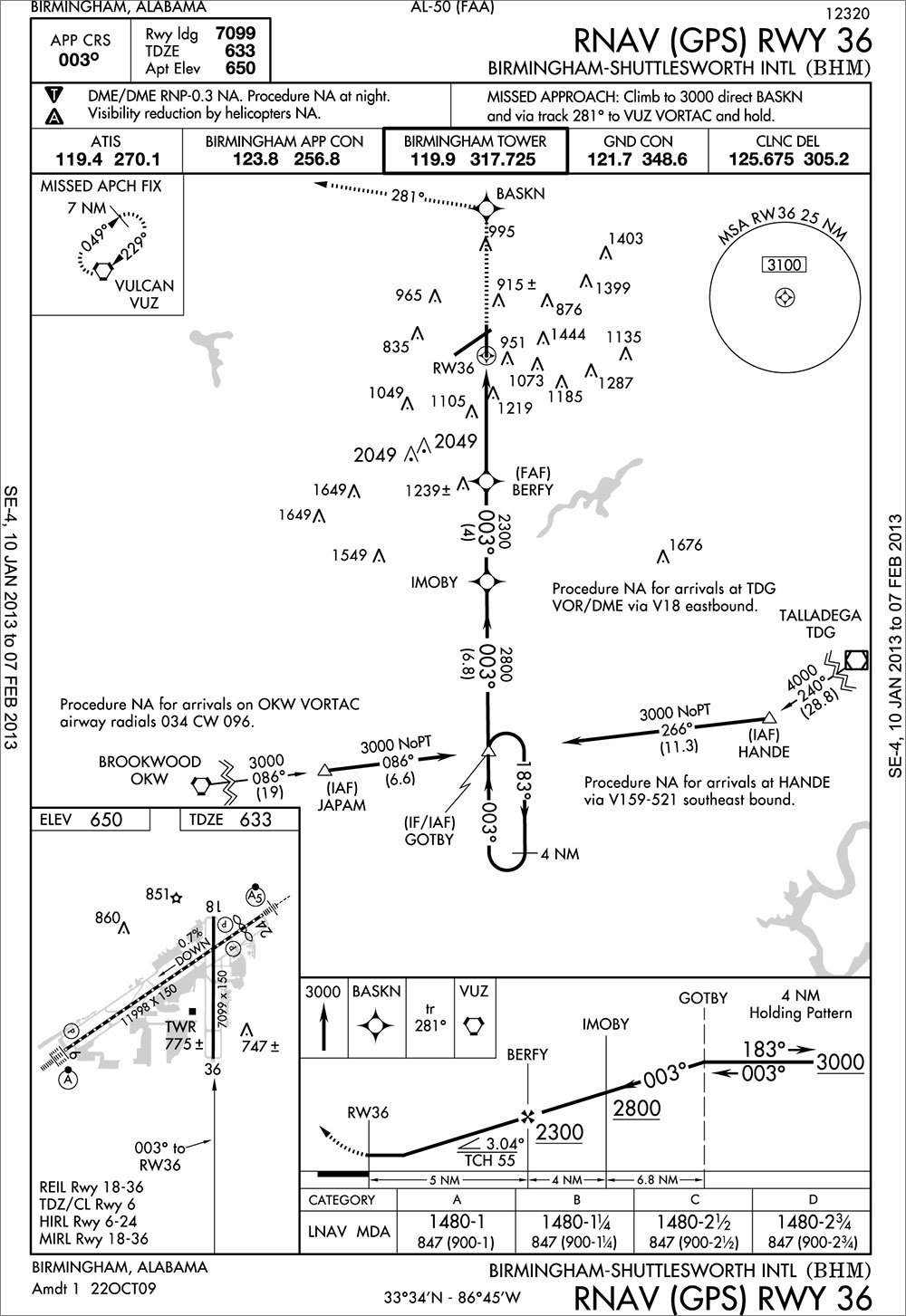
Recently, an airline began to receive notices that crews flying the RNAV (GPS) RWY 36 approach into Birmingham, Alabama (BHM) were receiving GPWS alerts while descending from the MDA to the runway. Since it wasnt an isolated incident, the airline suspected that the approach was flawed and notified the FAA, who flight checked the approach. The results of that inspection are educational to instrument-flying pilots at all levels.

Gemini Sparkle

Key Takeaways:

  • Pilots were incorrectly extending advisory Vertical Descent Angles (VDAs) below the Minimum Descent Altitude (MDA) on non-precision approaches, leading to GPWS alerts due to a lack of obstacle protection in this segment.
  • Unlike precision approaches (ILS/LPV) which offer obstacle protection from decision altitude to the runway, non-precision approaches (LNAV) provide no such protection between the MDA and the runway threshold, rendering the VDA advisory *only* to the MDA.
  • When descending below the MDA on a non-precision approach, pilots are solely responsible for visual obstacle avoidance, and continuing to follow the advisory VDA or relying on limited clues like VDPs does not guarantee obstacle clearance to the runway.
See a mistake? Contact us.

Recently, an airline began to receive notices that crews flying the RNAV (GPS) RWY 36 approach into Birmingham, Alabama (BHM) were receiving GPWS alerts while descending from the MDA to the runway. Since it wasn’t an isolated incident, the airline suspected that the approach was flawed and notified the FAA, who flight checked the approach. The results of that inspection are educational to instrument-flying pilots at all levels.

Ready to Sell Your Aircraft?

List your airplane on AircraftForSale.com and reach qualified buyers.

List Your Aircraft
AircraftForSale Logo | FLYING Logo
Pilot in aircraft
Sign-up for newsletters & special offers!

Get the latest stories & special offers delivered directly to your inbox.

SUBSCRIBE