











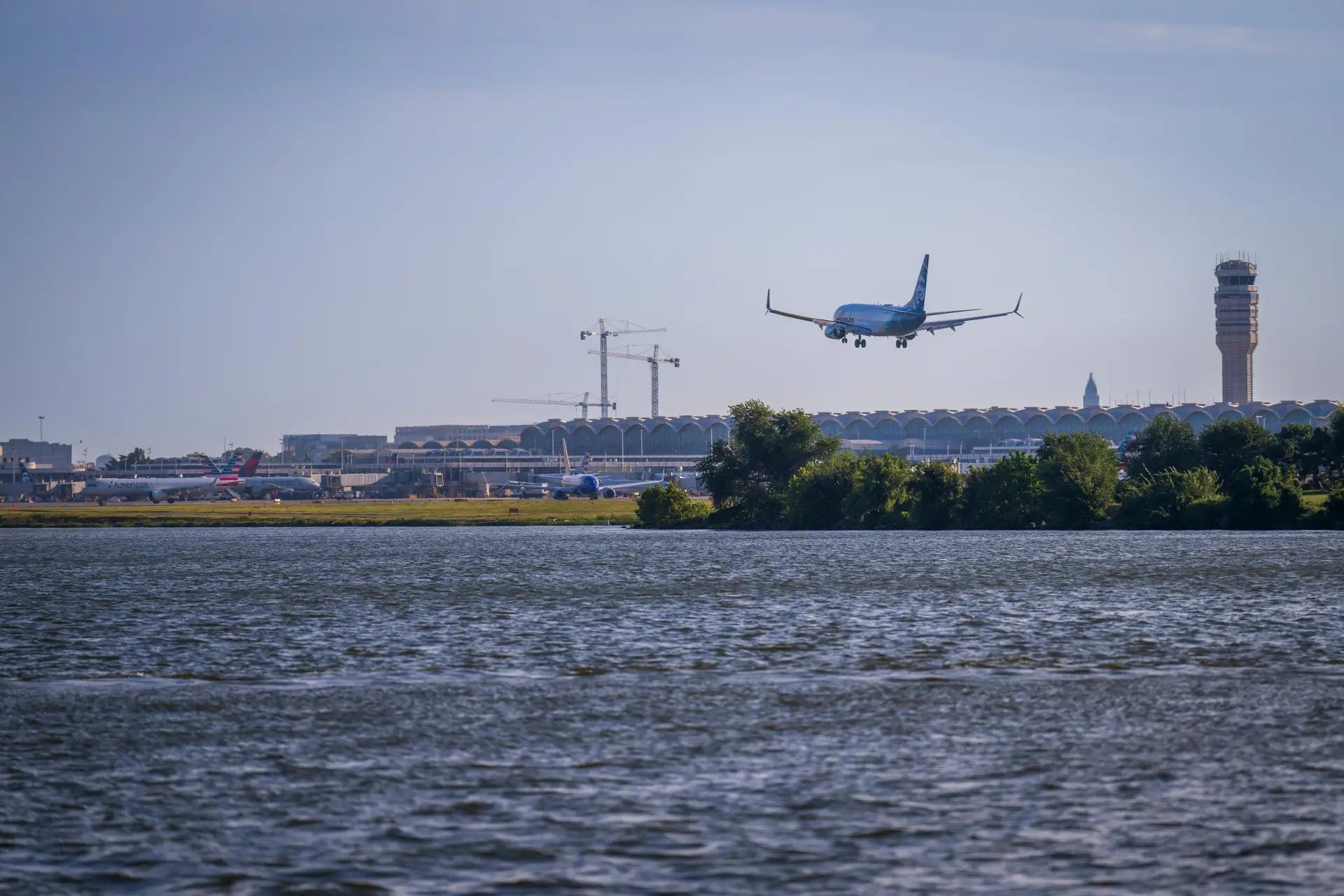


I spent three full days listening to the National Transportation Safety Board hearings into the midair collision of an Army Black Hawk helicopter and a regional jet over the Potomac that killed 67 people. There was over 30 hours of testimony, with the final day wrapping up at 10 p.m..
I then pulled the most interesting audio clips from each day and posted them on my new NTSB News Talk podcast that I cohost.
If you're not already a subscriber, what are you waiting for? Subscribe today to get the issue as soon as it is released in either Print or Digital formats.
Subscribe NowAfter listening to the testimony, one thing was clear. The accident wasn’t just caused by the mistakes of a couple of people on that night. It was a system failure hiding in plain sight. It was the proverbial accident waiting to happen. And, sadly, it did.
The hearing highlighted numerous issues, some visible and some invisible, that different organizations had failed to address over many years. A visible issue was that recommendations to lower the arrival rates into Ronald Reagan Washington National Airport’s (KDCA) airspace, weren’t acted upon.
In one case, a manager said it was “not a good time” to bring that up, as an FAA reauthorization bill was pending at the time. No record was found of that safety-related recommendation making it higher up the management chain, despite FAA policy requiring that safety issues be escalated.
An invisible issue was that seven of eight Lima-version Black Hawk helicopters in the U.S. Army’s 12th Battalion were incapable of transmitting ADS-B Out signals, apparently due to the incorrect entry of a timing parameter in the aircraft software. Another issue was that Sikorsky didn’t document in the Black Hawk’s pilot operating manual that when in flight altimeter altitudes displayed were less accurate because of rotor downwash.
In an NTSB test of three of the 12th Battalion’s helicopters, the altitudes in flight were off by as much as 80-130 feet. That rarely matters in a flight environment where Army aviators are looking outside most of the time to separate themselves from terrain and other aircraft. But it mattered a lot when flying at night on a helicopter route that was as little as 75 feet below the arrival path to KDCA’s Runway 33. In hindsight, everyone agrees that it was unsafe to have a helicopter route that close to the arrival corridor.


motion and shows where the traffic will pass relative to your aircraft.
A key factor often discussed before the hearing was that the helicopter was not transmitting ADS-B Out on the night of the accident. One of the 12th Battalion’s missions is continuance of government, meaning it may someday need to spirit away the country’s leaders and move them to a safe location.
To protect the secrecy of those locations, the helicopters don’t transmit their position during training flights. Though if they had turned on ADS-B Out for that flight, it wouldn’t have worked because of the software errors the NTSB investigation found.
Interestingly, the traffic system in the Bombardier CRJ700 regional jet lacked ADS-B In capability. In fact, one witness testified that ADS-B In receivers aren’t available for the CRJ700.
That’s not to say that the airliner’s traffic system wouldn’t see an aircraft broadcasting ADS-B Out. FAA ground stations receive ADS-B Out signals transmitted by aircraft, and that traffic information is uploaded to other aircraft via approach radar systems equipped with Mode-S capability. So, with or without ADS-B, the airliner would still have seen a white diamond, representing the helicopter, on its traffic display.
There was testimony to the effect that since the helicopter was close to the approach radar site, its position would be determined fairly accurately and hence the fact it was not broadcasting ADS-B Out wasn’t a factor in the accident. While technically accurate, that didn’t go far enough in explaining that full use of ADS-B In and Out by both the helicopter and airliner would have almost certainly prevented the accident.
While it’s true that the position of the white diamond on the CRJ’s traffic screen may have been accurate, its display lacked many of the capabilities I rely upon heavily when I fly. And those capabilities would have made the pilots more aware of an impending collision.
I’m lucky to be teaching mostly in late model aircraft equipped with the Garmin G1000 and in Cirrus Vision Jets with the Garmin 3000. Much of my flying is in dense urban areas with high volumes of traffic, and in those areas, I always have the dedicated traffic page displayed, so I can accurately determine the distance and bearings to other traffic. I also see aircraft ground speeds, which is helpful when flying in a traffic pattern behind slower aircraft.
There’s an invaluable feature Garmin calls “Relative Traffic” that tells me immediately and unambiguously if I’m on a collision course with another aircraft. Yet when I fly with other pilots and even CFIs, most of them are unfamiliar with the feature and aren’t using it.
Some traffic systems, such as the one used in the CRJ700, depict traffic as white diamonds with no motion vectors showing an aircraft’s direction. With these displays, you must stare at the diamond to figure out where it’s moving over time. This requires looking inside the cockpit for far too long, and you’re still left with just a vague notion of whether you’re on a collision course.
In the aircraft I fly, on the “Traffic” page, there’s a softkey labeled “Motion,” which lets you select “absolute” or “relative” motion. Absolute motion adds a white vector to traffic symbols that shows you where that aircraft is pointed. Relative motion, which I always use, adds a green vector to traffic symbols that takes into consideration the speed and direction of traffic relative to your aircraft. It essentially shows where the traffic will pass relative to your aircraft.
For example, a slow aircraft at 2 o’clock might show a white absolute vector that will pass in front of you. But when you select the green relative vector, you can instantly see that the aircraft will pass behind you. Whenever a green relative vector crosses your aircraft symbol, you are on a collision course with that aircraft.
At one point during the hearing, someone testified that to date no ADS-B In-equipped aircraft has been in a midair collision. Had the helicopter and CRJ700 both had ADS-B In and Out, this accident might have been avoided. If you don’t have ADS-B In, consider getting it.
This column first appeared in the October Issue 963 of the FLYING print edition.

