












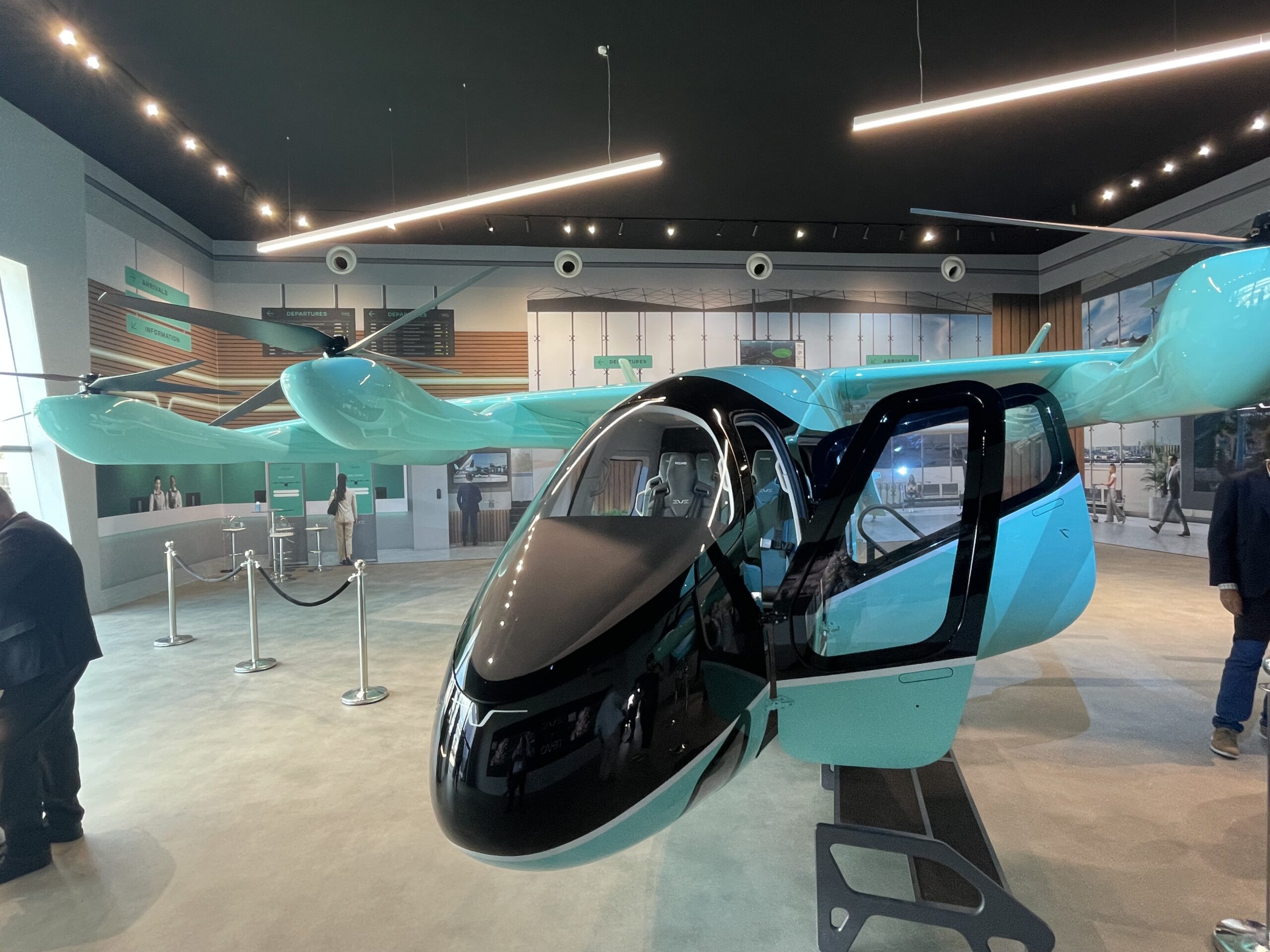


PARIS—Spun out of Embraer in 2020, electric vertical takeoff and landing (eVTOL) air taxi developer Eve Air Mobility is younger than competitors like Archer Aviation, Joby Aviation, Beta Technologies, and Boeing’s Wisk Aero. Unlike Eve, each of those companies have flown eVTOL prototypes. But Luiz Valentini, chief technology officer of the Brazilian company, told FLYING it is unfazed.
“[Ours is] not a process focused on flying as early as possible,” Valentini said. “It’s a process focused on advancing with the right maturity level at each time in the project.”

Valentini said Eve has about 2,800 orders for its flagship model. The vast majority of these are nonbinding letters of intent (LOIs). But “these orders, even at the stage of LOI, they help us connect in a very meaningful way with potential operators,” such as understanding their use cases and market characteristics, Valentini said.
“It’s very, very important for us to bring that information into the vehicle development, and we’re very fortunate to have that strong of a connection early on,” he said.
The developer’s steady approach is beginning to pay off. On Wednesday at the Paris Air Show, Eve announced an LOI for up to 54 aircraft from Future Flight Global, which CEO Karan Singh said it hopes to fly in Brazil and the U.S. “in the near future.”
Earlier in the week, Eve announced an order of up to 50 aircraft from Brazil’s Revo and parent company Helicopters International (OHI)—its first binding agreement. The deal also covers entry into service and aftermarket services, provided through Eve’s TechCare offering. It “marks Eve’s transition from development to execution,” the firm said.
Valentini told FLYING that Eve prefers to build the air taxi’s maturity before moving to conforming prototype flights. A key piece of that philosophy is its relationship with parent company Embraer.
For example, Eve’s design will use fly-by-wire controls that have been proven on the E2, KC-390, and other Embraer models.
“The fact that we have much more maturity on fly-by-wire for cruise flights, we believe that it’s more important for us to focus on vertical flight,” said Valentini.
He added that the former is following the latter’s development process: “More or less the same milestones, the same phases of design, which have been proven over the years by Embraer to be very successful in developing their aircraft.”
Crucially, Embraer also has a relationship with the FAA, with which Eve plans to validate its design after type certifying with Brazil’s aviation regulator (ANAC). Valentini said ANAC has a provision similar to the FAA’s powered-lift SFAR, which it is using to hone its operational and pilot training plans.
“There are some important differences with respect to reserves—energy reserves, for example,” he said. “There are some differences in pilot training that are important and that we are still discussing with authorities to strike the right balance between regulation and flexibility.”
Another benefit of Eve’s steady approach, Valentini said, is that it gives time for the FAA and ANAC to finalize these rules.
The Vision
Eve is selling its air taxi to global, regional, and urban operators. The latter are the company’s primary focus, Valentini said.
“One important one would be going from an airport to downtown,” he said. “Those are missions that usually span maybe 20-30 kilometers…and our vehicle is capable of flying up to 100 kilometers. That gives us flexibility not only to do long missions, but also to do these short missions.”
Revo, for example, will be Eve’s launch operator in São Paulo. The operator integrates its scheduled helicopter service with car and luggage services, creating an option that gets passengers where they need to go in the fraction of the time of a car.
“We see in some cities in the U.S.—for example, New York, where there’s a lot of sensitivity to the noise—that we can perform these flights with much less impact on the urban communities.”
Beyond urban flights, Eve is targeting aerial sightseeing or tourism missions that are typically flown by helicopters.
With its first binding order secured, the next step will be testing. Eve has already put the aircraft in a wind tunnel, turning rotors off to simulate cruise flight or on to mirror transition flight. It has testing rigs in Brazil to evaluate different parts of the aircraft, including a truck-based rig.
“That allows us to have a setup that represents a boom with rotors,” Valentini explained. “And as the truck runs forward and we run the rotors, we can see aerodynamic characteristics, loads, vibrations, things like that.”
The Eve chief said the company is working toward the first test flight of an “engineering prototype” this summer. The model is remotely piloted and has simplified systems, “but it’s very representative with respect to the dynamics of flight [and] noise characteristics.”
If all goes to plan, Eve expects to make its first delivery to Revo in late 2027.
Like this story? We think you’ll also like the Future of FLYING newsletter sent every Thursday afternoon. Sign up now.

