












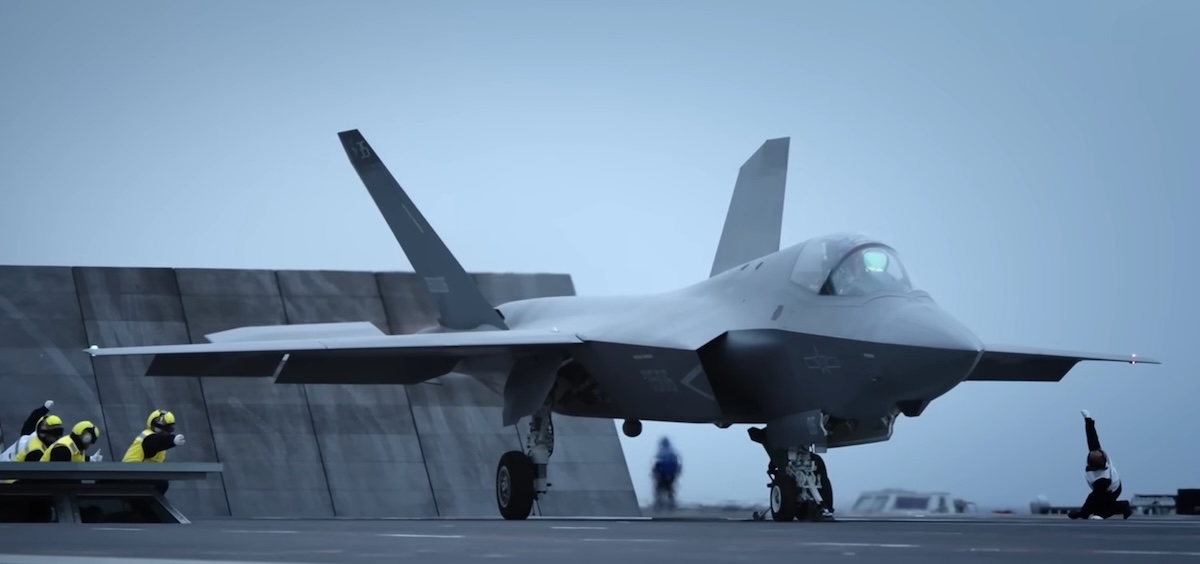


China’s new carrier-capable stealth fighter, the Shenyang J-35, is being touted as having a radar cross section (RCS) “smaller than a human palm.” The Global Times reported that state broadcaster CCTV credited the aircraft’s shaping and domestically developed metamaterial coatings as the primary contributors to this reduced radar visibility.
The same report quoted aerospace analyst Wang Ya’nan, chief editor of Aerospace Knowledge, who described the palm-sized RCS as “very small” for a fighter of this class. The disclosure followed a statement from the People’s Liberation Army Navy (PLAN) that the Type 003 carrier Fujian had completed electromagnetic catapult launches and arrested landings with the J-15T, KJ-600, and J-35.

Background details show the J-35 is a Navy development of the FC-31 demonstrator, featuring folding wings and catapult launch gear. Chinese state media added that the aircraft’s stealth performance is further enhanced by specially engineered coatings designed to absorb or deflect radar energy, the Global Times noted.
Regional observers have compared the claims to other stealth aircraft. The South China Morning Post reported that analysts estimate the implied RCS could be in the range of 10-100 square centimeters, close to the United States’ F-35, which is often cited as having a frontal RCS of about 15 square centimeters—roughly the size of a golf ball.

Additional reporting by digital media outlet Defence Security Asia highlighted that such a radar profile would allow the J-35 to approach air defense systems more closely before detection. The outlet also noted that internal weapons bays enable stealthier loadouts in line with fifth-generation fighter design.
The Global Times further stated that the aircraft has a maximum takeoff weight of nearly 30 tons and is powered by twin domestically developed engines.
Still, questions remain about actual performance. Reuters described the fighter as a “black box” to outside defense analysts, with limited independent verification of its capabilities despite recent carrier flight trials.

