












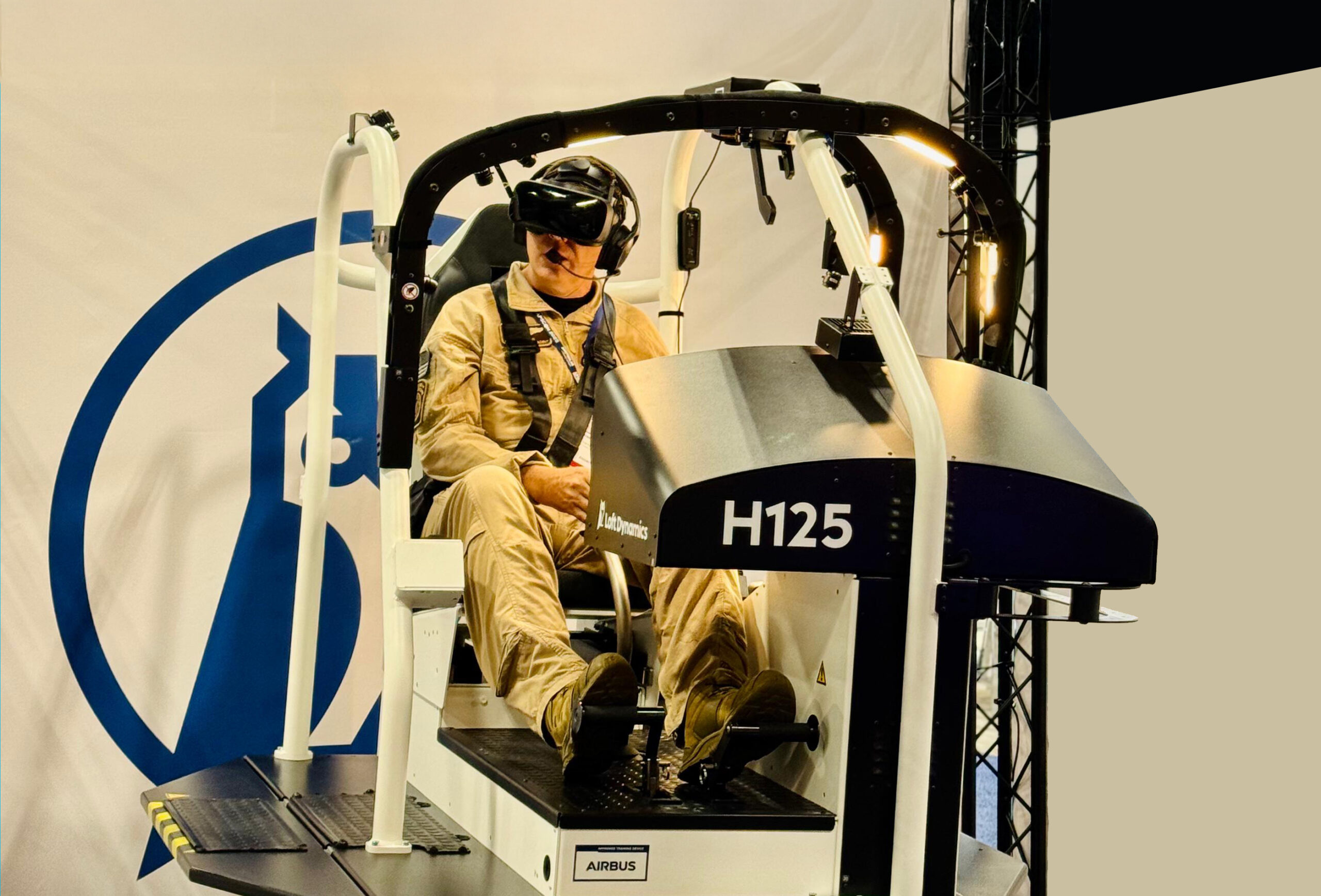


Customs and Border Protection (CBP) will be the first U.S. federal law enforcement agency and first branch of the Homeland Security Department to train pilots using virtual reality (VR) flight simulators.
On Wednesday, Swiss VR flight simulation training device (FSTD) provider Loft Dynamics announced that CBP’s Air and Marine Operations (AMO) unit awarded a contract to its partner, Davenport Aviation, for delivery of Loft’s Airbus H125 simulator—the first of its kind to be qualified by both the FAA and European Union Aviation Safety Agency (EASA).

Per Loft, AMO operates the world’s largest fleet of law enforcement aircraft, including more than 100 H125s. Davenport will install the company’s simulator at AMO’s air training center in Oklahoma City. Per USASpending, CBP paid the aerospace contractor close to $2 million. Since 2018, it has awarded almost $230 million for Davenport’s delivery of light enforcement helicopters, tailored by Airbus for border protection.
The Los Angeles Police Department’s Air Support Division was the first U.S. law enforcement agency to conduct VR pilot training, installing Loft’s H125 simulator for its 50 pilots in March. Now, the technology is being adopted at the federal level.
“CBP’s use of immersive simulation signals a broader paradigm shift in how aviation and public safety organizations prepare their teams for complex real-world missions,” Loft said in a news release.
How CBP Could Use VR
CBP operates more than 240 aircraft, including Beechcraft King Air and Super King Airs, Lockheed Martin P-3s, Cessna C-206/210s, Pilatus PC-12s, and General Atomics MQ-9 Predator Bs.
It also flies the UH-60 Black Hawk and H125, which launches from off-airport sites to surveil metropolitan areas. The helicopter has a top speed of 135 knots, range of 360 nm, and flight endurance of three hours. It is flown by a pilot and sensor operator and comes equipped with an infrared detection system, electro-optical and infrared cameras, and compatibility with night vision goggles.
According to Loft, which opened its first U.S. hub at California’s Santa Monica Airport (KSMO) in 2024, CBP pilots rely entirely on live helicopter flights for training. As a result, they may encounter inclement weather conditions, unavailable instructors, or risk from practicing maneuvers in the sky.
The company says its FSTDs offer a cheaper, smaller alternative that allow pilots to recreate real-world scenarios in a risk-free environment. It has developed VR simulators for the H125 and H145 in collaboration with Airbus, as well as for Robinson’s R22.
Like the H125 itself, Loft’s simulator is compatible with night vision goggles and can be used to assess reactions to anomalies such as engine failure, allowing pilots to perform proficiency checks, receive training credits, and obtain type or instrument ratings—all without risking a training accident. It is qualified by the FAA as a Level 7 flight training device (FTD). The system is about 12 times smaller than a traditional simulator, requiring only about 20 square meters of space for training.
The simulator’s full-scale replica cockpit includes original components and reproduced buttons, switches, levers, and touch panels. It comes in two configurations—one with a traditional instrument panel and Garmin’s GTN650 navigator, and another featuring a glass cockpit equipped with G500H TXi and GTN650 avionics.
Pilots experience simulated forces and real haptics, including vibrations, force feedback controls, and six degrees of motion. A VR headset allows them to step into a 360-degree, high-definition, panoramic virtual world, with views inside and outside the aircraft. The system even creates a digital avatar of the pilot, enabling tracking of hand and body movements. A virtual demonstration mode allows instructors to record and replay lessons.
Loft garnered early interest from the FAA, which installed its H125 and R22 simulators at the William J. Hughes Technical Center in New Jersey for evaluation and vertical flight safety research in 2023. About one year later, it awarded the company the first VR FSTD qualification in the U.S.
In May, Airbus became the first OEM to receive approval from a regulator—France’s Directorate General for Civil Aviation—for a VR-based type rating training program. The manufacturer has installed a Loft H125 simulator at its training center in Marignane, France. And there could be more to come.
Alaska Airlines, a Loft investor, is expected to be the company’s first fixed-wing customer. The airline is helping it to develop the first VR simulator for the Boeing 737. Loft in April said it would submit the technology for FAA approval “likely in the next few years.” It is also developing a system for the Airbus A320.
Like the H125 simulator, those fixed-wing VR systems will need to be qualified before they are widely adopted. In the interim, Loft and Alaska said they are exploring “training enhancement opportunities for pilots that would function as a supplement to existing FAA-required training.”
Correction: Loft Dynamics’ H125 simulator is certified to FTD Level 7, rather than FTD Level 3 as a previous version of this story stated.


