














Boeing X-37B Autonomous Spaceplane Will Return to Orbit in August

Reusable craft has flown 1.3 billion miles across seven missions spanning more than 4,200 days in space.

Boeing U.S. Space Force X-37b spaceplane
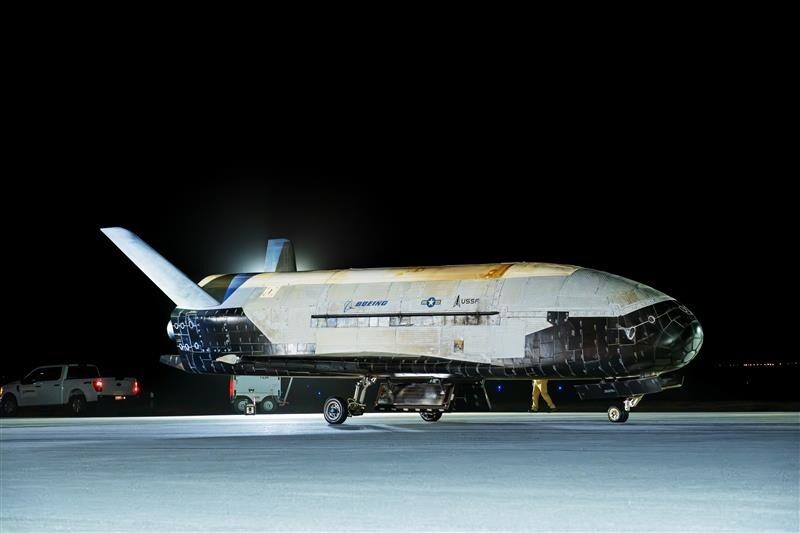
Boeing’s X-37B spaceplane lands at Vandenberg Space Force Base in California after completing its seventh mission in March. [Courtesy: U.S. Space Force]
Gemini Sparkle

Key Takeaways:

  • Boeing's X-37B spaceplane is scheduled for its eighth mission, OTV-8, on August 21, launching less than six months after its previous 434-day orbital stint.
  • As the world's only autonomous, reusable spaceplane, OTV-8 will conduct classified experiments, including a laser communication demonstration and testing a high-performing quantum inertial sensor for enhanced navigation and communication.
  • This mission continues the X-37B's successful track record of long-duration flights and testing cutting-edge technologies, highlighting its role in advancing U.S. space capabilities despite recent challenges in other Boeing space projects.
See a mistake? Contact us.

Boeing’s experimental X-37B orbital test vehicle (OTV) could fly again in August, less than six months after completing a 434-day orbital stint in March.

The aerospace titan and U.S. Space Force on Tuesday said the spacecraft’s eighth mission, OTV-8, is scheduled to launch on August 21 from Boeing’s facility at Kennedy Space Center in Florida. The X-37B is the world’s only autonomous, reusable spaceplane, designed for long-duration testing of technologies—often classified—in orbit.


A SpaceX Falcon 9 rocket will handle the launch, conducted in partnership with the Space Force and U.S. Air Force Rapid Capabilities Office. The Air Force Research Laboratory and Defense Innovation Unit will supply the mission’s experiments, including a demonstration of laser communication between satellites.

“It will strengthen the resilience, reliability, adaptability, and data transport speeds of our satellite communications architectures,” General Chance Saltzman, chief of space operations for the Space Force, said of the laser demonstration in a statement shared by Boeing.

Another OTV-8 payload is described as the “highest performing quantum inertial sensor ever tested in space.” The sensor enables precise navigation in GPS-denied orbit and could even facilitate communications in cislunar space.

Mixed Bag for Boeing Space

Boeing’s Space unit received plenty of negative publicity for its recent Starliner debacle. The autonomous, reusable spacecraft flew back from the International Space Station (ISS) without crew after suffering multiple on-orbit anomalies, forcing a pair of NASA astronauts to extend their ISS stay from eight days to nearly nine months. There is no firm time frame for Starliner’s next test flight, which NASA has said may be an uncrewed cargo mission.

So far, though, the X-37B has been a winner. Across seven missions spanning more than 4,200 days in space, a pair of them have flown over 1.3 billion orbital miles. The longest, OTV-6, lasted 908 days. The most recent landed in March after more than one year on orbit.

The X-37B’s inaugural mission completed the first autonomous orbital landing onto a runway in U.S. history. That unique capability allows it to return hardware to Earth for analysis. The spaceplane makes runway landings at Kennedy in Florida and Vandenberg Space Force Base (KVBG) in California.

It is also designed for advanced orbital maneuvers such as aerobraking, which involves flying through Earth’s atmosphere at the lowest point in an orbit. This increases drag on the spaceplane, allowing it to quickly alter its trajectory without wasting fuel.

Boeing designed and built the X-37B, which is operated jointly by the Space Force and Rapid Capabilities Office. Its payloads are often highly secretive. Past missions, though, have flown experiments designed by NASA and the Space Force to study the effects of space conditions like radiation or test state-of-the-art technology. OTV-6, for example, launched the Air Force Academy’s FalconSAT-8, which carried five experimental payloads.

Like the previous two missions, the X-37B on OTV-8 will fly with a service module designed to increase its payload capacity. It will be the first to launch on Falcon 9’s Block 5 configuration.

“With each successive flight, the X-37B has demonstrated adaptability and flexibility by hosting diverse experiments and pioneering new orbital regimes,” Michelle Parker, vice president of Boeing Space Mission Systems, said in a statement. “This mission continues that legacy by fielding cutting-edge technologies that advance our nation’s space capability and improve the resilience of future architectures.”

Like this story? We think you’ll also like the Future of FLYING newsletter sent every Thursday afternoon. Sign up now.

Jack Daleo

Jack is a staff writer covering advanced air mobility, including everything from drones to unmanned aircraft systems to space travel—and a whole lot more. He spent close to two years reporting on drone delivery for FreightWaves, covering the biggest news and developments in the space and connecting with industry executives and experts. Jack is also a basketball aficionado, a frequent traveler and a lover of all things logistics.

Ready to Sell Your Aircraft?

List your airplane on AircraftForSale.com and reach qualified buyers.

List Your Aircraft
AircraftForSale Logo | FLYING Logo
Pilot in aircraft
Sign-up for newsletters & special offers!

Get the latest stories & special offers delivered directly to your inbox.

SUBSCRIBE
