












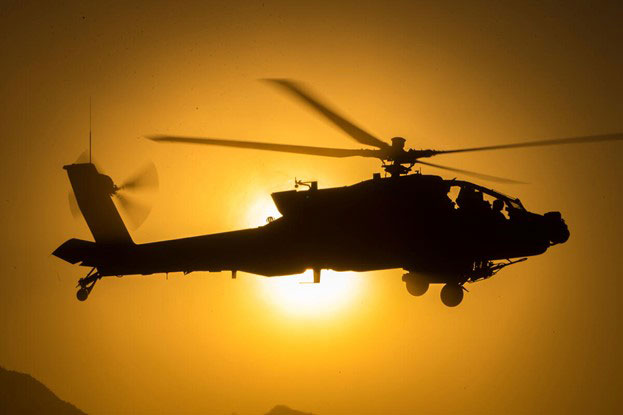


For the first time, U.S. military helicopter pilots will train using augmented reality (AR) technology that can recreate real-world scenarios within a digital space.
On Monday, augmented reality flight training systems developer Red 6 said it has integrated its Advanced Tactical Augmented Reality Systems (ATARS) on Boeing’s AH64E Apache Crewstation Advanced Technology Testbed (CATT). That marks the company’s first integration with a U.S. Army platform and the first-ever integration of such a system on a rotorcraft platform, Red 6 said.

The company’s ATARS is designed to allow pilots to simulate “threat-relevant, near-peer level training scenarios” without the risks, logistical constraints, and costs of live exercises. The system overlays virtual scenarios onto the real world, including one-on-one fighter jet combat and air-to-air refueling. It could even enable training with autonomous “loyal wingmen” envisioned under the military’s collaborative combat aircraft (CCA) strategy.
Previously, Red 6 collaborated with Boeing on an advanced pilot training system for the T-7A Red Hawk.
“Augmented reality technologies such as ATARS open up new opportunities to prepare military aviators for complex threat environments they face today and will encounter in the future,” said Kathleen “KJ” Jolivette, vice president and general manager of Boeing’s Vertical Lift division.
Augmented Reality Advantage
As U.S. military and adversary aircraft have grown in complexity, so too have the requirements for pilot training. That has created a training bottleneck driven by a chronic shortage of aircraft flown by trainees, adversary aircraft for them to train against, and other training assets.
The idea behind ATARS is to improve training capacity while increasing throughput.
The system’s hardware comprises a compute unit that links to a special lens on the pilot’s helmet visor. The compute unit is installed on the aircraft, connecting to its power and GPS so that it knows where to generate virtual combatants. The lens acts as a miniature heads-up display, allowing pilots to view the virtual environment.
The key to ATARS, though, is its software, which generates digital entities that are visible even on a sunny day. These can be preprogrammed, instructor-controlled, or generated by artificial intelligence based on best knowledge of adversary behavior. Unlike conventional training assets, the system can be updated with new data and intelligence within days.
ATARS can simulate one-on-one fighter jet combat and larger engagements, as well as logistics missions for tanker training. Pilots can use the augmented reality system to practice safe landings or simulate missions. ATARS compute units on different aircraft can connect to one another, allowing multiple pilots to take part in an exercise.
Through partnerships with manufacturers such as Boeing, Red 6 aims to integrate ATARS into the baseline avionics of new training aircraft. In July, for example, it reached an agreement with Northrop Grumman to install the system on the company’s next-generation Beacon testbed.
At the same time, the company is working closely with military customers.
In 2021, it won a five-year, $70 million U.S. Air Force contract for ATARS integrations on the Northrop T-38 Talon. It later expanded the agreement to cover the Lockheed MC-130 and F-16 Fighting Falcon. The company is working with defense contractor SNC to develop future military flight training platforms, including a program for the U.S. Navy’s Undergraduate Jet Training System.
ATARS has also been integrated into the U.K. Royal Air Force’s (RAF) BAE Systems Hawk T-2. RAF pilots conducted successful augmented reality trials earlier this year.

