Beta CEO Sees Path to U.S. Electric Aircraft Leadership Amid Fuel Price Spike

Rising costs present a challenge for most of the aviation industry—but an opportunity for electric aircraft.

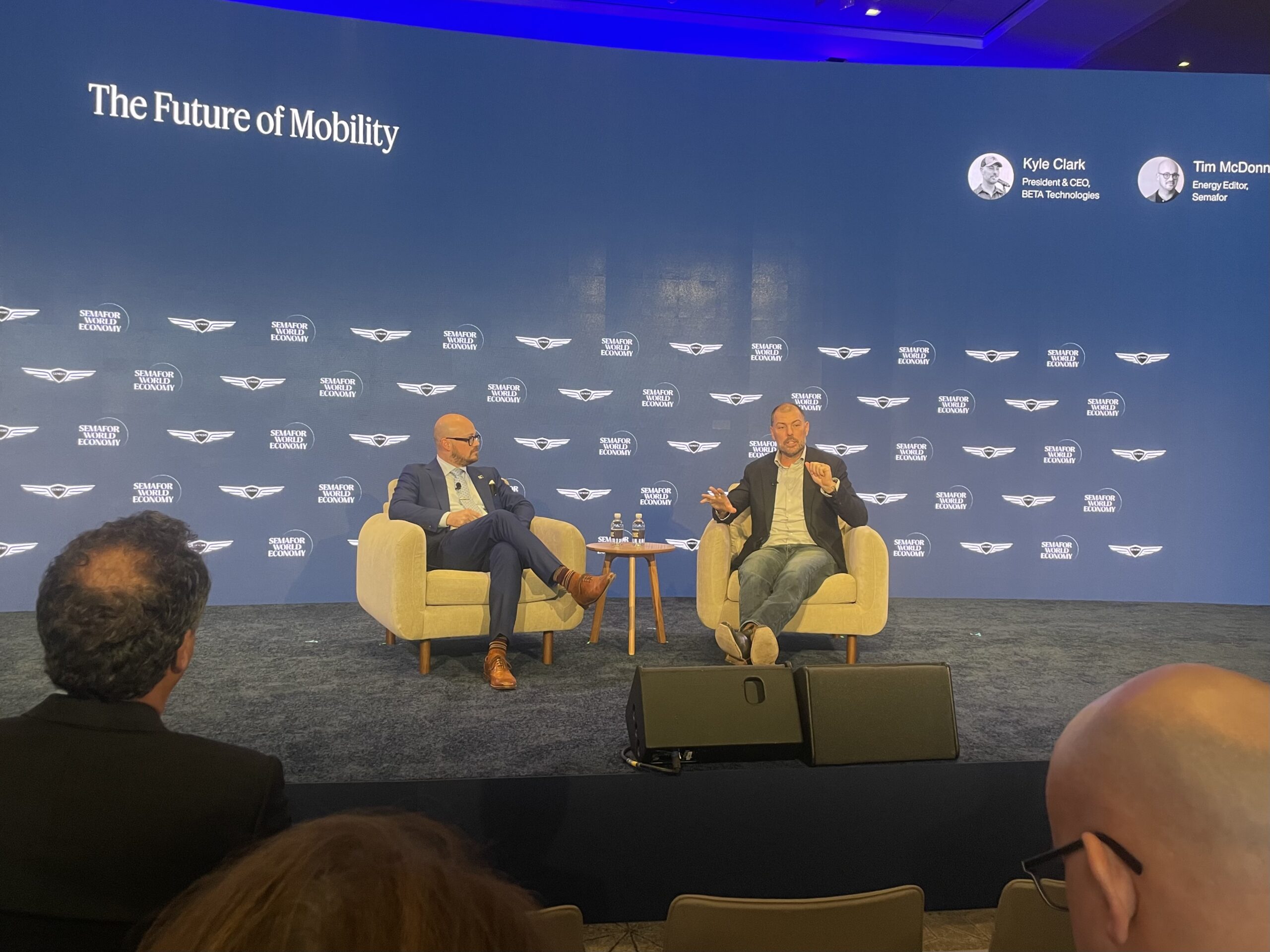
Kyle Clark Beta Technologies CEO at Semafor World Economy in Washington D.C.
Semafor climate and energy editor Tim McDonnell interviews Beta Technologies founder and CEO Kyle Clark at the Semafor World Economy Summit in Washington, D.C. [Credit: Jack Daleo]
Gemini Sparkle

Key Takeaways:

  • Volatile jet fuel prices present a significant opportunity for electric aircraft, with the U.S. asserting leadership through initiatives like the FAA's upcoming eVTOL Integration Pilot Program (eIPP).
  • Geopolitical instability is boosting demand for electric/hybrid aircraft in military applications, as they reduce fuel dependency and operational risk, leading companies like Beta Technologies to accelerate defense-focused development.
  • The U.S. regulatory environment is proving more supportive for electric aircraft development compared to Europe, enabling companies to strategically target military, cargo, and medical sectors first to build operational experience and cost efficiency before expanding to passenger services.
See a mistake? Contact us.

The price of a gallon of jet fuel is more volatile than it has been in years. For most of the aviation industry, that is an enormous challenge.

For electric aircraft, though, it is an opportunity—one the U.S. is primed to take full advantage of, Beta Technologies CEO Kyle Clark said at the Semafor World Economy Summit in Washington, D.C., on Tuesday.

Clark said the FAA will begin its electric vertical takeoff and landing (eVTOL) Integration Pilot Program (eIPP)—a series of real-world trials with precertified electric aircraft in 26 states—in September. The eIPP is just the latest in a string of welcoming developments for electric aircraft manufacturers, from regulatory clarity to volatility in the Middle East that is making sustainable technology a more viable investment.

“People are aware…not to the fact that fuel is more expensive today. It’s the fact that they just can’t plan around the price of fuel,” Clark said. “The cargo and logistics carriers say, ‘Look, absolve me of that risk associated with fuel prices and reduce the cost, and the volumes go way up.’”

The situation is not all good. Clark told FLYING the company has installed some chargers at airports in Abu Dhabi in the United Arab Emirates (UAE). But subsequent installations are “on hold” until the airports reopen, which has had a “minor effect” on revenue.

The region’s geopolitical situation “changes the outlook of the investments we’re going to make there,” Clark said. At the same time, he added, “it is financially a net positive for Beta” as military operators seek new strategic advantages.

“By reducing the logistics tail and the dependency on fuel—even if it’s by half with a hybrid aircraft—you reduce the risk of putting assets in the theater,” Clark said. “And if you use significantly less fuel, you’re going to be cheaper whether you’re hybrid or pure electric.”

The Beta CEO on the company’s fourth-quarter earnings call said it accelerated the development of its hybrid-electric defense aircraft, the MV250, by six months.

“I think change would be an understatement,” he said of the company’s outlook for defense demand since late February.

Power Shift

Amid the backdrop of rising jet fuel prices, Clark said American electric aircraft developers face a “major supply chain issue”—China’s control of mining and refinement for much of the world’s neodymium-boron and samarian-cobalt magnets, which are key components.

“That is, by far, the No. 1 issue” facing electric aircraft supply chains, he said.

China has a burgeoning low-altitude economy, with companies such as EHang and AutoFlight already conducting early passenger-carrying electric flights. But Clark said the U.S. has retaken the lead. A big part of that is the eIPP.

The eight selected eIPP projects span 26 states and will feature precertified aircraft from Beta, Joby Aviation, Archer Aviation, Boeing’s Wisk Aero, and several others. Beta has already flown its electric, runway-dependent Alia across the U.S. and Europe and conducted flight testing in Norway, New Zealand, and Japan. But these will not just be test flights.

“It’s not, ‘Does the airplane work?’” Clark said. “It’s, ‘Does the airplane work every single day in IMC, with real operational payloads? Charge at the right rate? Does the training work? Do the service and reliability meet the standards that our customers expect?’”

By the time the three-year eIPP concludes, Clark believes uncrewed, autonomous operations in several states—including with the company’s electric vertical takeoff and landing (eVTOL) model—will be well underway. Operators such as Beta will even be able to generate revenue from these activities. That sort of regulatory permissiveness mirrors China’s approach.

“Every one of the competitors in Europe is bankrupt now because of the regulatory environment,” Clark said. “They got way over their skis, put in very tight regulations, made it almost impossible financially to develop an aircraft.”

The U.K.’s Vertical Aerospace, which is touring the U.S. with its flagship Valo, is one of the lone exceptions.

‘New Weather, New Jet, New Route’

That’s how Clark described Beta’s philosophy amid geopolitical uncertainty.

“We’re constantly looking at the weather report as we’re figuring out our path to market,” he said. “New weather, new jet, new route.”

Right now, Clark said, the winds are shifting toward defense applications. Beta’s MV250 design is fairly simple, lacking variable pitch propellers, thrust vectoring, liquid cooling, and other complex features that drive up cost. Clark said it will be orders of magnitude cheaper to produce than a Black Hawk, Lakota, or Huey, allowing Beta to churn out 100 aircraft per month instead of two or three.

“In order to get the massive investment that we’ve all gotten, we better have a massive return,” Clark said. “We don’t get to say, ‘It’s 10 percent cheaper, 15 percent cheaper.’ We’ve got to be 40 to 70 percent cheaper in order to justify the billions of dollars of investment.”

According to Clark, Beta’s early focus on military, cargo, and medical applications will ultimately translate to lower fares for future passengers. He compared it to walking step by step up a staircase rather than trying to jump straight to the top.

“Entering in with cargo, medical, and logistics before passengers makes this technology accessible to everybody out of the gate,” he said. “I believe that having thousands of aircraft deployed with millions of flight hours doing cargo, medical, and logistics will bring the customer confidence, the safety, the track record, the serviceability to a level that allows us to offer this to every normal consumer out there.”

Jack Daleo

Jack is a staff writer covering advanced air mobility, including everything from drones to unmanned aircraft systems to space travel—and a whole lot more. He spent close to two years reporting on drone delivery for FreightWaves, covering the biggest news and developments in the space and connecting with industry executives and experts. Jack is also a basketball aficionado, a frequent traveler and a lover of all things logistics.


Ready to Sell Your Aircraft?

List your airplane on AircraftForSale.com and reach qualified buyers.

List Your Aircraft
AircraftForSale Logo | FLYING Logo
Pilot in aircraft
Sign-up for newsletters & special offers!

Get the latest stories & special offers delivered directly to your inbox.

SUBSCRIBE