










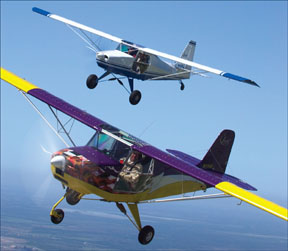
Formation Flight Survival Rules
Unless youre trained for it, we dont think its a good idea. But if you must-a photo mission, for example-here are some safety tips.

Unless youre trained for it, we dont think its a good idea. But if you must-a photo mission, for example-here are some safety tips.

Thunderstorm accidents are almost always fatal. What can we learn from pilots who failed to give them a wide enough berth?
Risk? What Risk?
Two local accidents on the same day involving singles got my attention in late February. The first occurred early in the morning as a series of snow squalls moved through the area. A Cessna 172 crashed while circling after its second GPS approach, killing two and injuring one. Late that same night, a Columbia 400 crashed at a different airport, killing the pilot and his three passengers. Early indications were that the Columbia went down while attempting an ILS.
Several members of an online discussion group in which I participate took these pilots to task for even attempting to fly in poor winter weather. A newspaper report of the second crash noted the weather…
Battery Maintenance
With reference to Its Not A River In Egypt (Learning Experiences, January 2006), I do not agree with the crews judgment to fly the airplane with a known problem. The Barons batteries were in such a low state of charge they would not crank the engines.
External power should never be used when the internal battery power isnt sufficient to start the engine(s). Dead batteries require three to four hours to recharge fully from the aircraft generating system. Therefore they are not considered airworthy in a discharged state.
Batteries that have enough power to crank and start the engine(s) will generally recharge to a reasonable state of charge prior t…
The airplane was substantially damaged and the Private pilot and one passenger were fatally injured when the airplane crashed during an approach at 1447 Eastern time. A pilot-rated passenger and two additional passengers received serious injuries. Instrument conditions prevailed. At 1335, the pilot requested an approach to Moultrie, Ga., which he missed. The pilot then requested vectors to the ILS Runway 4 approach at Albany, Ga. The pilot was cleared for that approach but, at 1430, advised the controller that he needed an airport nearby, as he was running out of fuel. The controller asked the pilot if he had ground contact, and he replied, negative. The controller then asked how much fu…
While making a localizer approach to Runway 36 in IFR conditions, the airplane broke out of the overcast at about 400 feet agl. The pilot forced the airplane down and landed some 2000 feet past the runways threshold at about 100 to 120 KIAS. The pilot stated that he was unable to stop the airplane before it departed the end of the runway and collided with the airports perimeter fencing. Damage consisted of the right wing, right aileron, right elevator, the nose gear and propeller. There were no mechanical problems reported by the pilot or discovered during the post-accident examination of the airplane….
At 1439 Pacific time, the scheduled American Eagle flight encountered icing conditions during its en route climb at about 11,500 feet msl and departed controlled flight. Instrument conditions prevailed; none of the two flight crewmembers, one flight attendant and 25 passengers were injured. The crew recovered the airplane, continued to their scheduled destination and landed without further incident. As the airplane climbed through 11,000 feet msl, the captain noted light rime ice accumulating. The captain reached up to activate the manual deice boot system and the airplane vibrated. The airplane encountered ice and the windscreen immediately turned white. The clacker and stick-shaker activat…
At about 1230 Mountain time, the airplane impacted terrain under unknown circumstances, killing the non-Instrument rated Commercial pilot and sole occupant. The airplane sustained substantial damage. Instrument meteorological conditions prevailed at the accident site. The flight was receiving VFR flight-following services; at about 1119, the controller advised the pilot of a storm system in the Salt Lake Valley and to the south. The pilot acknowledged receiving the information. At about 1138, the pilot was again advised of deteriorating weather conditions along his route of flight. About 1151, the pilot reported he was following I-80 south and, if necessary, would turn around and land at For…
At 1720 Central time, the aircraft was substantially damaged on impact with a bird about 10 sm west of the St. Charles County Smartt Airport (SET). An in-flight fire in the right wing main fuel tank then ensued. Visual conditions prevailed. The pilot was uninjured. The flight returned to SET after the bird strike….
The airplane hit a deer during the landing roll. The pilot reported the landing was normal. During the landing roll, she felt the airplane jerk to the left. She reported she was able to maintain control of the airplane on the runway. A passenger in the airplane stated he saw the deer just prior to it contacting the airplane, but there was not enough time for the pilot to take evasive action….

Get the latest stories & special offers delivered directly to your inbox.
SUBSCRIBE