Aviation Safety

Gladden MOA Mess

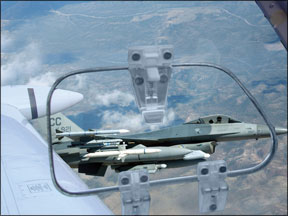
The military operations area, or MOA, is the Rodney Dangerfield of special use airspace (SUA): It doesnt get any respect. Part of the reason few pilots pay much attention to whether a MOA is hot or not is VFR operations are allowed-at our own risk-in an active MOA. This is much different from a MOAs more-serious brethren, the restricted or prohibited areas, or even the temporary flight restriction. That doesnt mean punching through an active MOA is a good idea. In late March, two civilian pilots found out the hard way that what goes on in a MOA probably should stay there. Online sister publication AVweb.com was on this story like a wet blanket-including a podcast with one of the civilian pilots and another with an F-16 driver-and the story generated a lot of comments from rank and file pilots. Many of those comments evidence some misunderstandings of MOAs and SUA: What kind of operations is the military engaged in, anyway? Are civilian aircraft endangering themselves or military pilots by entering? Under what rules, if any, is the military operating when in a MOA? As often is the case in an online discussion, these and other questions got thrown about with no clear answers. But were here to help make sense of it all.
Read More »

Speak No Evil

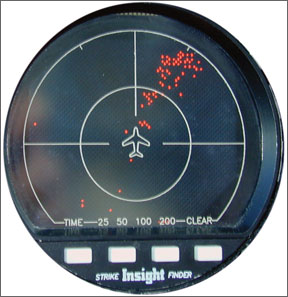
Thunderstorm avoidance is a perennial topic among GA pilots. There are all kinds of tips and equipment recommendations thrown about, including suggestions on how to use and interpret both airborne and data-linked Nexrad weather radar, plus sferic devices and, we suppose, animal entrails, powdered unicorn horns and coin flipping. All methods pretty much depend on a pilot actively seeking information, processing it and reacting to what is learned. As we detailed in last months feature article, On A Mission: Thunderstorms, operators who absolutely, positively have to fly when thunderstorms are present have evolved a wide range of tools and rules they employ to ensure safe flight. Those same methods, including the time-honored step of simply parking the airplane until the bad weather moves off, are easily adapted and adopted by more casual operators.

Read More »

This Is Not A Drill

It was a lousy day to begin with: Gusty winds, steady rain and low ceilings covered the entire area. I departed home plate at 0700 in our Navajo Chieftain for Louisville-Bowman Field. After flying the GPS WAAS Runway 24 approach down to minimums, I taxied to the ramp where my four passengers were waiting. The mission was carrying the governors economic development group to different potential sites across the state. Within minutes, we were off again, headed to our first destination, Hopkinsville, Ky. After another approach to near-minimums and taxiing to the ramp, I was thinking this was going to be a long day, given the amount of airports on their agenda and the weather.

Read More »

Bling

As I write this, the annual Sun n Fun Fly-In is ongoing at the Lakeland (Fla.) Linder Regional Airport, less than two hours away from me by car. I spent opening day there and will be returning as soon as I put the finishing touches on this issue. Even sun, fun and airplanes must wait when deadlines approach. My full day on the show grounds was spent mostly shopping. Events like this are great opportunities to stock up on airplane consumables-I bought some spark plugs, hydraulic fluid and other odds and ends at great prices-as well as drool over the latest and greatest offerings from a wide range of vendors. Owning and operating an airplane is never for the faint of heart, and finding good deals on parts and supplies leaves more scarce cash laying around for important stuff like $5.50/gallon fuel and unscheduled maintenance.

Read More »

Just Plain Broken

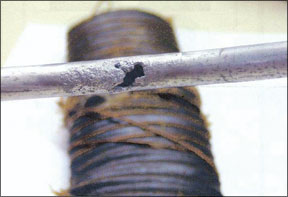
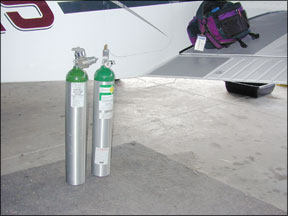
While in process of checking the individual oxygen masks during an annual inspection and five-year O2 bottle re-certification, a technician heard a very faint sound of a gas leak in the overhead interior paneling of the aircraft. After pulling the headliner for a closer inspection and plumbing in low-pressure nitrogen for troubleshooting, the technician narrowed down the “hiss” to a line just forward of the cabin door (p/n 5100107-46). To access this line, which passes through a structural beam in the overhead, it was necessary to drill out approximately 40 rivets securing a thin honeycomb panel to the overhead (structure). Above the panel is the ducting supplying the cabin Wemac vents. The line as pictured has been cleaned up and the corrosion removed for clarity. The corrosion occurred where the ducting passed under it. The ducting was removed to facilitate line removal, and was found to be totally deteriorated.

Read More »

Thunderbumbers

As a committed subscriber I believe you have the best “bible” of information anywhere. Anyone who doesnt take advantage of Aviation Safety is cheating themselves. I have saved every issue for years. Regarding Aprils article on convective weather (On A Mission: Thunderstorms) I acknowledge the 20-mile principle in avoiding thunderstorms. However, after 35 years of Florida summers, flying in both VFR and IFR conditions, it is seldom that thunderstorms allow 20-mile avoidance, especially in the afternoon and evening. In non-turbo light twins and singles that cant climb high enough to “see” whats ahead, getting under the bases and using cockpit Nexrad provides a better choice of airports to run to when things look grim and a better visual picture to dodge mature cell activity.

Read More »

February 2, 2008, Mukilteo, Wash., Bellanca 17-30A

The airplane was substantially damaged when it collided with a power line at about 1240 Pacific time during an attempted forced landing. The commercial pilot and sole occupant received serious injuries. Visual conditions prevailed. According to the pilot, who talked briefly with rescuers before being taken to the hospital, the airplanes engine lost all power while he was in the pattern for a touch-and-go landing. He then attempted to glide to the approach end of the runway, but was unable to maintain enough altitude to clear a power line. After hitting the power line, the airplane rolled to a steep angle of bank, and then descended into the terrain.

Read More »

February 4, 2008, Baytown, Texas, Cessna 210

The airplane was destroyed when it collided with terrain at about 1845 Central time following loss of control while in cruise flight. The non-instrument rated private pilot and sole occupant was fatally injured. At about 1830, the airplane initiated a descent from 6500 feet. Prior to disappearing from radar at 1844, the airplane made a single, descending “S” turn, beginning at an altitude of 2400 feet, and ending at the last radar plot at 1100 feet. A witness, who lived near the crash site, reported hearing the airplane engine “winding up.” A few moments later he heard the impact. The witness also reported the weather at the time of the crash was extremely foggy, with visibility less than a tenth of a mile.

Read More »

February 5, 2008, S. Padre Island, Texas, Eurocopter France AS350B2

At 2054 Central time the aeromedical helicopter crashed into water while maneuvering to a temporary landing zone. Visual conditions prevailed. The helicopter was substantially damaged. The airline transport-rated pilot-in-command, the flight nurse and the flight paramedic were fatally injured. A review of recorded Air Traffic Control radar data shows the helicopter flew to its intended destination at altitudes ranging from 700 feet to 1100 feet msl. It then overflew the destination at 800 feet; eyewitnesses observed it entering a left turn. Radar data shows the helicopter continued in the left turn and crashed two miles west of the destination. Weather reported at a station nine miles west include 8 miles visibility with scattered clouds at 1000 feet and overcast clouds at 1400 feet. Eyewitnesses at the scene reported the visibility as good, but no stars were visible.

Read More »

February 6, 2008, Austin, Texas, Cessna 172S

As the commercial pilot/owner was preparing to taxi, he dropped something on the floor. When he realized he could not reach the object, he moved his seat back so he could reach down to the floor. At that point, he felt motion and realized that he could not reach the brake pedals. Before the pilot could release his seatbelt and turn off the engine, the airplane struck two parked airplanes, resulting in minor damage to his airplane and one of the parked airplanes. However, the other parked airplane sustained substantial damage.

Read More »
Pilot in aircraft
Sign-up for newsletters & special offers!

Get the latest stories & special offers delivered directly to your inbox.

SUBSCRIBE