Aviation Safety

October 1, 2008, Crookston, Minn. Piper PA-28-161

The student pilot stated he was established on final approach and “everything was on track.” When the airplane crossed the threshold, he reduced engine power and began the landing flare. After touchdown, the student pilot applied the brakes, which resulted in a skid he was unable to control. The airplane subsequently departed the runway pavement and came to rest in a ditch. The left main landing gear collapsed.

Read More »

October 3, 2008, Alton, Ill. Cessna 172

The student pilot and flight instructor had conducted four takeoffs and landings during a dual instructional flight prior to the accident flight. The flight instructor stated that the landings “went really well” and he elected to endorse the student pilot for solo flight. The student pilot subsequently took off on his initial solo flight and flew a normal traffic pattern.

Read More »

October 4, 2008, Savannah, Ga., Cessna T210

At about 1130 Eastern time, the airplane experienced total loss of engine power and was ditched in a marsh. Visual conditions prevailed. The airplane was substantially damaged; the private pilot was not injured. The pilot stated that she filled the airplanes fuel tanks several days before the accident flight, and even asked her flight instructor to check the tanks to make sure they were full. The flight originated about 0725.

Read More »

October 5, 2008, Lakeland, Fla., Cirrus Design Corp. SR22

The airplane experienced an asymmetrical flap extension while approaching to land at about 1230 Eastern time. The private pilot was not injured; visual conditions prevailed. According to the pilot, upon moving the flap selector to its mid-position, the pilot heard a “bang” and the airplane rolled to the right. The pilot responded with “full roll input” and contacted ATC. The pilot noticed the left flap was fully extended but could not see the right flaps position. The pilot subsequently landed uneventfully using the “full roll input.” After exiting the airplane, the pilot observed the left flap in the fully extended position and the right flap in the fully retracted position.

Read More »

October 11, 2008, Cedar Lake, Mich., Cessna 150G

At 1332 Eastern time, the airplane impacted trees and terrain during initial climb from a private airstrip. Visual conditions prevailed. The student pilot was seriously injured and his passenger was fatally injured. The student pilot had reportedly sold the airplane to the passenger prior to the accident flight. The passenger had an expired student pilot certificate. According to the student pilot, the passenger performed the accident takeoff while seated in the right seat. The student pilot was seated in the left seat. The student pilot described the grass runway as “very bumpy.”

Read More »

October 16, 2008, Markleeville, Calif., Piper PA-28R-201T

At about 1100 Pacific time the airplane collided with trees during an off-airport forced landing. The private pilot was killed; the airplane sustained substantial damage. Visual conditions prevailed. While en route, at 14,500 feet, the pilot reported engine problems. A controller provided vector to a nearby airport. A witness about two miles from the airport saw an airplane flying low, then disappear behind a hill. He went to investigate, and saw the inverted wreckage of the airplane.

Read More »

October 19, 2008, Big Bear, Calif., Beech F33A Bonanza

After obtaining wind information, which she recalled as from 240 degrees at five knots, gusting to 17 knots, the pilot entered a left downwind for Runway 26. The pilot landed on the runway and the airplane swerved to the right, departing the runway surface and impacting a parked airplane, a vehicle and an airport hangar.

Read More »

October 24, 2008, Albemarle, Va., Piper PA-24 Comanche

At about 1901 Eastern daylight time, the airplane was substantially damaged when it impacted trees and terrain while being vectored for an instrument approach at the flights alternate airport. The private pilot and his passenger were killed. Night visual conditions prevailed. During the diversion to the alternate airport, ATC provided radar vectors for the approach. About seven minutes before the accident, the airplane began descending from its cruise altitude of 7000 feet. Shortly thereafter, the pilot issued multiple distress calls to ATC before the airplane was lost from radar. No further transmissions were received from the airplane.

Read More »

October 14, 2008, Portland, Ore., Piper PA-31-350

The airplane sustained substantial damage to its left rear wing spar after the left engine caught fire shortly after takeoff. The commercial pilot was not injured. Visual conditions prevailed. The pilot later reported she was 1000 feet agl when she noticed the left engines manifold pressure had dropped about six inches below the right engines indications. The engine was surging, and she thought that the turbocharger had stopped operating. She returned for landing, noting the CHT was reading zero degrees but all other gauges were normal. After landing, the left engine died.

Read More »

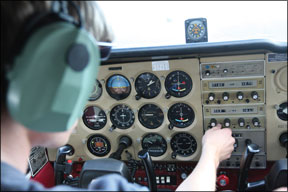
Six Single-Pilot IFR Tips

There was a time not so long ago that a single pilot flying hard IFR was considered an accident waiting to happen. There was simply too much going on, conventional wisdom held, for one pilot to handle all alone. Instrument pilots contemplating a flight in actual weather actively sought out others-perhaps an instructor-who could help with the cockpit chores and make sure the dirty side stayed down. Except for the freshest instrument pilots, thats all changed. And good riddance. Ive long been convinced the second most dangerous thing in aviation is two pilots trying to fly the same airplane at the same time (the first is a private pilot with a #2 Phillips screwdriver, but thats a different article). But the idea of single-pilot IFR, or SPIFR, being something to avoid seems to have hung on in some quarters. Sure; theres a time and a place to take along some backup, depending on how comfortable a pilot is with the weather, the airplane and the airspace. But Id argue against making the flight in the first place if the only way youd consider it is with another pilot. Be that as it may, advances in automating the cockpit have paved the way for much more SPIFR than only a decade ago. Thats a good thing, in my opinion, but also means our lone pilot needs to prepare for the flight a bit more than might otherwise be the case.


Read More »
Pilot in aircraft
Sign-up for newsletters & special offers!

Get the latest stories & special offers delivered directly to your inbox.

SUBSCRIBE