













Wally, who was nearly thrice my age, was giving me a Taylorcraft checkout at a grass strip. I already had a tailwheel endorsement, but my insurer wanted time in-type for the new (to me) BC-12D. There were no systems to learn, so all I needed were a couple of stalls and about a hundred laps around the traffic pattern.
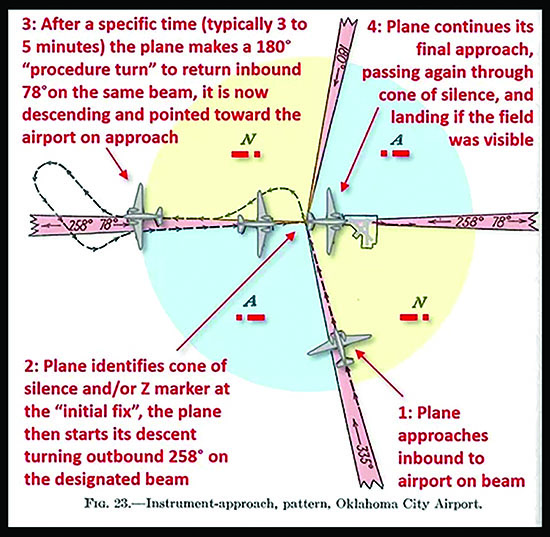
Wally and I got to talking about instrument flying. For his instrument rating check ride, he’d flown one approach in some fabric-covered taildragger using a four-course low-frequency range. That’s the old navaid that had four quadrants, broadcasting a Morse code “A” or “N” in each one. If you were on the boundary between the quadrants, the dots and the dashes canceled each other out. You were “on the beam” if you heard a steady tone. If you weren’t on the beam, knowing the Morse code for “A” and “N” would tell you which side of it you were on. The region right above the transmitter, which got no signal, was known as the “cone of silence.”

