











Lee Smith Wednesday, February 24, 2010

Put Down Your Checklist!

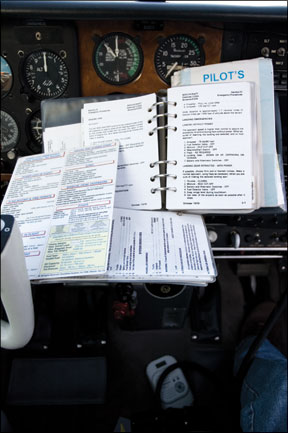
A wise old pilot once told me here are three distinct types of flying: simulator flying, checkride flying and typical everyday line flying. Although the context of this nugget was originally air carrier operations, there seems to be an innate understanding of this concept among all pilots. When administering flight reviews to experienced owner-pilots, I often get to see them on their “best behavior.” Of course, flight reviews arent checkrides, but many pilots view them as such, especially if its been a while since their last “real” pass/fail flight. While somewhat flattering to me, its usually obvious which aspects of their behavior are part of their normal operation and which are a show put on for my benefit. Often, Ill see them whip out a ratty old checklist, dust it off and try to use it sequentially as a do-list. Almost comically, the effort comes across almost as awkward as a middle school dance: The desire is there, but they just dont seem to know what to do with it.

Read More »
Lee Smith Tuesday, January 12, 2010

Deep Stall Aerodynamics

In October 22, 1963, a prototype of the British Aircraft Corporation One-Eleven (BAC 1-11) short-haul jet airliner, registration G-ASHG, crashed near the village of Chicklade in southwest England. The aircraft was evaluating stall characteristics at varying center of gravity locations when the flight crew found the flight controls unresponsive after entering a stable stall and the aircraft struck the ground at a wings level attitude with a high rate of descent and little forward speed. All aboard died in the crash. The 1-11 was one of the second-generation of jet airliners-others being the Douglas DC-9 and Boeing 727-featuring aft-mounted engines, swept wings and all-moving T-tail horizontal stabilizers. Post-crash investigation concluded the prototype 1-11 had experienced an unrecoverable deep stall in which the wake of the stalled wing covered the high-mounted horizontal stabilizer, thus blanking the elevator controls and preventing normal recovery techniques.

Read More »
Lee Smith Thursday, July 23, 2009

The Part 135 Way

On a recent foggy morning in Hagerstown, Md., I sat waiting for the visibility to improve enough for me to depart on a Part 135 passenger flight. Every airport in the region was socked in with less than a quarter mile visibility, when a somewhat agitated passenger came up to me and asked what we were waiting for. I explained that the visibility had to improve before we would be legal to depart. In an incredibly ill-timed coincidence, we heard the sound of a single-engine piston departing from somewhere in the cloud outside the door, and my passenger snidely inquired why that plane could leave, but we couldnt. I felt like I had been asked to explain Bernoullis principle to a five-year-old. It was a deceptively complicated question, and one that should be of interest to pilots flying in their own aircraft under FAR Part 91.

Read More »