A trio of European aerospace companies are pooling their resources in a bid to eat at SpaceX’s share of the commercial space industry.
Last week, Airbus joined forces with France’s Thales and Italy’s Leonardo to create an as-yet unnamed joint venture, combining the firms’ satellite manufacturing and space systems, components, and services businesses.
The combination—which has been rumored for years—will be based in Toulouse, France, and is expected to be operational by 2027. It will notably exclude launch activities despite Airbus’ 50 percent ownership of European launch vehicle developer ArianeGroup (another French company, Safran, owns the other half).
Airbus’ Defense and Space division competes directly with Thales and Leonardo, which jointly own satellite manufacturer Thales Alenia Space and spaceflight services provider Telespazio. Thales has a majority (67 percent) stake in the former, while Leonardo has the larger stake in the latter.
However, as Europe seeks ownership of its space activities—many of which are outsourced to American providers—the three companies evidently see collaboration as more beneficial. Recent estimates suggest that SpaceX owns or operates roughly two-thirds of all active orbital satellites.
“This partnership aligns with the ambitions of European governments to strengthen their industrial and technological assets, ensuring Europe’s autonomy across the strategic space domain and its many applications,” said Guillaume Faury, Roberto Cingolani, Patrice Caine, the CEOs of Airbus, Leonardo, and Thales, in a joint statement.
Taking on SpaceX
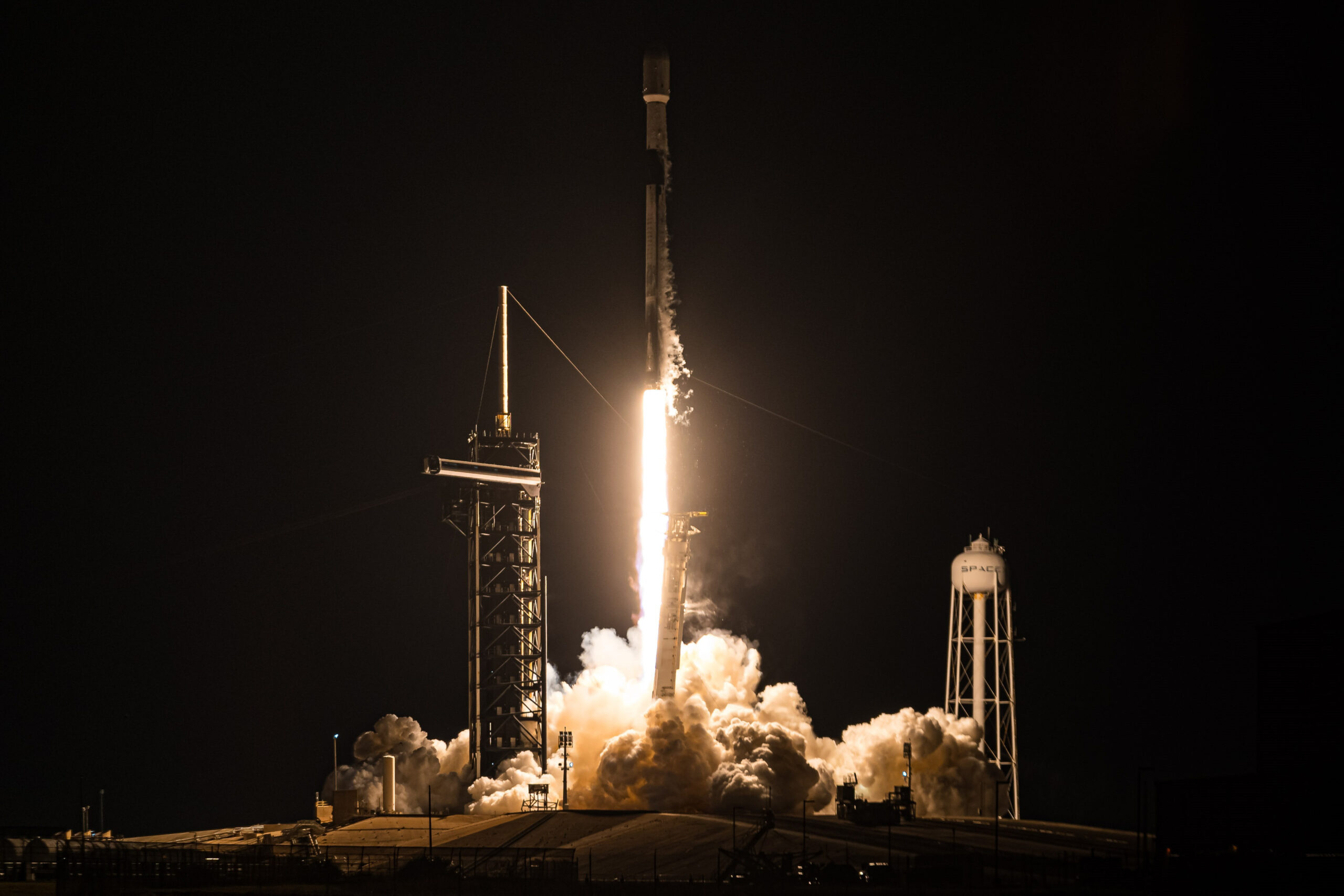
SpaceX’s workhorse Falcon 9, the first commercially built reusable rocket, has revolutionized spaceflight in just a few short years.
Falcon 9 accounted for the bulk of the company’s 134 orbital launches in 2024, which represented 83 percent of all spacecraft launched that year. It was more than double the next closest competitor, China Aerospace Science and Technology Corporation.
The rocket’s reusability has given SpaceX an edge in other space activities. For example, it has launched more than 10,000 Starlink satellites, creating a constellation that encircles the globe. The company also contracts with NASA for tasks such as International Space Station crew transport and cargo resupply. The U.S. military uses Falcon 9 and the larger Falcon Heavy to launch some of its most sensitive missions.
Amid SpaceX’s rise, European competitors have struggled to keep pace.
Per Payload Space, Airbus, Thales, Leonardo, and Safran collectively cut 3 percent of their space workforces in 2024 due to falling profits. Thales, for example, cut about 1,300 jobs at Thales Alenia Space, moving employees to other divisions as part of a restructuring. Airbus, meanwhile, in October said it would cut up to 2,500 Defense and Space employees by mid-2026, citing a “continued complex business environment, especially in the space systems segment.”
Airbus will have a 35 percent stake in the companies’ joint venture, with Leonardo and Thales each owning 32.5 percent. It will combine Airbus Defense and Space and the latter’s shares in Thales Alenia Space and Telespazio, with Thales also contributing its SESO optics unit.
The new firm is expected to employ about 25,000 people across Europe, but each home country will retain its existing capabilities. It is expected to generate about 6.5 billion euros in annual revenue, the companies said.
During a news briefing on Thursday, the firms said the joint venture will be modeled after MBDA—a European missile launch provider created in 2021 by Airbus, Leonardo, and BAE Systems—per the Financial Times. The goal is to eliminate fragmentation in the industry and form a “unified, integrated and resilient” pan-European rival to SpaceX’s global dominance.
End to End
The combined company would grant Europe sovereignty over activities beyond Earth’s atmosphere. Airbus, for example, is considered a European leader in telecommunications satellites and specializes in services such as global navigation, earth observation, science, and exploration.
But Europe is also looking to take on SpaceX in launch.
Though Airbus, Leonardo, and Thales excluded launch operations from their combination, the European Space Agency (ESA) is using initiatives such as Boost and its Launcher Challenge to fund providers such as Germany’s Isar Aerospace and Italy’s Avio. In August, Isar and Avio won space launch services contracts for five upcoming missions—the first commercial agreements between privately funded European launch providers and a European institution.
Homegrown developers could give ESA greater trust in the vehicles and services it contracts from the commercial industry. In Isar’s case, that could come with the ability to launch from European soil.
Holding these companies back, though, are the capacity and expendability of their spacecraft. Unlike SpaceX’s Falcon 9, Isar’s Spectrum and Avio’s Vega C are not reusable (though they could be in the future). They are also designed for much smaller payloads, limiting the missions they can handle.
The tie-up between Airbus, Leonardo, and Thales capabilities is a step forward for European sovereignty in space. But many more remain, with reusable launch vehicles among the largest.