













Register

How To Fly Twin Engine Aircraft At Single Engine Performance Levels

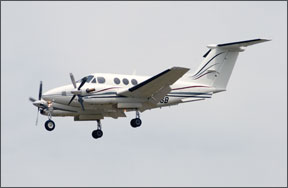
Twin-engine airplanes certified under FAR 23 do not have the same performance guaranteed for transport category airplanes certified under FAR 25. Especially, light twins weighing less than 6000 lbs and have VS0 equal to or less than 61 KCAS are not required to have any positive single-engine performance. Twins weighing more than 6000 lbs and/or having VS0 above 61 KCAS must demonstrate, in still air at 5000 ft, with the inoperative engine feathered, a climb gradient of 1.5 percent (if certified after February 1991), or a rate of climb of 0.027 V2S0-not exactly earth-shaking performance. We often hear that losing an engine in a light twin-engine airplane is far more dangerous than losing the only engine in a single-engine airplane. Melville Byington Jr. (1989 and 1993) of Embry-Riddle Aeronautical University conducted an experimental study of the bank angles required to obtain the zero sideslip flight, and consequently, the maximum performance in light twins. Based on the NTSB accident data, Byington concluded that 30 percent of twin-engine airplane accidents occur due to the loss of directional control (VMCA rollover), while 43 percent can be traced to insufficient performance with one engine inoperative (OEI). The remaining 26 percent or so are stall/spin accidents, which also carry the highest fatality rate. Evidently, more accidents happen due to the inadequate SE performance planning or understanding, than due to the control problems.

Gemini Sparkle

Key Takeaways:

  • Light twin-engine airplanes certified under FAR 23 often lack guaranteed positive single-engine climb performance, leading to a significant number of accidents attributed to insufficient performance or loss of directional control.
  • The optimal bank angle for zero-sideslip flight (minimizing drag with one engine inoperative) is not a fixed value like the commonly taught five degrees, but varies based on factors such as aircraft weight, density altitude, and engine/rudder arm ratios.
  • Pilots must actively adjust controllable parameters, primarily reducing takeoff weight, to ensure sufficient single-engine climb performance for IFR departures, obstacle clearance, and missed approaches, as certified performance is often inadequate.
See a mistake? Contact us.

Twin-engine airplanes certified under FAR 23 do not have the same performance guaranteed for transport category airplanes certified under FAR 25. Especially, light twins weighing less than 6000 lbs and have VS0 equal to or less than 61 KCAS are not required to have any positive single-engine performance. Twins weighing more than 6000 lbs and/or having VS0 above 61 KCAS must demonstrate, in still air at 5000 ft, with the inoperative engine feathered, a climb gradient of 1.5 percent (if

Conventional Twin Engines

288

Ready to Sell Your Aircraft?

List your airplane on AircraftForSale.com and reach qualified buyers.

List Your Aircraft
AircraftForSale Logo | FLYING Logo
Pilot in aircraft
Sign-up for newsletters & special offers!

Get the latest stories & special offers delivered directly to your inbox.

SUBSCRIBE

