











Airspace designations, along with what is and isnt permissible inside specific areas, are perennial sources of frustration and confusion among pilots of even considerable experience. Once ones understanding develops beyond the different classes and past special use airspace, theres always the issue of how to deal with airspace in which more and different rules or procedures apply. In recent years, special flight rules areas, SFRAs, have been created to ease the flow of traffic and prevent unsafe 288
The New SFRAs
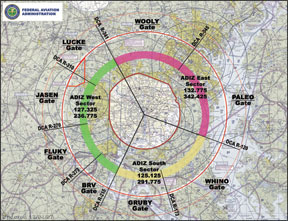
Airspace designations, along with what is and isnt permissible inside specific areas, are perennial sources of frustration and confusion among pilots of even considerable experience. Once ones understanding develops beyond the different classes and past special use airspace, theres always the issue of how to deal with airspace in which more and different rules or procedures apply. In recent years, special flight rules areas, SFRAs, have been created to ease the flow of traffic and prevent unsafe conditions at the Grand Canyon and at the Los Angeles International Airport (LAX). The dimensions, rules and procedures for these areas are clearly documented in various places, including FAR Part 93, the FAAs Airport/Facility Directory and the respective visual charts. (Its always helpful, of course, to ask local pilots about any tricks they may know or additional information necessary to safely operate in these and similar areas.) Meanwhile, two additional SFRAs were created recently-one over Washington, D.C., and the other at New York, N.Y. Both were created in the aftermath of significant events and demand pilots planning to operate in or near them become familiar with their requirements.

Key Takeaways:
- Special Flight Rules Areas (SFRAs) are established in complex airspaces like New York and Washington, D.C., to enhance safety (e.g., traffic separation) or security, requiring pilots to adhere to specific, mandatory rules beyond standard airspace classifications.
- The New York SFRA segregates transient and local aircraft operations along the Hudson and East Rivers by altitude and mandates specific procedures such as speed limits, lighting, self-announcing, and carrying current charts.
- The Washington, D.C. SFRA is security-focused, requiring a D.C. SFRA flight plan for most VFR operations, prohibiting squawk 1200, and demanding discrete transponder codes from ATC for entry and exit.
- Pilots must familiarize themselves with SFRA requirements, and successful completion of a specific training course is mandatory for VFR flights within 60 nautical miles of the D.C. SFRA.
Key takeaways sponsored by Aviator Pro | Start Your Training ->
See a mistake? Contact us.

