
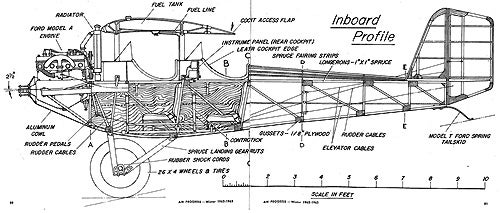


One evening in the late ’60s, probably after a few “ginskies” in the Sky Galley bar, Ebby and Walter Rye decided to buy a curious little antique airplane I’d seen advertised in the yellow rag (Trade-A-Plane) that arrived that day. I think they called the seller from the phone in the bar and closed the deal that night. While I was pretty pumped about the whole thing, I was also surprised since neither one of these guys had the foggiest idea what a Pietenpol Air Camper was. Ebby was all about “big-iron-round-engine-preferably-Lockheeds,” and Walter didn’t even drink. Maybe they were intrigued because this two-hole, parasol wing experimental had been built by Bernard Pietenpol himself and, in its original design, was powered by a Model A Ford motor. Anyway, a nice kid delivered it to Lunken later that week, painfully reluctant to part with his beloved Air Camper. But there was college tuition and ratings to pay for if he was to realize his dream of flying for Northwest Airlines.
The poor kid had hardly boarded the flight back to Minneapolis when Ebby, in time-honored tradition, went to work with a pair of diagonal cutters severing everything behind the instrument panels. Even though it wasn’t that big a deal since the Pietenpol had no electrical system and precious few instruments, there were still groans from the mechanics. For 30-some years they’d watched him buy airplanes — Staggerwing Beeches, UC-78s, P-51s, Beech 18s, and Lockheed 10s, 12s and 18s — knowing they’d be faced with sorting out the tangle of cut wires, cables and lines behind the panel. The idea was to ensure everything was replaced instead of renovated, salvaged or repaired. At one of Ebby’s birthday celebrations, the mechanics at Cincinnati Aircraft and Queen City presented him with a pair of “dikes,” gold-plated and firmly welded shut.