













The Old Conundrum: Time vs. Money

When comparing a high-speed, cruise-power descent against a cruise-speed, reduced-power descent, there are a surprisingly large number of variables in the equation, all pulling in different directions.

Gemini Sparkle

Key Takeaways:

  • A mathematical model was used to compare the efficiency of high-speed, cruise-power descents versus cruise-speed, reduced-power descents, considering variables like airspeed, time, and fuel burn.
  • Common sense suggests that a shallow, cruise-power descent (around 300 FPM) achieves the shortest flight time, albeit with a slightly higher fuel burn.
  • A middling descent rate offers a good compromise, providing some time savings at minimal additional fuel cost.
  • Savings from optimizing descent profiles are negligible if the descent begins below 8,000 feet or if the aircraft's airspeed difference between cruise-power and cruise-airspeed descents is 30 knots or less.
See a mistake? Contact us.

When comparing a high-speed, cruise-power descent against a cruise-speed, reduced-power descent, there are a surprisingly large number of variables in the equation, all pulling in different directions.

On the one hand, descending at cruise power will guarantee a higher airspeed, but on the other hand it comes at the cost of a higher fuel burn. However, a higher airspeed will reduce the amount of time in the air, and thus overall fuel cost, right? What about true airspeed? True airspeeds are highest at cruise altitudes, and decrease approximately two-percent per thousand feet during the descent, which throws in an another dimension. So which method is truly more efficient?


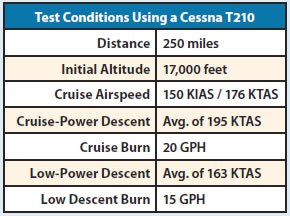
Not having an infinite amount of money to perform airborne testing, I developed a mathematical model to test out descent profiles over time, taking into consideration variables such as airspeed variation and fuel burn. While it’s not a completely perfect simulation, it should give a rough estimate of expected performance, at least enough for comparison.

Common sense wins when it comes to descent planning. Flying a cruise-power descent at a fairly shallow average rate of descent of around 300 FPM will give you the shortest flight time at the cost of a slightly higher fuel burn. A middling descent rate gives you some time savings at little fuel cost.

Running this with some other starting points, it turns out that if you start your descent below 8000 feet or fly an aircraft having a difference in airspeed between cruise-power descent and cruise-airspeed descents of 30 knots or less, any savings were basically negligible.

— L.S.

Ready to Sell Your Aircraft?

List your airplane on AircraftForSale.com and reach qualified buyers.

List Your Aircraft
AircraftForSale Logo | FLYING Logo
Pilot in aircraft
Sign-up for newsletters & special offers!

Get the latest stories & special offers delivered directly to your inbox.

SUBSCRIBE