Receiving my instrument ticket from a university pilot-mill, flight and weather planning was grueling and intense. For flights over an hour, a Terminal Aerodrome Forecast (TAF) is used. For secondary airports within five miles of a field with a TAF, the TAF from the primary airport can be used No TAF? Use the Area Forecast (FA).This originated from the Aviation Weather Services advisory circular, which states that an FA is used to interpolate conditions at airports which [sic] do not have a Terminal Aerodrome Forecast. Determining forecast weather, particularly ceilings and visibilities, is essential for instrument pilots to ascertain if an alternate is needed and to select one that meets requirements.
The FAA and NWS are discontinuing the 80-year-old Area Forecast (FA), a crucial weather product for general aviation (GA) instrument pilots, especially when operating to airports without Terminal Aerodrome Forecasts (TAFs).
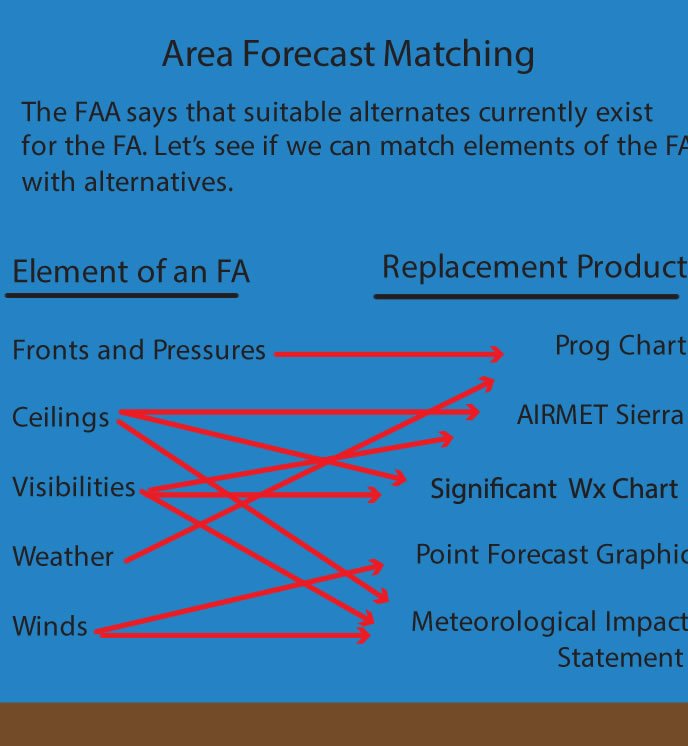
The FA is uniquely valuable for IFR flight planning, providing specific ceiling and visibility forecasts essential for determining alternate airport requirements and selecting suitable alternates, information not adequately replicated by current or proposed alternative products.
Existing alternatives lack the necessary specificity and granularity for IFR alternate planning at non-TAF airports, potentially burdening pilots with unnecessary alternate filings or forcing them to use less precise data.
Receiving my instrument ticket from a university pilot-mill, flight and weather planning was grueling and intense. For flights over an hour, a Terminal Aerodrome Forecast (TAF) is used. For secondary airports within five miles of a field with a TAF, the TAF from the primary airport can be used No TAF? Use the Area Forecast (FA).
CREATE A FREE ACCOUNT
Sign up to keep reading
Create a free account to continue. Already a member? Sign in below.