













Instrument X-C

The so-called “long” cross-country in instrument training requires three different approaches. Defining “different” and what approaches qualify has been a process.

Gemini Sparkle

Key Takeaways:

  • The FAA has significantly clarified the "three approaches" requirement for the IFR long cross-country flight, evolving from previous, often conflicting, interpretations that focused on "different navigation systems."
  • As of September 2022, the updated guidance states that applicants need to conduct "three kinds of approaches regardless of the navigation system utilized," with the key differentiator now being "various lines of minimums" found on an approach plate.
  • This new interpretation offers greater flexibility, permitting approaches using the same navigation system (e.g., GPS or LOC) to count as different if they utilize distinct lines of minimums (e.g., LPV DA, straight-in MDA, circling MDA).
  • Instructors maintain discretion in selecting approaches for training to ensure comprehensive student preparation, covering precision, non-precision, and circling profiles, while also ensuring proficiency in various navigation systems.
See a mistake? Contact us.

Any pilot who got an instrument rating in the last 25 years knows that part of the training requires a 250 NM (for airplanes) cross-country flight under IFR. It is called the “long cross-country” flight, although there’s no “short cross-country” flight. That flight requires three approaches, but which three has been confusing.

Confusion History

When Part 61 was rewritten in 1997, the IFR cross-country flight included “three different kinds of approaches with the use of navigation systems.” There’s similar language for helicopters. Instrument instructors were unsure how to interpret the language.


In March 2008, the FAA Office of the Chief Counsel (OCC) issued the Glaser interpretation, concluding that “different kinds of navigation systems” must be used, saying to pick three from this list: NDB, LDA, VOR, GPS, SDF, and LOC, as they were considered different. It excluded ASR approaches (airport surveillance radar) using approach control radar and military PAR approaches (precision approach radar). The technology of the radar approaches was not considered to be navigation systems but rather radar-tracking systems.

In September 2012, the OCC issued the Pratte interpretation, reaffirming the ASR and PAR exclusions as not being acceptable approaches for the three on the long X-C. It also mentioned that the Glaser interpretation “was not intended to exclude navigation systems that might be approved in the future.” Interestingly, it further stated that Flight Standards Service (AFS) was better positioned to provide guidance on what constituted “different kinds of approaches.” But nothing further came out after the Pratte interpretation.

Getting More Difficult

Fast forward 10 years later to February 2022. The OCC issued a Memorandum to Flight Standards Service rescinding the Glaser and Pratte interpretations. It allowed ASR and PAR approaches to meet the requirements of the IFR cross-country flight. It also mentions that neither §1.1 nor §61 define “approach” and “navigation system.” The Memorandum concludes that Flight Standards Service is best positioned to issue policy on what “navigation systems” meet regulatory requirements.

The Glaser interpretation mentions six kinds of approaches, and instructors must select three. But today, some are outdated. LDA and SDF are few and far between, as are NDB approaches. It is also difficult to find working ADFs. Plus, the proliferation of GPS approaches and the MON (minimum operational network), VOR approaches are becoming scarce. Planning the cross-country flight, has become more challenging as approaches are potentially limited to ILS/LOC and GPS.

On September 27, 2022, the FAA changed Order 8900.1, Volume 5, Chapter 2, Section 9, paragraph 5-434 B. The change concludes that “an applicant (for an instrument rating) only needs to conduct three kinds of approaches regardless of the navigation system utilized.” It means that technology is not a discriminator, but it introduces another point: “different approaches can be defined by various lines of minimums found on an approach plate.” But what does “various lines of minimums” mean?

Final Answer (?)

The question is best answered with examples of what is and what is not allowed. Examples of what are not permitted: multiple ILS approaches, multiple VOR straight-in approaches, and multiple GPS approaches flown to LPV minimums. You may pick any three approaches, but not with duplicate lines of minimums.

Examples of acceptable approaches based on different lines of minimums:

  1. VOR to straight-in MDA mins, ILS to DA mins, GPS to circling mins.
  2. GPS to LPV DA mins, GPS to straight-in and circling MDA mins.
  3. LOC to side-step MDA mins, LOC to straight-in MDA mins, and LOC to circling MDA mins.

Example 1 seems reasonable, but examples 2 and 3 are less obvious. The only difference in examples 2 and 3 is the target altitude; they’re flown the same. Using lines of minimums considerably expanded the choices.

Practicality

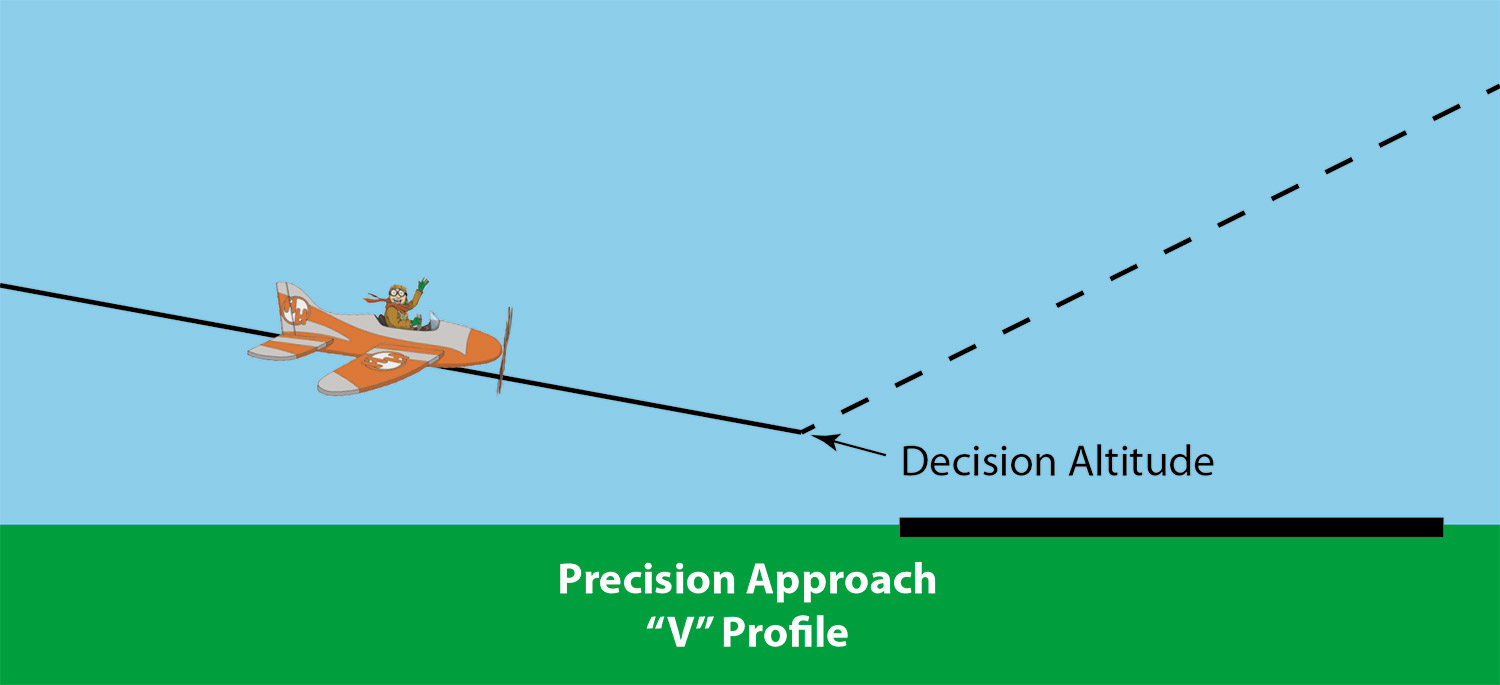
(I understand the ACS lists testing guidelines, not training requirements, but bear with me a moment.) I believe the instrument ACS correctly identifies three kinds of approaches— precision, non-precision, and circling. The precision approach is flown to a DA using a “V-shaped” profile, a non-precision straight-in approach flown to an MDA using a “U-shaped” profile with maybe a step-down fix along the way, and a circling approach flown to an MDA followed by visual maneuvering to the landing runway. In my opinion, the differentiator is the vertical profile of the final approach segment.

On the cross-country, I try to choose precision, non-precision, and circle-to-land approaches. At least one should include the missed. I mix it up with the non-precision approach being an “approach with loss of primary flight instrument indicators,”—partial-panel. Such a selection of approaches will better prepare the student for the check ride and for life after.

Ultimately, the instructor should determine the best use of the training time and which kinds of approaches to practice (considering the capabilities of installed equipment on the aircraft and reasonably available instrument approaches). Additionally, candidates are still required by §61.65(c)(5) and (6) to be proficient in navigation systems and instrument-approach procedures. While such a candidate might only be exposed to GPS-based approaches or ILS/LOC approaches on the IFR cross-country flight, they should still receive training on other types of approaches.

The change in guidance regarding the approaches also applies to training under a Part 141 Certificate for the instrument rating and combined private certificate-instrument rating. (See Part 141 Appendices C and M.) There is an additional and existing requirement for the IFR cross-country to be “a distance of at least 250 nautical miles along airways or ATC-directed routing with one segment of the flight consisting of at least a straight-line distance of 100 nautical miles between airports.” Students and instructors at a Part 141 flight school must also comply with any other requirements in the approved Training Course Outline.

Finally note that the new guidance does not affect instrument proficiency checks (IPC) since the types of approaches are covered under the instrument rating ACS.

Ready to Sell Your Aircraft?

List your airplane on AircraftForSale.com and reach qualified buyers.

List Your Aircraft
AircraftForSale Logo | FLYING Logo
Pilot in aircraft
Sign-up for newsletters & special offers!

Get the latest stories & special offers delivered directly to your inbox.

SUBSCRIBE