













Register

Exploring Every Angle

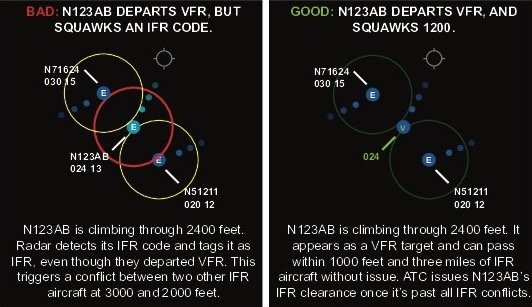
What happens if you depart on the original IFR squawk? In a word: confusion. While, you are technically VFR-you voided your clearance by departing VFR-ATCs radar doesnt know that. Itll still detect that IFR squawk and tag you up on the scope as if you were on that IFR clearance. An unexpected IFR target popping up amidst their other IFR traffic is a real distraction to a controller, especially if its an aircraft who was expected to hold for release.

Gemini Sparkle

Key Takeaways:

  • When unable to obtain an IFR release from ATC at a non-towered airport due to communication issues, pilots must explore alternative strategies to proceed safely.
  • Viable solutions include repositioning the aircraft for better radio contact, departing VFR (squawking 1200) and requesting IFR clearance airborne, or contacting ATC via Flight Service (FSS) or a direct phone call.
  • Pilots should report communication failures to ATC and understand that "cleared for takeoff" is inappropriate at non-towered airports, as ATC does not provide visual runway clearance or bear associated liability.
See a mistake? Contact us.

You’ve had a good day so far. A friend invited you over for lunch and you took him up on the offer. You flew into a non-towered airport in his town, spent the afternoon catching up over a nice lunch, and now it’s time to head home.

With an IFR flight plan already filed to your home base, you fire up and get on the radio while still at the FBO. There’s no tower, but there is a clearance delivery frequency. The controller sounds a little hurried as you get your clearance—including a squawk code, of course—and tells you, “Hold for release. Report number one and ready to go.”


Ready to Sell Your Aircraft?

List your airplane on AircraftForSale.com and reach qualified buyers.

List Your Aircraft
AircraftForSale Logo | FLYING Logo
Pilot in aircraft
Sign-up for newsletters & special offers!

Get the latest stories & special offers delivered directly to your inbox.

SUBSCRIBE