











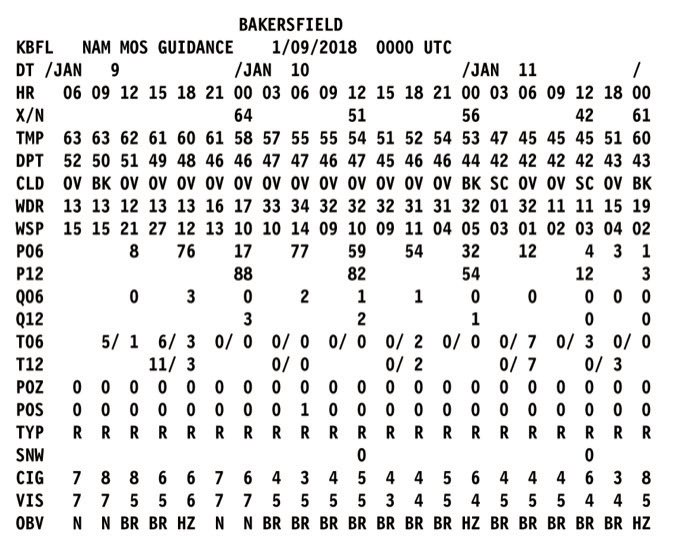


Models like the NAM, RAP, and HRRR are often considered the cutting edge of weather forecasting on supercomputers. Indeed, these are some of the best forecasting innovations of the past 15 years. They are a class of tools called dynamical models, designed to solve conditions in the entire atmosphere across a large forecast zone. Typically a three-dimensional grid is built with a granularity of several miles, and the equations of motion are solved at each gridpoint to provide us with temperature, pressure, moisture, and wind.
Extracting this raw data directly does not provide good information for planning purposes. Forecasters rely onstatisticalmodels, which offer better integration of all the available information. A statistical model often usesdynamicalmodels or other data as a source of information, and then uses a system of predictors to determine the weather.

