













Register

Going Direct: HUD vs. Combined Vision

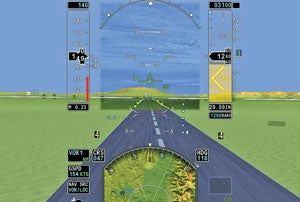
** Honeywell's experimental head-down solution
combines infrared and computerized vision
with traditional PFD symbology. Some early
tests are encouraging, but can the new system
replace HUDs in the cockpit?**
Gemini Sparkle

Key Takeaways:

  • The aviation industry is debating whether pilots should focus head-down on primary flight displays or head-up on the runway during critical low approaches.
  • Honeywell's "combined vision" system, which blends enhanced and synthetic vision on a PFD, demonstrated in tests that pilots achieved landing accuracy equivalent to those using Head-Up Displays (HUDs), challenging the perceived superiority of HUDs.
  • Rockwell Collins, a major HUD manufacturer, advocates for continuous head-up viewing and has introduced a new, more compact and affordable HUD, the HGS-3500, to expand HUD technology to a wider range of business aircraft.
  • The competition between Honeywell's head-down PFD-based vision systems and Rockwell Collins' head-up HUD technology represents a significant battle for market share and design philosophy, driving innovation in aviation.
See a mistake? Contact us.

(January 2012) The question that was being debated around the halls of NBAA 2011 the other week was about as technical and geeky as it gets: When flying a very low approach, lower even than a decision height of 200 feet, where is the proper place for your “head,” that is, your eyes and your attention, to be? Should it be down, looking at the primary flight display, and then out, looking for the runway environment at decision height, or should your eyes simply be up and outside the airplane all the time?

At first blush, it sounds as though it’s a no-brainer. Why would the pilot be looking down when the runway is out there if he doesn’t have to be? Then again, unless the airplane is equipped with a head-up display, the pilot has to be looking down a good part of the time. Quantifying how much time is spent up and how much time is spent down is not an easy task. Proficient instrument pilots are skilled at monitoring two instruments simultaneously while peeking at a third, and the layouts of PFDs make it easier to see even more than that without shifting focus. I’ve long felt that the way we teach instrument students to scan is a poor imitation of the way we actually take in the flight instrument data and make sense of it, but one does have to start somewhere. The theory behind the HUD is that, by using it, the pilot has everything in the main field of view. There is still a scan going on, though it is a compact, fluid and efficient one, to be sure.


Isabel Goyer

A commercial pilot, Isabel Goyer has been flying for more than 40 years, with hundreds of different aircraft in her logbook and thousands of hours. An award-winning aviation writer, photographer and editor, Ms. Goyer led teams at Sport Pilot, Air Progress and Flying before coming to Plane & Pilot in 2015.

Ready to Sell Your Aircraft?

List your airplane on AircraftForSale.com and reach qualified buyers.

List Your Aircraft
AircraftForSale Logo | FLYING Logo
Pilot in aircraft
Sign-up for newsletters & special offers!

Get the latest stories & special offers delivered directly to your inbox.

SUBSCRIBE