












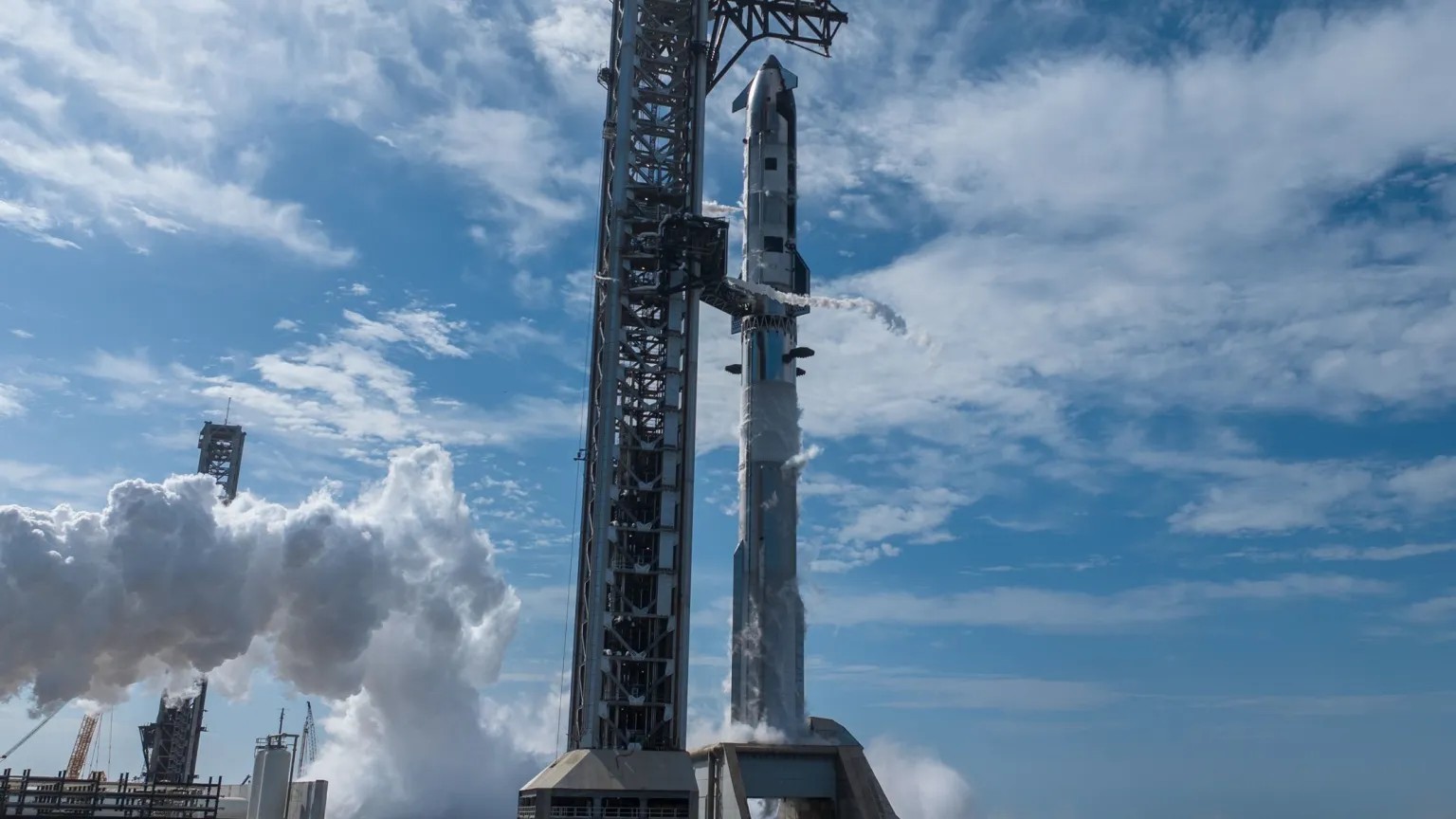


After completing what it said was a “thorough assessment,” the FAA on Wednesday ordered SpaceX to investigate anomalies that its Super Heavy booster experienced during the 12th test flight of its behemoth Starship rocket.
The aviation regulator on Tuesday was ambiguous about whether an investigation would be required into Starship Flight 12, which launched Friday evening from SpaceX’s Starbase facility in Texas. Now, it is grounding the largest rocket ever constructed until the company determines what prevented multiple engines from lighting during a planned Super Heavy flip and boostback maneuver.

Super Heavy, powered by 33 Raptor engines, is the vehicle that boosts Starship to suborbit, the highest altitude it has reached in flight testing. Stacked together, the spacecraft stand more than 400 feet tall, or nearly the length of a Boeing 777. SpaceX aims for Starship to reach low-Earth orbit (LEO) in 2026, per the prospectus it filed with the Securities and Exchange Commission last week outlining its planned initial public offering (IPO).
Ahead of stage separation minutes into Flight 12, one of Super Heavy’s engines shut down prematurely. Several more failed to ignite during the flip and boostback burn, ending the maneuver prematurely. The booster struggled to light its engines as it tumbled back to Earth, ultimately splashing down hard in the Gulf of Mexico.
Despite losing one of its own six engines, the Starship upper stage achieved its planned trajectory and released 20 dummy Starlink satellites. Two of these performed the first in-space scans of Starship, a capability that could be used in the future to determine its health before attempting to catch it back at Starbase. SpaceX aims for both rocket stages to be fully reusable.
Starship also made it to atmospheric reentry and splashdown in the Indian Ocean, which it has sometimes failed to accomplish. The ship performed maneuvers intended to stress its heat shield, which appeared to fare better than on previous missions.
However, the FAA’s mishap determination will keep Starship grounded until SpaceX completes an investigation. In the past, that has typically taken months.
The agency could also issue an earlier return-to-flight determination as it did for Starship Flight 8 in March 2025, before SpaceX completed its inquiry into January’s Flight 7 anomalies. That can only happen when an anomaly does not jeopardize public safety. But the FAA could do the same for Flight 13 after receiving “no reports of public injury or damage to public property,” it said Wednesday.
The agency said the booster anomaly prompted it to activate a debris response area (DRA), placing five aircraft in holding patterns and delaying six departures.
SpaceX Soldiers On
Flight 12 was SpaceX’s first launch of Starship in its upgraded Version 3 (V3) configuration, which is larger and more powerful than its predecessors.
The V3’s improved Raptor 3 engines produce double the thrust of NASA’s Space Launch System (SLS)—the launch vehicle for April’s Artemis II moon mission—at sea level. Per CEO Elon Musk, that gives it a payload of almost 100 metric tons, far more than the Version 2 (V2) Starship that debuted on Flight 7.
The improved payload should allow Starship to launch larger batches of Starlink satellites than the company’s Falcon 9 and Falcon Heavy spacecraft. It also gives the rocket enough juice to reach LEO. Those upgrades could allow Starship to begin commercial orbital missions.
More enhancements to Starship will enable in-space docking and propellant transfer demonstrations for NASA ahead of a planned human lunar landing in early 2028. The space agency is considering the Starship human landing system (HLS) variant as the vessel to deliver astronauts to the moon’s surface. SpaceX and NASA officials have estimated the mission will require low-single digit or double digit tanker flights to stock an orbital fuel depot, where the Starship HLS will stop on its way to the moon.
SpaceX said the main goal of Starship Flight 12 was to test how the V3 upgrades performed under real flight conditions, which it succeeded in doing. At the same time, the rocket’s grounding will disrupt SpaceX’s aim to increase its cadence.
The more than seven-month drought between Flight 11 in October and last week’s test flight was the longest since Starship debuted in April 2023. During that time, SpaceX constructed a new pad at Starbase to accommodate the V3 and decrease mission turnaround time. But as the midpoint of 2026 looms, it has now completed only one flight following two in 2023, four in 2024, and five last year.
SpaceX has FAA approval to conduct up to 25 annual Starship launches and landings at Starbase in Texas. It plans to build V3 pads on Florida’s Space Coast and is also exploring international launch sites. Until the company solves its Super Heavy issues, those assets won’t be fully utilized.
Additionally, delays to Starship flight testing could prompt NASA to instead use Blue Origin’s Blue Moon Mark 2 as the landing system for its 2028 lunar landing attempt. Politico in November reported that SpaceX’s Starship propellant transfer demonstration is planned for June. Artemis III, a planned demonstration of both SpaceX and Blue Origin’s HLS systems, is scheduled for late 2027.
Starship Safety Concerns
Starship’s first six test flights in 2023 and ’24 were a mixed bag, with some ships reaching splashdown and others breaking apart in orbit.
Flight 7 in early 2025, though, was different. It marked the debut of Starship V2, which suffered a “rapid unscheduled disassembly”—SpaceX parlance for an explosion—within minutes of lifting off. Flight 8 in March suffered a similar fate.
The exploding ships cascaded debris into the airspace below the flight path, prompting the FAA to activate DRAs and clear aircraft. The Flight 8 DRA diverted 28 aircraft, placed another 40 in holding patterns, and delayed 171 departures. According to digital news outlet ProPublica, multiple aircraft placed in holding patterns ran low on fuel. An Iberian Airlines flight carrying 283 people reportedly declared Mayday to bypass the DRA and land safely in Puerto Rico.
The FAA in response increased the size of aircraft hazard areas (AHAs) for future Starship flights. It warned pilots to exercise extra caution to avoid “catastrophic” mishaps due to falling space debris when flying through the AHAs. That could include stocking additional reserves to avoid a fuel emergency if forced to hold.
However, per Steve Jangelis, aviation safety chair for the Air Line Pilots Association (ALPA), out of four Starship test flights that required DRAs, the FAA activated only one within a required six-minute, 30-second time frame, in part because SpaceX was slow to respond. The Wall Street Journal reported that the company did not immediately tell the FAA about its Flight 7 mishap, leading air traffic controllers to learn of it from pilots who witnessed falling debris firsthand.
Starship’s tenth and eleventh test flights were a return to form, with both Starship upper stages completing controlled splashdowns. However, the requirement of yet another DRA for Flight 12 is a reminder that the rocket is still experimental.
FAA analysis indicates that there could be further disruptions to commercial aviation under new trajectories it greenlit for Starship in February. Larger AHAs will prompt increased airspace closures, affecting more than 13,000 commercial aircraft operations annually, by the agency’s estimate.

