












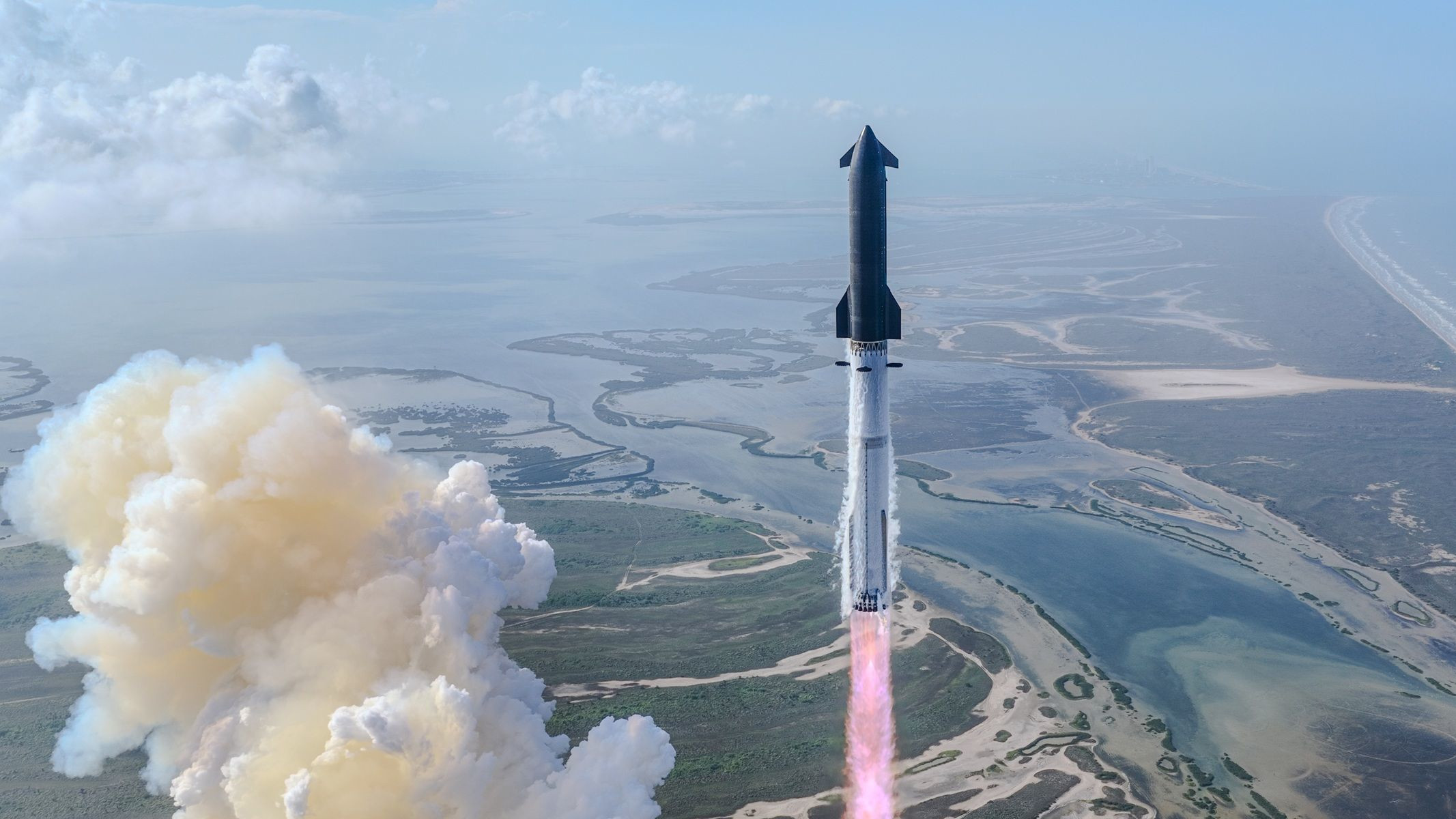


Ahead of what observers anticipate will be the largest initial public offering (IPO) in history, SpaceX debuted its largest rocket yet on a mostly successful mission.
Though Starship and the Super Heavy booster—which combined stand more than 400 feet tall, nearly the length of a Boeing 777—suffered multiple engine failures, the ship achieved its planned suborbital trajectory and deployed a batch of dummy Starlink satellites. For the first time, two of these used cameras and sensors to scan Starship in space.

The ship’s flaps and heat shield also appeared to fare better during the extreme conditions of atmospheric reentry than they have on previous test flights. SpaceX in a post-mission update said it was “able to gather critical data on the performance of [Starship’s] heatshield and structural strength.”
Starship’s 12th test flight, its first using an upgraded Version 3 (V3) vehicle, followed the rocket’s longest drought between missions since it debuted in April 2023. SpaceX has not yet indicated when the next flight may take place. But the debuts of Starship Versions 1 and 2 in 2023 and 2025 both ended in explosions, which means the V3 could be back in action sooner than its predecessors.
NASA Administrator Jared Isaacman in a social media post Tuesday congratulated SpaceX on what he called a “hell of a V3 Starship launch.” The FAA said the engine anomalies prompted it to activate a debris response area (DRA), where booster debris fell and forced five aircraft into holding patterns. But the agency said Tuesday that it has not yet required SpaceX to conduct a mishap investigation, which would keep Starship grounded.
“The FAA is aware an anomaly occurred during the SpaceX Starship Flight 12 mission that launched from Starbase, Texas, on May 22,” the FAA said in a statement. “The anomaly involved the Super Heavy booster during its flyback over the Gulf of America. There are no reports of public injury or damage to public property.”
The V3’s introduction could be a boon for SpaceX’s IPO. In the prospectus it filed with the SEC on Wednesday outlining the IPO, the company said it expects to begin orbital missions with Starship in the second half of 2026. All flights to date have been suborbital, preventing the rocket from delivering Starlink satellites to low-Earth orbit.
The V3’s upgraded Raptor 3 engines produce more than double the thrust of NASA’s space launch system (SLS)—the launch vehicle for the Artemis II lunar mission—at sea level, and its reduced mass enables payloads up to 100 metric tons, per SpaceX CEO Elon Musk. That could allow Starship to deliver larger batches of satellites than the company’s Falcon 9 or Falcon Heavy.
Per CNBC, Starlink deployments account for nearly 70 percent of SpaceX’s revenue. American Airlines on Tuesday joined United Airlines, Delta Air Lines, and other carriers in adding Starlink to its fleet. SpaceX also aims to deploy satellite constellations to create orbital data centers.
At the same time, it is reportedly navigating strife with the Pentagon over hiking Starlink connection costs fivefold during the Iran War, per Reuters. Both Musk and the Pentagon have refuted the report.
The human landing system (HLS) variant of Starship will play a key role in NASA’s Artemis campaign. Ultimately, the agency seeks to build a multibillion-dollar moon base, using the Starship HLS to deliver astronauts to the lunar surface as soon as 2028. It shared new details of those plans Tuesday.
Per SpaceX, enhancements to the V3 Starship will enable ships to dock and transfer propellant in orbit. That would allow SpaceX to complete demonstrations for NASA ahead of human missions to the moon, which will require the Starship HLS to fuel up at an orbital depot.
How Starship Flight 12 Went Down
After an earlier launch attempt was scrubbed, Starship lifted off from SpaceX’s Starbase launch pad in Texas at 6:30 p.m. ET on Friday.
Ahead of the mission, SpaceX installed a second pad at Starbase that is designed to accommodate the larger V3. The new pad appeared to suffer only minor damage Friday, which bodes well for SpaceX’s plans for similar sites on Florida’s Space Coast.
During ascent, one of Starship’s 33 Raptor engines shut down. Several more failed to light during Super Heavy’s flip and boostback burn, ending the maneuver prematurely, SpaceX said. Super Heavy then “attempted to relight its engines for the landing burn” but ultimately splashed down hard in the Gulf.
Meanwhile, the Starship upper stage successfully lit its six Raptor engines and continued on its suborbital trajectory. It too lost an engine but achieved its intended flight path by burning the other engines for longer than usual. Due to the earlier failure, SpaceX did not attempt an in-space engine relight, which it has demonstrated on many previous missions.
However, Starship did deploy its 20 dummy satellites, including two that assessed the ship as it hurtled through space. The demonstration was the first test of the vehicle’s upgraded, PEZ dispenser-like mechanism, designed for rapid orbital deployment.
During reentry, SpaceX said it intentionally placed stress on the rocket’s flaps to test their limits. Starship also performed a “dynamic banking maneuver” intended to mimic the trajectory it would take for future catch attempts at Starbase. SpaceX has successfully caught Super Heavy on multiple occasions and recently upgraded the launch base’s tower to accommodate the upper stage.
Finally, the ship used its flaps to guide itself to a predetermined zone in the Indian Ocean, completing a successful flip, burn, and splashdown. It then tipped over and exploded, as it has following previous splashdowns.
More upgrades and test flights will set the stage for full reusability. The new Starlink scanners could help SpaceX determine the health of the ship’s heat shield in orbit before it determines whether or not to attempt a catch. But that is unlikely to happen until the engine anomalies are solved.
The next major step will be advancing to an orbital trajectory once engineers are confident that Starship can complete a controlled reentry that does not endanger commercial aircraft. That would open up commercial Starlink deployments and demonstrations for NASA.

