













Register

Pitot-Static Blockages

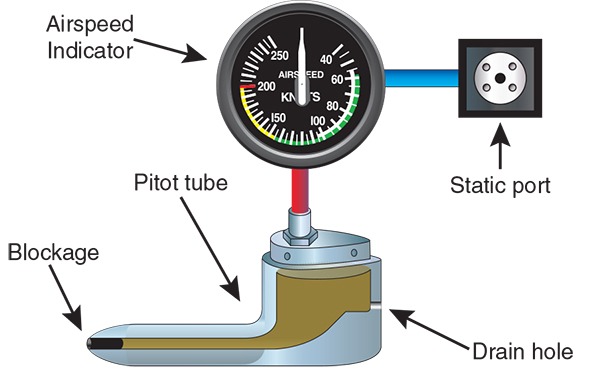
One pitot/static failure mode, involves a blocked pitot tube but an open drain hole. In this scenario, the airspeed indicator shows zero, since the rest of the system is open to static pressure. As the FAA’s Pilot’s Handbook of Aeronautical Knowledge (FAA-H-8083-25B) states, “ram air is no longer able to enter the pitot system. Air already in the system vents through the drain hole, and the remaining pressure drops to ambient (outside) air pressure. Under these circumstances...the ASI senses no difference between ram and static air pressure.”
Gemini Sparkle

Key Takeaways:

  • Pitot-static systems, vital for airspeed measurement, are highly vulnerable to blockages (e.g., ice, covers, insects) which can lead to erroneous or absent airspeed indications.
  • Similar pitot-static blockages can result in drastically different outcomes, as seen in two Boeing 757 incidents; effective crew resource management and timely, accurate diagnosis were key to survival in one case, while their absence led to a fatal crash in the other.
  • Various types of pitot or static port blockages produce distinct, often confusing, instrument readings and contradictory automated system warnings, making accurate diagnosis by the crew a significant challenge.
  • Successfully managing a pitot-static failure relies on pilots critically interpreting confusing instrument data, correctly diagnosing the specific blockage type, and applying appropriate manual control strategies, often without advanced warning systems found in transport aircraft.
See a mistake? Contact us.

To sense airspeed, the vast majority of airplanes use a pitot tube. Oncoming air enters the tube and is routed to the airspeed indicator or the air/data sensor. That’s where the air’s pressure is measured and compared with ambient or static, then translated into knots or some other measurement and displayed on the instrument panel. The pitot tube itself is mounted somewhere on the airplane’s exterior. As such, it’s exposed to the elements, whether the airplane is airborne or parked.

The basic device was invented by Henri Pitot in the 1700s. In non-aviation applications, its principle of measuring pressure can be used with other fluids, not just flowing air. Like any similar system, if the pitot tube is blocked, it won’t work. And a blocked pitot tube or system poses a significant challenge for pilots of all airplanes. The best examples of what can happen and how pilots might respond comes from two well-documented events.


Ready to Sell Your Aircraft?

List your airplane on AircraftForSale.com and reach qualified buyers.

List Your Aircraft
AircraftForSale Logo | FLYING Logo
Pilot in aircraft
Sign-up for newsletters & special offers!

Get the latest stories & special offers delivered directly to your inbox.

SUBSCRIBE