











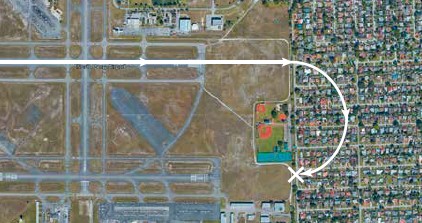


Few of us will never need a 180-degree turn back to a runway following a power failure. But, if you ever do, here is a trick for you to consider. Recently, a Beechcraft B36TC Bonanza was cleared for takeoff from Runway 10L at North Perry Airport (KHWO), located six miles southwest of Fort Lauderdale/Hollywood International Airport in Florida. After liftoff, the Bonanza suffered an engine failure. The pilot attempted a right 180-degree turn to the parallel runway to land on or near Runway 28L. This is often referred to as “the impossible turn” for a variety of factors. Unfortunately, during the maneuver, it struck a utility line (unconfirmed) and then an SUV on the road adjacent to the airport. It came to rest in a ball of fire against the airport’s chain-link fence with tragic results. Both occupants of the airplane and a passenger in the SUV perished.
Had the airplane been 100 feet higher, it might have overflown the chainlink fence and landed on the airport property, which is open land. Assuming he used best glide speed, how else might the pilot get that needed 100 feet? A nearby doorbell camera captured the moment of impact and showed the gear was retracted. The next question is, did
the pilot consider placing the constant speed prop in the “coarse” position to minimize its drag?

