













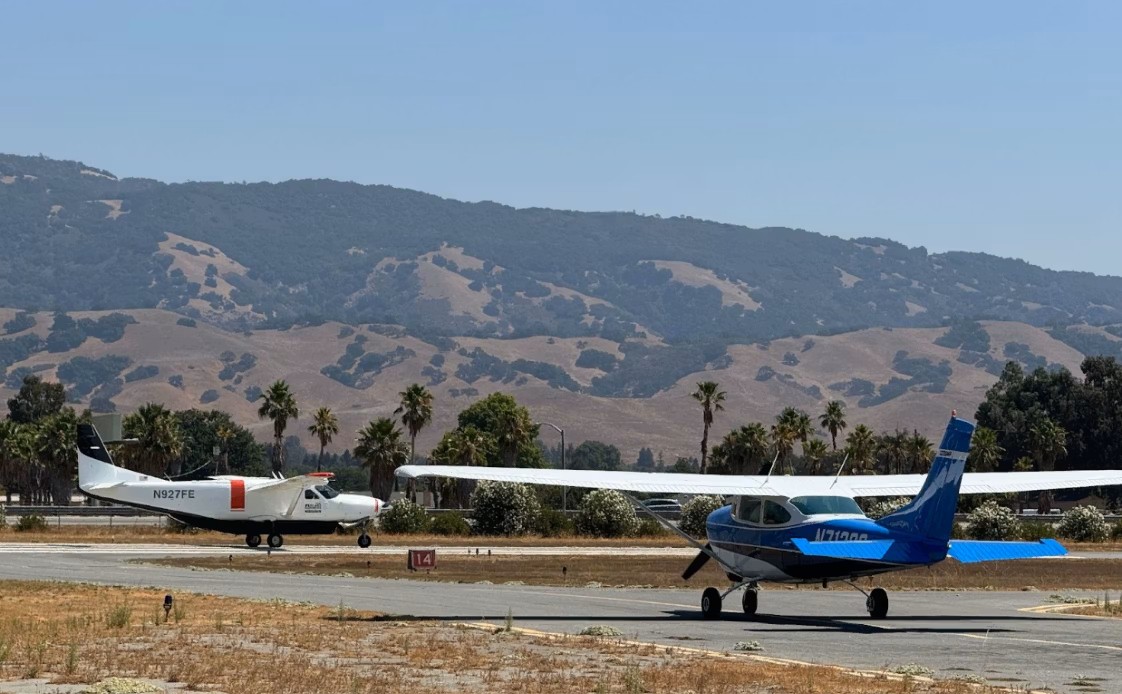


Remotely piloted aircraft are flying in and around airports to help the FAA develop certification standards for large uncrewed aircraft systems (UAS).
The data collection flights in and around the terminal area of Hollister Municipal Airport (KCVH) in California are intended to guide the FAA and standardization bodies in their quest to safely integrate larger UAS models. The FAA has regulations for small UAS, such as delivery drones, but they do not cover models weighing over 55 pounds.

Reliable Robotics on Tuesday shared details on the flight test campaign, which gauged how a Cessna 208B Grand Caravan equipped with its detect and avoid (DAA) system separated from and avoided collisions with an “intruder” aircraft. The testing marks the completion of a contract the FAA awarded in 2024.
Reliable’s DAA system is built around the FAA’s ACAS X technology—a more sophisticated version of Traffic Alert and Collision Avoidance System II (TCAS II) designed to improve alerting and minimize nuisance alerts. ACAS Xu is the version of the system for uncrewed, fixed-wing models, such as the company’s Caravan testbed.
Combined with Reliable’s air-to-air radar and sensors, the ACAS Xu-based DAA platform helps a remote pilot steer clear of all other aircraft. It receives data from cooperative as well as noncooperative radars, which track aircraft without onboard avionics. That means the system can detect aircraft that are not broadcasting their position. It is designed for IFR operations in all classes of airspace. Traffic, alerting, and guidance are displayed for the remote pilot.
FAA Puts DAA to the Test
Reliable said it found that the “behavior and output” of ACAS X changed between en route and terminal airspace, “confirming an important adjustment that pilots under IFR make to interoperate with VFR aircraft.” The campaign used two aircraft—Reliable’s DAA-equipped Caravan, N927FE, and an instrumented Cessna 182 Skylane.
The Caravan navigated more than 50 scripted “encounters” with the Skylane on a converging flight path, feigning a loss of safe separation. It was commanded by a remote pilot from about 50 miles away but flew area navigation (RNAV) approaches under “full control” of Reliable’s automation system, the company said. The remote pilot and intruder pilot coordinated closely to ensure the aircraft did not actually come within an unsafe distance.
The intruder aircraft used the minimum viable equipment set to meet FAA requirements for ADS-B equipage, mirroring the systems on older, smaller aircraft. That allowed Reliable to test the performance of both cooperative and noncooperative radar.
Data is being shared with the FAA as well as the RTCA committees developing minimum standards for ACAS Xr, which covers rotorcraft and electric vertical takeoff and landing (eVTOL) models, and DAA systems.
“Demonstrating the ability of UAS to integrate into airport environments with a VFR traffic pattern is necessary for building a scalable aviation autonomy solution,” said Brandon Suarez, vice president of UAS integration for Reliable. “The data Reliable captured through this testing under the FAA is nearly impossible to generate in a lab environment, and is tremendously useful in the development of relevant and useful standards.”
The campaign was conducted in partnership with Virginia Tech’s Mid Atlantic Aviation Partnership (MAAP). Prototype ACAS X hardware, ground-based radar, and communication equipment were supplied by Sagetech, Collins Aerospace, and uAvionix, respectively.
Takeoff to Touchdown Autonomy
Reliable’s DAA system integrates with its Reliable Autonomy System (RAS), which is designed to automate all phases of flight, eliminating accidents due to pilot error or impairment such as controlled flight into terrain (CFIT) and loss of control in flight (LOC-I).
The system automates control surfaces and engine controls, using DAA, precision navigation systems, and continuous autopilot technology to chart its own path. A remote supervisor can use voice and data links to communicate with air traffic control and other pilots, stepping in if necessary to coordinate an alternative landing spot. Electromechanically actuated brakes enable autolanding.
Reliable has a partnership with Textron to retrofit the Caravan, its intended launch airframe. But the RAS is designed for just about any model, including heavy-duty military airframes such as the KC-135 or Cessna 408 SkyCourier. An onboard safety pilot will oversee initial operations with small cargo aircraft.
Reliable is working toward supplemental type certification (STC) to convert the Caravan to a UAS and retrofit other Part 23 cargo and Part 25 passenger aircraft. It seeks approval for operations across the entire coterminous U.S. and Alaska, with no special conditions or exemptions.
The FAA in 2022 approved the company’s G-1 issue paper, defining the certification basis for its STC on the Caravan. In 2023, it formally accepted project-specific certification plans (PSCP) for its continuous autopilot engagement system. The sides have also agreed upon a testing and analysis campaign for Reliable’s advanced aircraft navigation and autopilot systems.
However, the FAA must still define broader standards for DAA systems for large UAS.
In addition to the recent FAA data collection flights, Reliable in 2023 performed DAA encounter flights for NASA with the Caravan and a Cessna Skyhawk, helping it evaluate primary surveillance radars. It secured two more NASA partnerships in 2025—one focused on integrating uncrewed cargo aircraft at scale, and another for airport data collection flights, similar to the FAA campaign.
Further testing could give regulators more insight into large UAS operations. As soon as this summer, Reliable and the city of Albuquerque, New Mexico will conduct autonomous cargo operations out of Albuquerque International Sunport (KABQ), Durango-La Plata County Airport in Colorado (KDRO), and Santa Fe Regional Airport (KSAF). Those demonstrations under the eVTOL Integration Pilot Program (eIPP) are expected to net the FAA valuable real-world data.
The U.S. Air Force, meanwhile, last year awarded Reliable a $17.4 million contract to integrate, test, and deploy an autonomous Caravan on a yearlong operational mission in Guam.

