












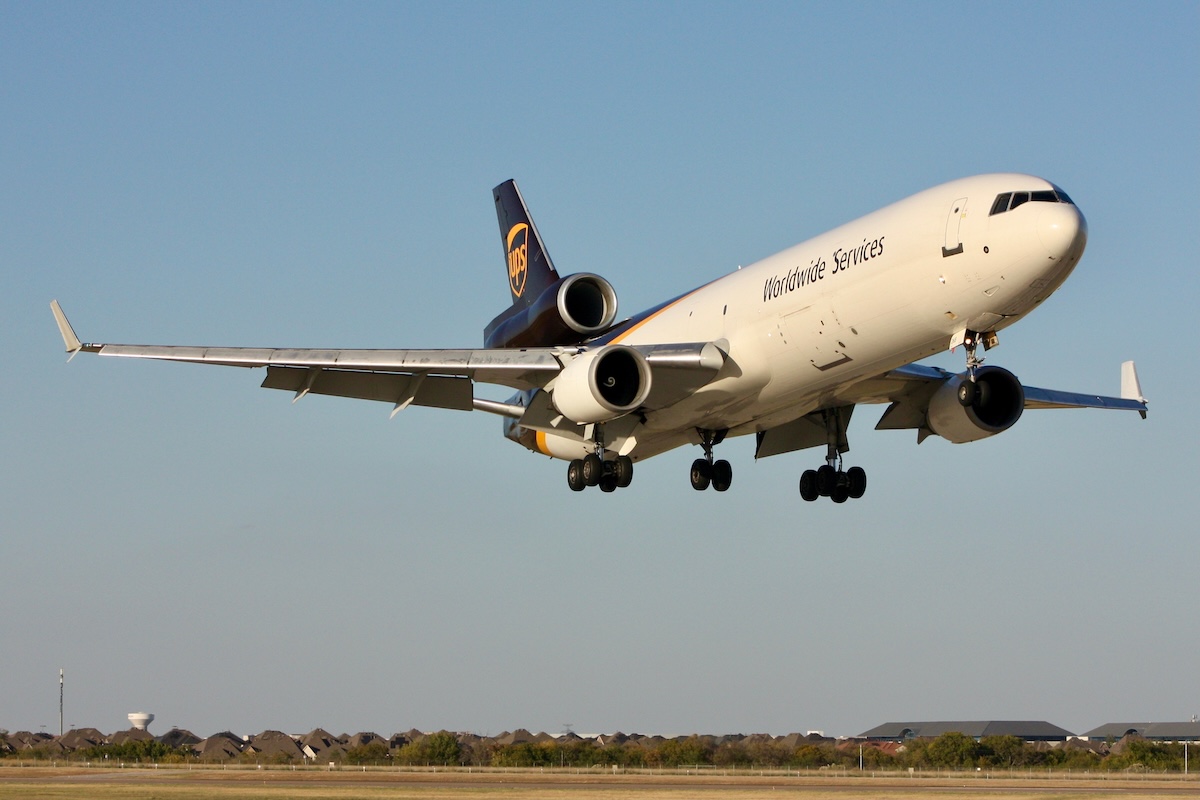


The cockpit voice recorder (CVR) of the UPS cargo jet that crashed in Louisville, Kentucky, on Tuesday revealed the sound of a bell heard in the cockpit 37 seconds into the takeoff roll.
This was part of the information released by Todd Inman, board member for the National Transportation Safety Board (NTSB) at Friday’s media briefing. Inman was joined by Chihoon Shin, the agency investigator in charge of the investigation.
Inman began the briefing by again expressing the agency’s condolences to the families of the victims and thanking the first responders and local authorities who have been part of the recovery efforts. He advised that the investigative team was encouraged by what has been found thus far on the CVR.
“The cockpit voice recorder contained 2 hours and 4 minutes of what we consider good quality digital recorded audio,” said Inman. “In reviewing that audio, [the] crew completed their standard checklists and briefings in preparation for the flight. The takeoff roll was what we called uneventful through the different speed callouts. About 37 seconds after the crew called for takeoff thrust, a repeating bell was heard on the CVR, which persisted until the end of the recording 25 seconds later. During this time, the crew engaged in efforts to attempt to control the aircraft before the crash.”
The NTSB will now be forming a CVR group of technical experts on the MD-11 at its headquarters in order to review the recording and produce a written transcript. Inman said the transcript will not be made public until a majority of the other factual reports are placed in the NTSB public docket for this accident, which will be several months from now.
The No. 1 engine continues to be the focus of the investigation of the crash at Louisville Muhammad Ali International Airport (KSDF). According to Inman, the preliminary information gathered indicates the “bulk of the left engine pylon was still attached to the left engine when the engine separated from the wing.”
These components have been removed from the scene and are now in a secure facility undergoing further examination.
In addition, NTSB investigators spent more time in the grass field near the runway using specialized equipment, including metal detectors, to look for more wreckage that might yield important information.
“But even with that work going on, we still understand the importance of the recovery of those who are still missing,” Inman said. “And we’re making sure that we are identifying any areas [where] they have potential victims and making sure that we’re trying to prioritize so that the coroner and the medical examiner can obviously do their work.”
Friday the death toll rose to 13 as one of the persons hospitalized succumbed to their injuries. Among the dead are the three UPS crewmembers. Authorities said they expect to find more victims as the recovery efforts continue.
In the coming days specialized equipment will be employed in the debris field to move larger parts of wreckage.
“They’re what are called…aviation salvers,” Inman said. “hey’re highly specialized in working accident scenes because they know exactly what can be picked up without damaging it and how to do that. Once those come in, those will actually enable us to lift and move more things, and that will help along with the investigation.”
Inman pointed out that this investigation scene has a “complicating factor” because of the type of businesses located where the aircraft came down. Both the auto yard and the petroleum reclamation company have a lot of metal and alloys and ground vehicles that were destroyed.
“We’ll have to distinguish between aircraft parts and those which may already be on the ground, but we’ve already made plans to try to move as much of that off-site and then evaluate what we need to in a different location, which will hopefully free up more of the debris area,” Inman said. “We’re cognizant of the disruptions of a lot of the businesses around there and the fact that people need to go back in and check on their property and be able to find and look for some of their lost items as well.”
In the meantime, the NTSB will be working more closely with UPS, which will be giving the agency access to another MD-11 with the same type of engines to allow investigators to become more familiar with the design. Some of the NTSB operations team members also will be utilizing UPS MD-11 simulators on-site that will allow them to study the cockpit configuration and run scenarios.
“We will be here [at the accident site[ as long as it takes,” Inman said. “Some of us may transfer out because we’re…using resources [better] to bring in other people. But I can tell you this much: We’re not going to leave until we know that we’ve secured all of the perishable evidence and all the information that will be necessary to come out with the most comprehensive investigative report. We will do it as quickly as we can and with respect to those people who are still missing family members.
“We have a good cadence, and we’re working on that cadence to make sure we’re doing it as efficiently as possible, but more importantly, making sure we’re doing everything that’s necessary.”

