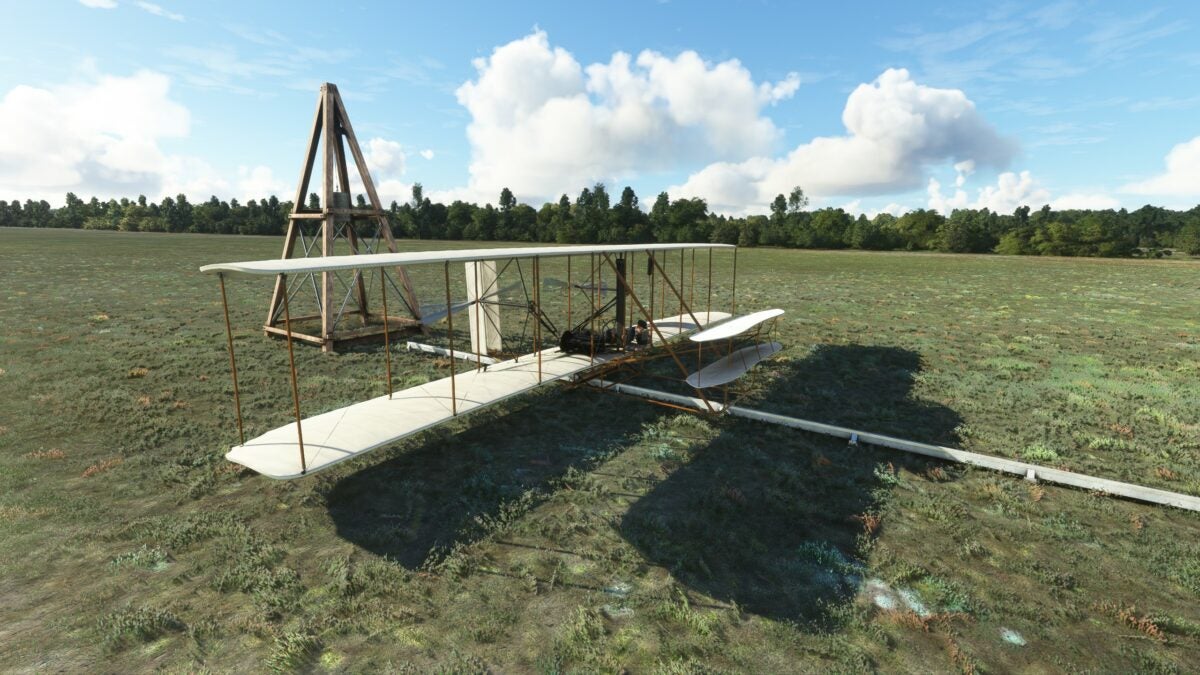
The 1903 Wright Flyer as rendered by Microsoft Flight Simulator 2020. [Courtesy: Patrick Chovanec]
Key Takeaways:
The 1903 Wright Flyer, though primitive, incorporated all essential features of a modern aircraft, most notably its groundbreaking three-axis control system.
The Wright brothers achieved their success through systematic experimentation, including building a unique wind tunnel to refine wing design and propellers, alongside developing a custom lightweight engine.
Their pivotal and patentable innovation was the method for achieving controlled flight across three axes (roll, pitch, and yaw), which laid the fundamental principles for all subsequent aircraft design and operation.
Initial flights were short and straight due to limited engine power, and the Wrights' early secrecy to secure their patent delayed widespread recognition, leading to later disputes over their inventions.
Today in Microsoft Flight Simulator 2020, I’m at Kitty Hawk, North Carolina, to reenact the first flight of the world’s very first airplane, the 1903 Wright Flyer.
At first glance, the boxy Wright Flyer doesn’t look much like our modern notion of an airplane. However, it possesses all the key features that still define an airplane to this day.
CREATE A FREE ACCOUNT
Sign up to keep reading
Create a free account to continue. Already a member? Sign in below.
Patrick Chovanec works as an economist in New York City, and has taught as a professor at China's Tsinghua University and at Columbia University. He is a private pilot, and author of the recently released book ""Cleared for the Option: A Year Learning to Fly.""