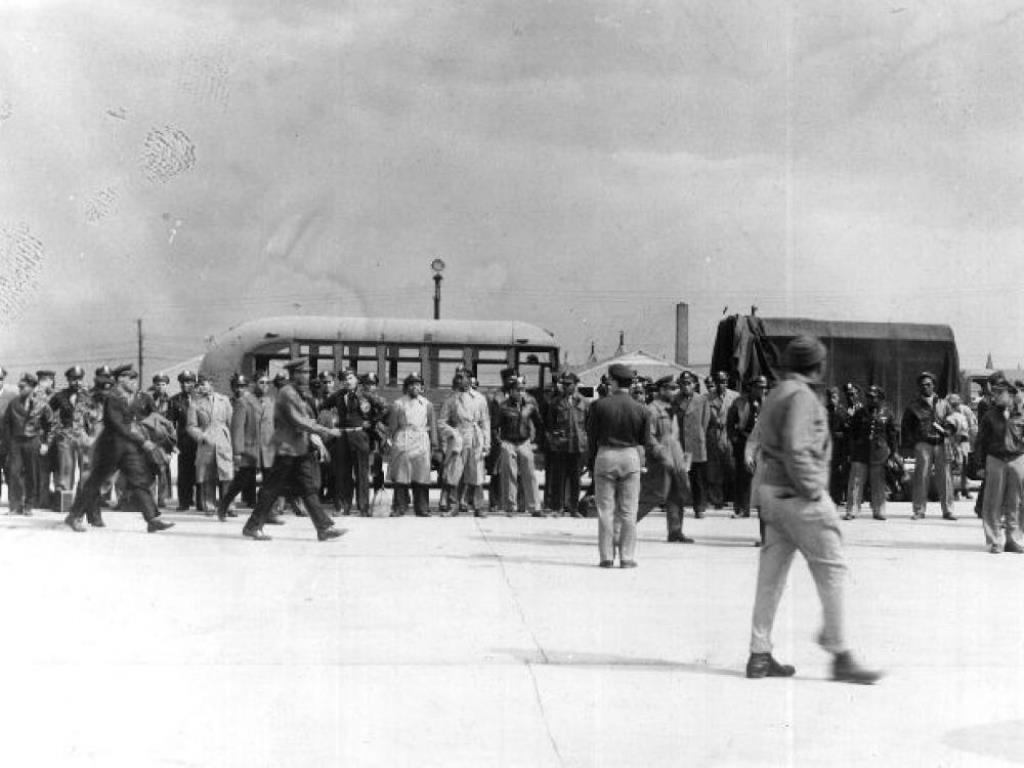
This photograph shows part of the 477th bomber group after being arrested at Freeman Field.
[Credit: Library of Congress]
Key Takeaways:
Freeman Army Airfield, established in 1942, initially served as a WWII bomber pilot training base and later became the Foreign Aircraft Evaluation Center for captured enemy planes.
In 1945, the airfield was the site of the "Freeman Mutiny," a pivotal civil rights incident where Black officers challenged segregated facilities, leading to arrests and contributing significantly to President Truman's order to desegregate the U.S. armed forces.
The airfield's diverse history, including its role in the mutiny and foreign aircraft evaluation, is now preserved and commemorated at the Freeman Army Airfield Museum, which also features monuments to the Tuskegee Airmen involved.
Constructed in 1942, Freeman Army Airfield in Southeastern Indiana was a training base for U.S. Army Air Corps bomber pilots through 1944. It became the Foreign Aircraft Evaluation Center after World War II ended.
Near the war’s end, it was also the site of a pivotal civil rights battle that helped desegregate the armed forces.
CREATE A FREE ACCOUNT
Sign up to keep reading
Create a free account to continue. Already a member? Sign in below.
William Flood is a freelance historian and writer specializing in local history and heritage tourism. He has written extensively on subjects such as vintage highways, historic architecture, and twentieth-century commercial culture. He is the author of two Ohio local history books.