














Register

The High Speed, Low Drag Northrop X-21

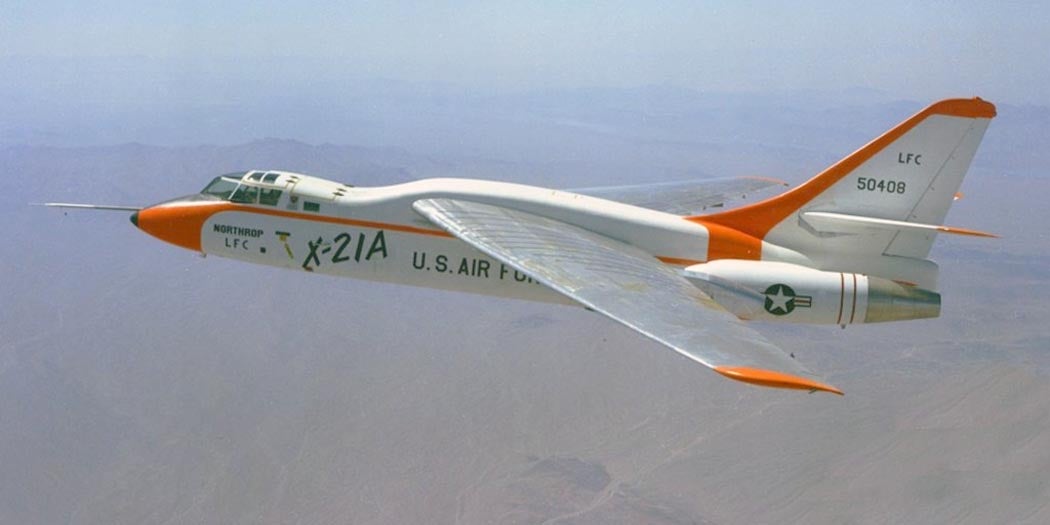
The prototype's wing lift was artificially boosted by an extensive pattern of razor-thin slots in the upper wing surface to reduce drag.

The X-21A’s wing incorporated an extensive pattern of razor-thin slots in the upper wing surface to reduce drag. [Credit: NASA photo]
Gemini Sparkle

Key Takeaways:

  • In the 1960s, Northrop led a research program, resulting in the X-21, to explore Laminar Flow Control (LFC) – a technology designed to reduce aerodynamic drag on aircraft wings by up to 80 percent.
  • The X-21, a heavily modified Douglas B-66, utilized millions of tiny slots and a vacuum system on its wings to control airflow and successfully demonstrated the LFC system's effectiveness in flight.
  • Despite its drag reduction capabilities, LFC was deemed impractical for operational aircraft due to its susceptibility to environmental factors like moisture, icing, and insect buildup, which would clog the delicate wing slots and cause dangerous performance issues.
  • Both X-21 testbeds are currently derelict in the desert, but the Air Force Flight Test Museum plans to recover and restore one for display, pending necessary funding.
See a mistake? Contact us.

If an aerospace engineer was given their choice of time periods in which to work, it’s likely the 1960s would be a top pick. With swept-wing jets like the Boeing 707 and Douglas DC-8 having made their first flights just a few years prior, the decade ahead would see the introduction of such groundbreaking aircraft as Concorde, the Boeing 747, and the XB-70 Valkyrie. Research and development budgets were robust, competition was fierce, and a young engineer looking for employment must have felt like the proverbial kid in a candy store. 

While the majority of action in the U.S. centered around the production of civil airliners, military jets, and the space race, there were some less flashy but thoroughly intriguing programs taking place in some of the industry’s quieter, less-traveled corridors. One of which was a research program led by Northrop, the U.S. Air Force, and the U.S. Army. The objective? Explore how a wing’s lift could be artificially boosted to reduce drag and increase performance, particularly in large, long-range aircraft designs—some of which would be supersonic.


Jason McDowell

Jason McDowell is a private pilot and Cessna 170 owner based in Madison, Wisconsin. He enjoys researching obscure aviation history and serves as a judge for the National Intercollegiate Flying Association. He can be found on Instagram as @cessnateur.

Ready to Sell Your Aircraft?

List your airplane on AircraftForSale.com and reach qualified buyers.

List Your Aircraft
AircraftForSale Logo | FLYING Logo
Pilot in aircraft
Sign-up for newsletters & special offers!

Get the latest stories & special offers delivered directly to your inbox.

SUBSCRIBE
