














Next year, visitors to the entertainment capital of the world will be able to take to the skies without a pilot’s certificate.
Zapata, the French company behind a jetpack and hoverboard system that founder Franky Zapata used to cross the English Channel in 2019, on Friday announced that its AirScooter—a personal, vertical takeoff and landing (VTOL) aircraft—will debut in Las Vegas in early 2026. The company’s inaugural U.S. flight center will offer training and 40-minute flights on the single-seat AirScooter, which has a top speed of 63 mph.

Franky Zapata got his start in competitive jet ski racing before founding Zapata Racing in 1998. More than a decade later, he unveiled the Flyboard, which is powered by a jet ski turbine and propels users for a few meters over the water. Flyboard was the blueprint for Flyboard Air—the prototype Zapata used to make a 22-minute English Channel crossing. It comprises a kerosene-filled backpack and special boots that strap into a board.
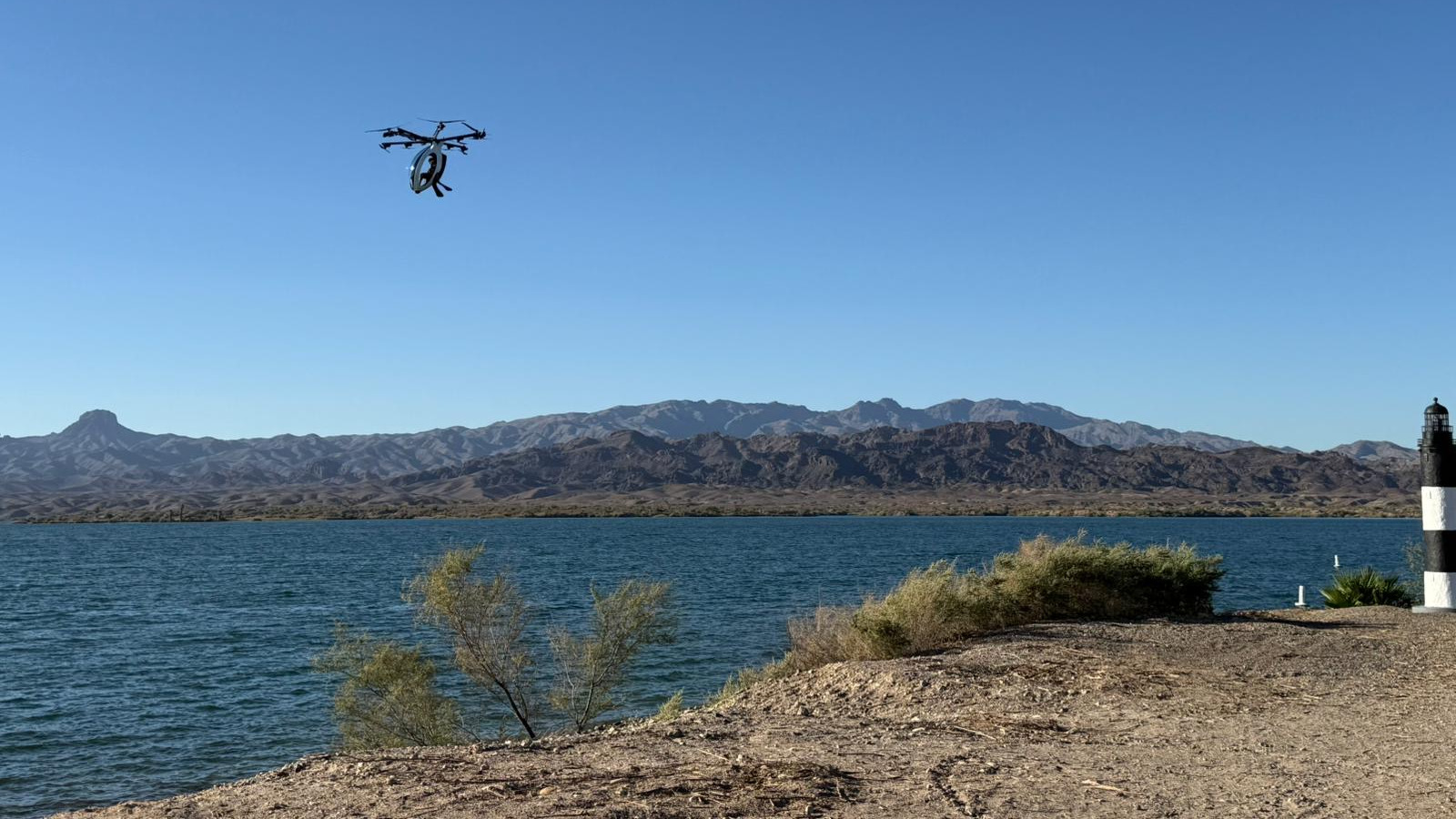
The AirScooter is Zapata’s fourth prototype and is designed to open access to personal flying machines beyond entertainment and extreme sports. In August, due to a technical issue, it was forced to land on the water about halfway through another English Channel crossing attempt. But Franky Zapata, in a LinkedIn post last week, said the AirScooter is now at Lake Havasu, Arizona, where it is undergoing flight testing.
The AirScooter Experience
With an empty weight of about 250 pounds, the AirScooter qualifies as an FAA Part 103 ultralight, meaning no pilot certification is necessary to fly it.
That allows Zapata to offer experiential flights to members of the public, similar to Texas-based Lift Aircraft and its ultralight Hexa. Other VTOL ultralights, such as Pivotal’s BlackFly and Helix, are already in the hands of private owners.
Like those models, AirScooter is designed for a single pilot, who will rely on computer-assisted fly-by-wire controls. Its hybrid-electric propulsion system comprises a hybrid powertrain and 5-gallon petrol fuel tank, combining thermal and electrical energy. Per Zapata, it has a longer flight time (about two hours) than any VTOL model currently available. The model first flew in July 2023.
Eventually, Zapata envisions commercial applications for the AirScooter, including rescue and offshore operations. It could even complement travel by plane or train, serving as a stopover for passengers between modes of transit. Initially, though, the company intends for it to be purely recreational.
At AirScooter flight centers, instructors will walk customers through a virtual reality training course and preflight checklist. Prospective flyers must also practice and pass a test in a simulator. After that, they can fly for up to 40 minutes under constant oversight from the instructor.
Through the end of 2025, Zapata is offering prebooking vouchers for $400. Voucher holders will have the first opportunity to book a flight once the schedule becomes available. Zapata will also bring the AirScooter to the Formula 1 Grand Prix in Las Vegas on November 20-22. Guests at the VIP event will get an early look at the AirScooter experience, Zapata told FLYING.

