












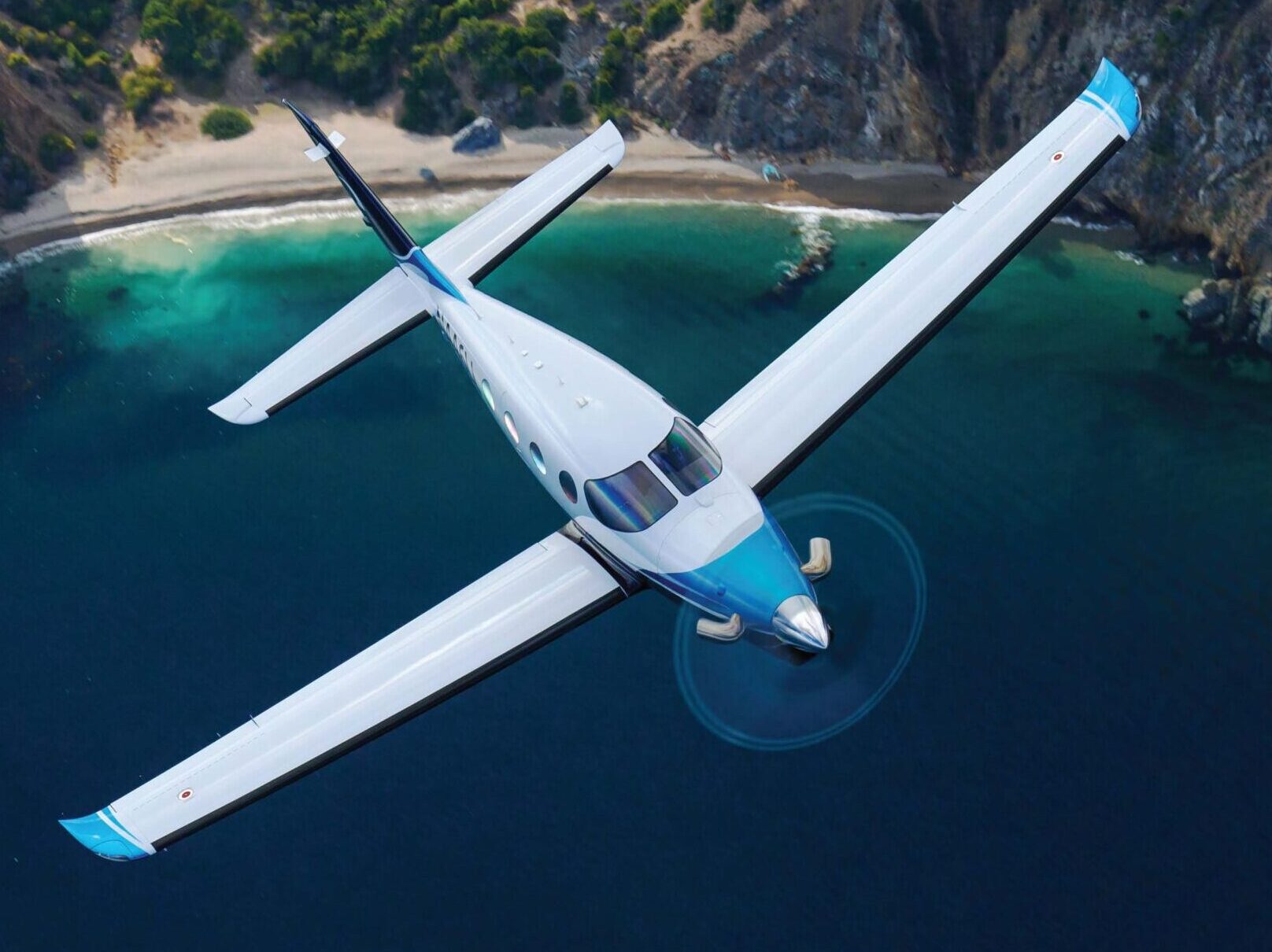


The curves compel. Looking at the flowing, complex bends of the carbon fiber airframe, the flawless fairing of the windshield, windows and deice boots with the skin as it stands tall on its trailing-link landing gear, one tends to think that the Epic E1000 AX just slips between the air molecules.
Well, sort of. Its clean design is augmented by the most power ever hung on a production turboprop single—1,200 hp, making it the fastest of the breed.

If you're not already a subscriber, what are you waiting for? Subscribe today to get the issue as soon as it is released in either Print or Digital formats.
Subscribe NowEpic Aircraft’s path to being the manufacturer of one of the top-end, single-engine turboprops was not exactly conventional. The E1000 started life as a kitplane. However, as Epic CEO Doug King told FLYING, the airplane was originally designed to be a big-engine, high-performance machine, unlike many manufacturers that start small and progressively add power.
“Being a kitplane company helped us learn how to be an aircraft company before we tried to go through certification,” King said. “Over 10 years we learned about customer support, parts supply, and manufacturing logistics. Another thing that helped us was that because we had flying airplanes in the experimental category, we could bring in designated engineering representatives, have them fly and learn what we needed to do to turn the airplane into one that could get through the rigors of FAA certification.”
- We Fly: We Fly: CubCrafters NXCub
At FLYING, we have followed what is involved in gaining FAA type certification (TC) and can say unequivocally that obtaining approval is difficult at a level few understand, and the sheer amount of time and money required is eyewatering. What’s more, rather than certificate the E1000 in the normal category, Epic took advantage of the innate strength of composites in airframe manufacture and went through the hoops to certificate the E1000 in the more rigorous utility category, something beyond rare over the last 80 years.
After the E1000 was certificated, it morphed into the E1000 GX with flight into known icing (FIKI) certification and avionics upgrades. In 2020 FLYING named the E1000 as the winner of our annual Innovation Award.
Epic has just released the most recent iteration of the airplane, the E1000 AX, with a major avionics upgrade including Garmin’s G1000 NXi suite and upped the useful load to an advertised (on its website) 2,860 pounds—gross weight 8,000, max ramp weight 8,035. We note that the airplane we flew, the first AX off the line, equipped with nearly every option, had a useful load of 2,918 pounds. That is the first time we can remember that an aircraft we reviewed had a useful load greater than shown in advertising. We can’t say enough about how much we appreciate honesty in aircraft advertising when it comes to weight, because useful load matters in the utility of an aircraft.
Other relevant numbers for the E1000 AX are its max cruise speed of 333 knots, max operating altitude of FL 340 and NBAA range of 1,560 nm. Full-fuel payload is a whopping 1,150 pounds, and max landing weight is 7,600.

The Basics
Powered by a 1,200 shp (five-minute limit, 1,000-shp continuous) Pratt & Whitney PT6A-67A turning a five-blade Hartzell composite prop, the E1000 AX boasts the most power and the highest max cruise speed of the single-engine turboprops. Max pressurization differential is 6.6 psi, giving a 9,750-foot cabin at the max operating altitude of FL 340. Because the airframe is composite, it is not subject to pressurization cycle life limits as is the case with metal fuselages.
As the FAA certification of composite airframes evolved starting with the Beechcraft Starship, we’ve observed that the FAA has remained very conservative when it comes to structural strength when allowing for damage and repair techniques—meaning that composite structures end up being much stronger than may be necessary, as well as heavier. However, that also means, as King noted, the E1000 AX is “built like a tank.” We consider that reassuring when the weather becomes turbulent.
- We Fly: We Fly: Aviat Husky
Composite construction also means being able to easily build highly complex curves, maximizing aerodynamic efficiency. In adding the radar pod to the AX, the magic of composites allowed Epic to shape it for laminar flow without impairing transparency to the radar transmission and reception.
With its reputation as a hauler, we were curious about loading flexibility.
Almost unheard of in turbine aircraft, there is no cabin weight limiting zero-fuel weight, so loading is greatly simplified. We used the Garmin G1000 NXi’s weight and balance calculation capability to run some sample loading problems. The loading envelope of the AX is slightly unconventional in that with full fuel and two large occupants up front, it’s possible to be over gross because the useful load is least at the forward CG limit. The solution is to put something in the baggage compartment. While adding weight sounds counterintuitive, it works because the gross weight of the E1000 AX increases dramatically as the CG moves aft.
Over the years we’ve flown a lot of aircraft with “aft-tending” centers of gravity—if you filled the seats, you were outside the aft CG limit, and the rear seats in six-place airplanes were unusable. That is not the case with the AX, you can generally fill the seats and the 200-pound limit baggage compartment and be well within the allowable CG range. The 18-cubic-foot baggage compartment is inside the pressure vessel, behind the rear seats.
Talking with Epic chief pilot Peter King, he told us of doing a loading problem for a flight from Van Nuys, California, to Las Vegas with two 400-pounders in the front seats, two 300-pounders in the middle seats, two 200-pounders in the rear seats, and 200 pounds of baggage. Loaded with enough fuel for the flight and a one-hour reserve on landing, the aircraft was within the CG envelope.
The AX carries 264 gallons of usable fuel. Max imbalance between the wet-wing tanks is 20 gallons. The fuel selector automatically changes tanks every two minutes.

The big change in the AX is the avionics suite, with an upgrade to the Garmin G1000 NXi integrated flight deck, including Autothrottle and Autoland. [Courtesy: Epic Aircraft]
Avionics
The big change in the AX is the avionics suite, starting with the Garmin G1000 NXi integrated flight deck with synthetic vision, vital traffic, engine monitoring, 3D Safe Taxi and Taxiway Routing, Smart Glide, and weather. It couples with the Garmin GFC 700 AFCS autopilot with flight director, envelope and overspeed/underspeed protection, and automatic level feature—one button push returns the airplane to level flight.
The dramatic news is the inclusion of Garmin’s Autothrottle and Autoland, which, when activated, takes over control of the airplane, selects an appropriate airport and runway for landing after consulting weather and NOTAMs, keeps the occupants briefed on what’s happening, notifies ATC of the emergency, flies to the airport, activating deicing systems as needed, lowers the gear and flaps, lands, stops, and shuts down on the runway.
- READ MORE: We Fly: Skyryse One
In the event of engine failure, Smart Glide picks the optimum airport for conditions, holds best glide speed, and brings the airplane overhead. With a 15.4-1 glide ratio, the AX has an 86 nm radius of action from 34,000 feet. Also included is Garmin’s GWX 8000 StormOptix weather radar that automatically sets the appropriate tilt and only depicts adverse weather that will affect the aircraft’s route in real time.
The yaw damper automatically activates when 250 feet up on takeoff and deactivates at 200 feet agl on landing. Everything is powered by a 300-amp generator and backed up by two True Blue Power Intelligent lithium-ion batteries that constantly monitor their condition and status. The batteries provided so much cranking power that both cold and hot starts never even approached engine temperature limits.
Walkaround
Approaching the E1000 AX one gets a sense of its true size—it is 35 feet, 10 inches long and 12 feet, 10 inches tall, with a 43-foot wingspan.
Preflight is conventional and gives one an opportunity to look at the excellent fit and finish of the airframe. On each wing are devices to keep the airflow attached during slow speed operations such as leading edge turbulators that energize the airflow over the ailerons, stall strips and VGs placed under the inboard section of the wing to activate the airflow over sections of the double-slotted flaps, allowing the stall speed with full flaps to be reduced to 68 knots indicated.
The deicing boots seem to mate so smoothly with the wings and tail that the only way to tell where that happens is that they are different colors.

The Epic E1000 AX is so nice to hand-fly that it stands to reason that a lot of pilots won’t make full use of the automation. [Courtesy: Epic Aircraft]
Cabin
Big airplane, big cabin—that’s true with the AX. The cabin is 15 feet long, 4 feet, 11 inches tall, and 4 feet, 7 inches wide, which gives a volume of 184 cubic feet. There is plenty of space between the club seats in the back—passengers won’t be intertwining legs.
Moving between the passenger seats in flight, we found them comfortable with amazing visibility out of the oval windows. The AX introduces CoolView windows to the Epic line. The windows, from Lee Aerospace, block 73 percent of infrared rays, resulting in a cooler cabin and help preserve its materials. They also seemed to reduce the glare associated with flying over a cloud deck.
The interior fabrics and fittings are of the quality one expects from this class of airplane, with amenities for passengers such as power plugs, lights, and vents, but nothing is ostentatious. We liked its understated presentation.
“The passenger cabin is a…nice place to ride, but this is a pilot’s airplane,” Doug King said.
Flight Deck
The roomy cabin and compact power control pedestal provide plenty of room to nestle into the pilot seats without the contortions necessary in some turbine aircraft. Once in the seat, adjustment through a very wide range of travel is straightforward. Epic advertises the flight deck as designed for pilots as tall as 6-foot-8.
As we spent time getting to know the panel, it was clear the thought that went into its design from ergonomics. Everything fell easily to hand—through human factors—and switches were grouped logically and facilitated a “flow” for the various stages of a flight.
There are two PFDs, one in front of each seat, with angle-of-attack indicators above each one, just below the top of the panel, nicely in the pilot’s line of sight. The annunciator panel is to the left of the AOA indicator, on the “wedge” panel above the pilot’s PFD. It is designed so that as a last check before takeoff the pilot presses and holds the TOGA button on the power level and the annunciator panel lights up. If all systems monitored show green, the airplane is ready for departure.
The large MFD dominates the center of the panel with a Garmin GMC 711 mode controller above, GCU Flight Management System Controller and GMA 350c Audio panel below.
The lower panels on the pilot’s side got our attention for how well they positioned and grouped relevant switches. The farthest left panel contains all the test switches and has a cover so that they are not touched accidentally. The panel to the left of the yoke contains, in descending order, pre-start, pre-taxi, and systems switches. They are actuated left to right, top to bottom.
The power quadrant is placed where a pilot’s hand naturally falls and contains the condition, prop control and power levers. The manual override lever is cleverly designed to be folded and stowed against the left side of the quadrant so it will not be moved accidentally.
Flying It
As we were getting ready to fly, I spoke with chief pilot Peter King about training, especially for pilots stepping up to the world of owner-flown turbines from piston airplanes. King, who had experience as instructor in the Cirrus Aircraft training program, said that he and top company management felt strongly that a solid initial and recurrent training program was essential for Epic pilots.
It set up an in-house program that starts with a new owner/pilot going through online training in preparation for coming to Epic’s factory in Bend, Oregon, where the pilot undertakes five days of training in a classroom, on an avionics kiosk, in a Frasca-built E1000 simulator, and in the airplane. King noted that Epic focuses on stick-and-rudder skills to the point that the first time in the airplane the pilot uses absolutely none of the automation.
Recurrent training is annual. Epic factory-approved flight instructors are available around the country, so recurrent training can be done at locations convenient to the customer. King told us that the decision was made to keep training in house so that they can be flexible in assuring that each pilot receives enough training to achieve proficiency. King said that the training program is not a profit center, but rather a safety center and of vital importance to the company.
Start-up was simplified by being able to push switches in a logical and orderly flow, ending with the start button. Then it’s time to watch to assure oil pressure is increasing, move the condition lever to low, then when Ng reaches at least 12 percent, confirm that fuel is flowing, and monitor temperature.
Taxiing requires forays into Beta as there is so much thrust at idle that the Epic will rapidly accelerate beyond taxi speed. Steering with the rudder pedals is direct and effective—brakes are only required for the tightest turns. The AX will pivot on one main gear with brake use as the nosegear steering unlocks to allow the amazingly tight turn.
Prior to takeoff, the rudder trim is set from 50 to 100 percent to the right. There’s a lot of power up front—think P-51. You’re about to experience the effect of a 6.3 pounds per horsepower weight to power ratio—something not found in many flying machines. It’s your choice whether to use the autothrottle or push the power lever up yourself. No matter how you do it, you’re in for a ride. A solid pushback into the seat as you hold enough right rudder to track the centerline and the airspeed tape seems to spin as you ready for the 90-knot rotation speed—which is reached with alacrity.
Then, pitch up a long way—12.5 degrees—this machine has power, then gear up and clean up the flaps and discover that the automatic yaw damper has engaged and you’re carrying too much right rudder. VY, 150 knots, is reached before you have time to take a deep breath and the rate of climb goes through 3,000 fpm.
Activate the automation and let the autothrottle take care of power settings in the climb to altitude—on this day at FL 320, where we record 310 ktas, burning 48.7 gph at normal cruise power. Calling for max cruise power, we watch the power lever move under the ministrations of the autothrottle as the speed slides up to 324 knots at a 52.1 gph fuel burn. Pulling the prop back to 1,500 rpm (from its normal 1,700 rpm) reduces the noise level but does not change speed or fuel burn as the autothrottle adjusts torque.
Our one-word description of the visibility from the flight deck is amazing—in all directions. It is a step above what we are used to in any airplane.
Switching to weather on the MFD and activating the GWX 8000 radar initially reveals a half-dozen areas of precipitation with red returns inside. However, within four scans an automatic feature of the smart radar analyzed each and eliminated all of them because they were either not on our route or below our altitude. We’ve used this system before for weather avoidance, and having only weather that is of concern displayed makes mapping out an avoidance route much easier.
We experimented with varying descents from an emergency descent profile—from coming down at nearly 10,000 fpm to seeing if we could cure being high and fast on an arrival procedure. We found that it is not difficult to go down rapidly and slow down, not always the case in a turbine. When that big Hartzell prop flattens out, it produces a lot of drag that lets one nicely fine-tune speed and rate of descent.
Once we canceled IFR, we spent some time hand-flying the AX. The controls are slightly heavy as is expected in the class of aircraft, but quite responsive. Roll rate, in particular, is delightfully fast when desired. All trim is electric. Even though the plane was new to us, we had little trouble holding targeted airspeeds and altitudes, although it took a bit of time to learn to make subtle power changes by appropriately bracing our hand on the throttle quadrant.
Slow flight is utterly solid with no hint of a desire to drop a wing or make speed excursions. Steep turns were just plain fun. Elevator forces are light enough that corrections were easy to make but not so light that a pilot would inadvertently load up Gs.
Slowing further, we pulled the airplane into the stall protection regime and started a stall recovery when the shaker came on, we didn’t wait for the pusher to act. Recovery was simply a matter of lowering the nose and adding power. The yaw damper kept rudder forces low, something that would not be the case with the yaw damper off.
Overall, the airplane is so nice to hand-fly that we suspect a lot of pilots won’t make full use of the automation. In the pattern, the power makes the initial climb exhilarating, and the moderate stick forces allow one to toss the airplane around a bit—OK, we’ll say it, it was fun.
We flew the pattern at 120 kias, slowing to 95 with gear and full flaps on final. The yaw damper shuts off automatically at 200 feet. On our second landing we just kept pulling the nose up and were rewarded with the shaker activating just as the wheels started to roll.
We agree with CEO Doug King—this is really a pilot’s airplane.

Spec Sheet: Epic E1000 AX
Price as Tested: $4,852,500.00
Engine: PT6A-67A
Propeller: Hartzell, composite, 5-blade
Horsepower: 1,200 shp
Length: 35.80 ft.
Height: 12.80 ft.
Wingspan: 43.03 ft.
Wing Area: 207 sq. ft.
Wing Loading: 38.6 lbs./sq.ft.
Power loading: 6.3 lbs./eshp
Cabin Width: 4 ft., 7 in.
Cabin Height: 4 ft., 11 in.
Max Takeoff Weight: 8,000 lbs.
Max Zero Fuel Weight: No zero fuel weight limit
Standard Empty Weight: 5,079 lbs. (without options)
Max Baggage: 200 lbs.
Maximum Useful Load: 2,956 lbs.
Max usable fuel: 264 gallons
Service Ceiling: 34,000 ft.
Max Rate of Climb (MTOW, ISA, SL): 2,652
Max Cruise Speed: 333 ktas
Max range: 1,560 nm [NBAA reserves]
Fuel consumption at max cruise power: 50 gph
Stall Speed, Flaps Up: 88 ktas
Stall Speed, Full Flaps: 68 ktas
Takeoff Over 50 Ft. Obs.: [ISA, sea level] 2,254 ft.
Landing Over 50 Ft. Obs.: [ISA, sea level] 2,399 ft.
This column first appeared in the July Issue 960 of the FLYING print edition.


