














You may be familiar with the concept of pianos used as weapons—it happened frequently in cartoons—but did you know that Steinway & Sons, the makers of pianos since 1853, had a military contract to build pianos during World War II? And that these pianos, packed tightly in specially designed crates, were often parachuted into war zones?
The pianos, known as Victory Verticals, are the focus of an exhibit opening Saturday, August 9 at the Museum of Flight in Seattle. You will find three of them placed among the exhibits in the WWII Personal Courage wing. In addition to the pianos, there are photographs with captions explaining the history and use of the instrument.

The idea for the exhibit came from Frank Haude, a Seattle-area resident who is a student pilot and a self-described aviation and military history enthusiast. He owns several of the pianos.
“I’ve been a longtime member of the Museum of Flight, and since supposedly these have been airdropped close to the front lines, I thought there’s an aviation connection,” he said. “There’s proof that one of them had been flown from San Francisco on a B-17 all the way to Australia.”
Haude was born in Cologne, Germany, and grew up hearing stories about how World War I and II shaped the culture there and the importance of learning from these conflicts.
“I find it extremely powerful how some artifacts can tell an entire and very complex story,” he said. “It was 1942, and the war wasn’t exactly going well for the United States. The military was looking for some sturdy pianos to send to the troops to boost morale. Steinway, who was producing gliders at the time for the War Department, said, ‘Hey, we happen to know a little bit about making pianos. Can we get in on that contract?’ The company sent the military a few upright pianos painted olive drab as requested, cheap ones with an art deco case, and the Army War Department said, ‘Yes, we like those.'”
According to Haude, approximately 1,784 were made between 1942 and 1946. They were painted olive drab for the Army and Air Corps and blue gray for the Navy and Marines.
“There was a break in the production, then a second batch was made between 1948 and 1953 for a total of approximately 2,436 pianos,” he said.
Pianos from that second batch were shipped to the Pacific and European theaters, where they found their way into USO canteens and officers’ clubs to entertain the troops. They were also used during the Korean and Vietnam conflicts.
When hostilities ended, Haude said, “They just disappeared into the fog of history.”

He first learned about them in 2010 when he saw a social media post about one that someone had liberated from a military base in Alaska.
“They were on a forum asking, ‘How much is this worth?’ An expert told him it was worth $500 max. It looked so cute in olive drab. It’s a tiny piano, only 40 inches high, and I thought, ‘I can have one of those,’ and then it took me three years to find one.”
Haude found his first piano (the three in the exhibit belong to him) in the basement of a home in Kansas City, Missouri.
“A gentleman had fully restored one. It looked beautiful, like a concert piano, painted ebony black,” he said.
He called the owner and made an offer.
“He asked, ‘Do you want to come and play it?’ I said, ‘No, no, just ship it.’ And he was really surprised. He sent me a video to show me actually how well he had restored it because he understood that I am more into the military and the artifact side of it. He sent me photos of the restoration. And there were little splotches of light blue as a color visible on the piano.”
Haude thought it had been an Air Force piano until he learned that was the color for the Navy and Marine Corps instruments. Eventually Haude’s collection increased—he also owns one that was ebony when it came off the production line and was purchased by a civilian and one in olive drab that was sent to the Army.
As it is often tradition to name an aircraft, he was compelled to name the pianos. The USN/USMC piano is Elisabeth, after his daughter, the Army instrument is named Evie, after the person who sold him the piano, and the concert piano is named Louise, after his wife. All three are on display at the MOF.

The Details
Victory Verticals have a boxy look to them, as the pianos were designed without front legs to make them easier to transport in tight crates, which are now also on display. The crates were specially designed to protect the pianos as they were pushed out of aircraft while attached to parachutes. There were three different styles of crates, said Haude, all made to be hand-carried by a group of soldiers with thick rope handles.
Even the stenciling on the crates is authentic, thanks to Steinway’s Mike Moore, said Haude.
“He found the original World War Two stenciling cutting machine. There was a thick layer of dust. It was the far corner. And then he said, ‘Frank, I will cut you every letter that you want. So with that, we’re able to create from Steinway & Sons in New York the decal ‘Musical Instrument Handle With Care Do Not Drop.’ So we have one box that has original markers in the right place. The boxes are fully functioning. There’s a lot of engineering that went on on the inside. You can push the piano into the box with a millimeter to the side, a millimeter like everywhere—and it fits perfectly.”
On at least one occasion, the ropes were used to keep the instrument from moving around in rough seas as someone was playing it, Haude said, recalling the story of a man who was sent overseas in 1945 on a troop carrier.
“Since he knew how to play piano, they let him play a piano for the troops. And the sailors were holding on to the piano by ropes because the sea was so rough. It went to Italy first, then went up the boot and then across the Alps and ended up in Germany.”
Along with a piano, the crates contained a bag of tools for tuning the instrument, instructions on how to use them, and sheet music. One of Steinway’s advertisements of the time shows an image of a Victory Vertical with a B-17 in flight above it. The tagline reads, “Instrument of the immortals, this Steinway rode in a Flying Fortress.”

Haude noted the exhibit would not have happened without Matthew Burchette, the MOF’s senior curator who “knows everything about World War II,” according to Haude, but even he was at a loss about the Victory Verticals, as it is a little-known part of the conflict.
“This is a temporary exhibit that had to happen,” Haude said. “He said, ‘Let’s show the pianos; let’s show the crates. Let’s have people actually come in with a military background or any connection to aviation and play this.’ And I thought, thank you. This is fantastic. That’s exactly what I wanted. So we’ll have one month of fun.”
In addition to Haude, the MOF staff, and Steinway & Sons, Jordan Cook, who works at Lighthammer Piano in Mukilteo and is the owner of Arukah Piano, helped make the exhibit happen.
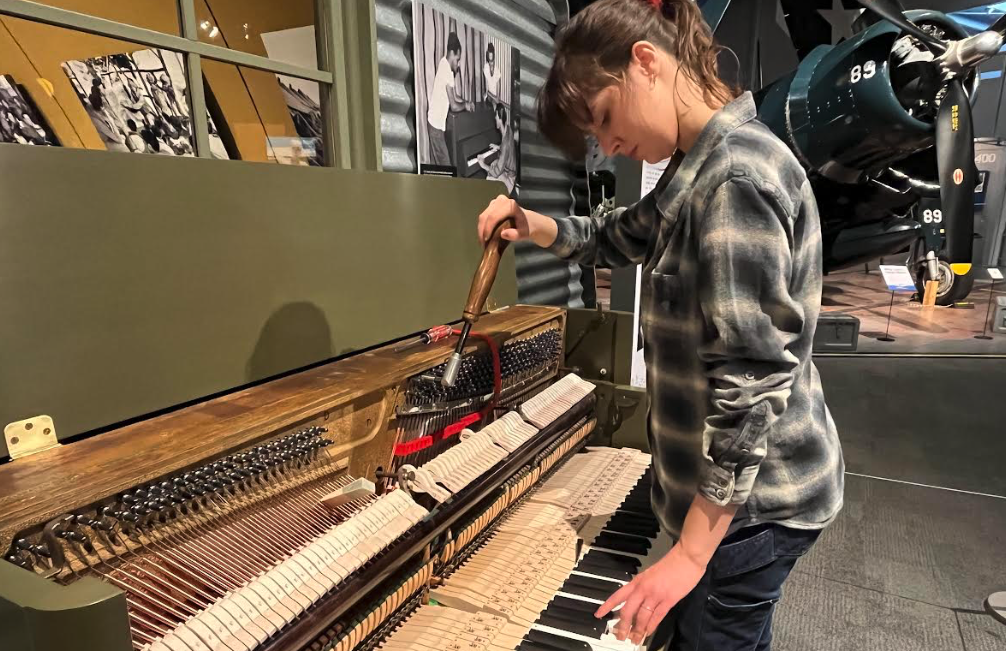
When FLYING Magazine arrived, Cook was carefully tuning Evie. She showed off a length of wood that was crafted into a tool to protect the felt-covered hammers—the internal workings of the piano—during shipment.
Like Haude, she has a fascination with the Victory Verticals. She has been working on them since 2021 and bought one of her own out of Florida. She said that although thousands of the pianos were built, they are hard to find.
“Some of them probably were just left where they were,” Cook said. “Others, I’ve heard of people lighting them on fire in celebration. Hopefully some of them have been well taken care of that we haven’t found yet, but most of the ones that I’ve been aware of have just been found. Somebody’s family rescued it, and they’ve kept good care of it, and they want somebody to keep the story alive.”
How to Identify a Victory Vertical
According to Cook, “any traces of green paint” is a giveaway.
“Tropicalization (protecting it from humid climates) is the main feature of Victory pianos, which involves a lot of different things,” Cook said. “Most of the Victories had waterfall front keys, which are the wraparound, without the loose key top, but really the mechanics inside and the serial number are going to tell you if this piano is a Victory.”

The serial number can be faded and hard to find, she noted, and some people remove the serial number in an effort to restore the piano.
“It is a bit of a task to discover what’s a Victory or not. You have to go deep into the Steinway records.”
The exhibit features three Steinway GI pianos fully restored and in tune. There will be special programs, including regularly scheduled mini-concerts, during the month-long run of the exhibit focusing on how music helped win the war.
Visit museumofflight.org for details.

